


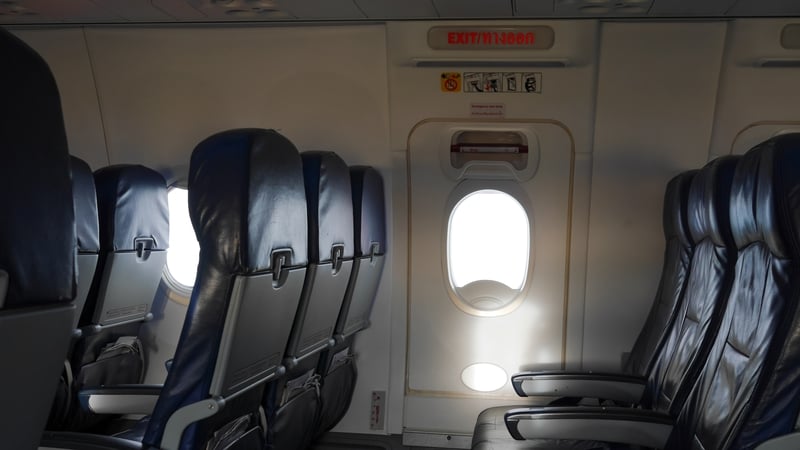
An airline has been ordered to pay a passenger €7,500 for refusing to let him sit in an exit row seat he had booked specially for extra legroom because he had disclosed that he was autistic.
The Workplace Relations Commission (WRC) made the award after upholding a complaint of disability discrimination and harassment in breach of the Equal Status Act brought against the airline in an anonymised decision.
The tribunal heard the difficulty arose when the man arrived to check in for a return flight to Dublin from London in March 2024.
The claimant, whom the tribunal noted was "autistic and uses a sleep apnoea machine" had written to the airline requesting special assistance before he left.
In the letter, he referred specifically to difficulties with queuing and requiring space for the sleep apnoea machine, the tribunal heard.
"All went well on the first leg," he told the tribunal, and he flew in seat 12A, which he had pre-booked.
When he went to check in his baggage for his return flight on 18 March that year, he was told he had been moved out of the emergency exit row seat he had booked "due to his disability", he said.
His evidence was that he produced his medical certification and asked to have the matter "resolved quickly and discreetly" so that he "would not have to keep explaining his disability in the presence of other passengers".
The man added that he was told to speak to the cabin crew.
He was first to the boarding gate and spoke to a worker there who "did not understand his difficulty", the man said.

By the time she had called over a colleague, he said, the gate was full of passengers and a queue was forming behind him. He "again told the entire story".
The second worker told him that "as a result of being autistic they would not let him sit at the emergency exit", he said.
The claimant said it was "humiliating and degrading" to have to discuss his diagnosis "in front of a large crowd of onlookers" who "all could hear what was happening".
Having explained that his disability did not amount to any "cognitive or physical impairment" that would impair his ability to aid in an evacuation of the plane in an emergency, he was again told to speak with the cabin crew.
When the time came to board, he was put in the second row and said he sat with his legs "pinned up against the seats in front of him" and was "unable to move".
After asking twice to speak to a member of the cabin crew, one came and told him he could not sit in the emergency exit row "because of his disability".
He remained in that seat for the rest of the flight, which he called a "distressing, humiliating and degrading" experience.
The passenger's position was that being required to repeatedly refer to his diagnosis in public because of the "persistent" questions of airline staff amounted to harassment.
In its defence of the claim, the airline’s lawyers, Arthur Cox LLP, relied on safety regulations governing "special categories of passengers".
The rules covered people requiring "special conditions, assistance and/or devices when carried on a flight" and barred such passengers from being seated in seats which "permit direct access to emergency exits", the tribunal was told.
As the claimant had registered himself as a person with a disability, he therefore fell under the remit of those regulations, the airline’s lawyers submitted.
"It is an unreasonable onus on cabin crew to make an assessment on the type of disability a passenger has, or where on a spectrum a person with a disability falls, on a case-by-case basis," the airline’s lawyers submitted.
'A shambles'
Adjudication officer Pat Brady wrote in his decision: "A full reading of the regulations makes it clear the critical criterion is that of mobility, and its impact on safety in an emergency."
The regulations went to "some trouble" to set out definitions and categories of disability, and to define the reasons for imposing seating restrictions, Mr Brady wrote.
"[The regulations] do not provide a blanket ban on seating any person who may be a special category passenger at an emergency exit row, unless the nature of that person's disability or lack of mobility pose a reasonable impediment to the safe evacuation of the aircraft," Mr Brady wrote.
He added that it was "not an unreasonable burden" for the airline to assess this at the point when the passenger applies to be treated as part of the special category of passengers.
Mr Brady wrote that what happened at the boarding gate could only be described as "a shambles".
He concluded that the passenger had been discriminated against in breach of the Equal Status Act by being denied reasonable accommodation for his disability as well as suffering harassment.
Mr Brady directed the airline to pay the claimant €7,500 for discriminatory treatment.
He also ordered the airline to establish procedures for ascertaining the "capacity and mobility" of any passenger seeking the special category status according to the regulations "before declining a booking in any part of an aircraft".
