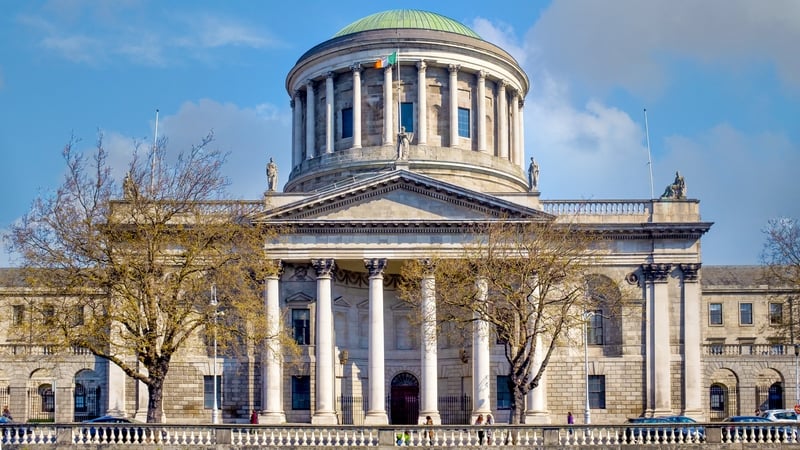

The Supreme Court has begun hearing a significant case relating to the use of mobile phone metadata in criminal cases.
The outcome of the hearing could have implications for other cases involving privacy rights and the use of such data to prosecute crime.
It is also likely to affect any further court action being taken by convicted murderer Graham Dwyer, who it is understood, wants the Supreme Court to hear a final appeal from him.
The Court of Appeal last month rejected Dwyer's appeal against his conviction for the murder of Elaine O’Hara in 2012. It is understood he is now in the process of seeking permission for leave to appeal to the Supreme Court.
The Supreme Court can allow such an appeal if it decides it involves a matter of general public importance, or that an appeal is necessary in the interests of justice.
But the outcome of the current case may resolve the issues raised by Dwyer and may determine if the Supreme Court decides it is necessary to hear Dwyer’s appeal at all.
The present case is an appeal by 30-year-old Caolan Smyth against his conviction for the attempted murder of James "Mago" Gately in May 2017.
The court is also hearing the related appeal of his co-accused, 55-year-old Gary McAreavey, who was convicted of assisting an offender.
Smyth, from Donore in Co Meath was jailed for 20 years in February 2021 by the Special Criminal Court. McAreavey, from Castlebellingham in Co Louth, received a three-year jail sentence.
Their trial relied in part on evidence relating to mobile phones, which the accused men denied were used by them.
In his sentencing, Mr Justice Tony Hunt said Smyth was part of an organised conspiracy to commit murder. The court heard McAreavey was not a member of any organised crime gang.
The men appealed their convictions and the Court of Appeal found last year that gardaí were entitled to access the mobile phone data that helped to secure their convictions.
It was the first decision of the Court of Appeal on the issue following a ruling by the Court of Justice of the EU and declarations by the Supreme Court, in the Dwyer case, that Ireland's system of indiscriminately retaining mobile phone data and allowing gardaí to access it without independent oversight, breached European law.
The Appeal Court found that at the time of the investigation into Gately’s attempted murder, the legislation was the law of the State and enjoyed a "presumption of constitutionality".
The Supreme Court found the two men’s cases raised issues of law of general public importance and agreed to hear their further appeals.
Opening the case, Senior Counsel, John Fitzgerald, for Smyth, said at the time of the investigation into James Gately’s attempted murder in 2017, the problems with the Irish legislation allowing for the retention of and access to mobile phone data, were well known.
The breach of his client’s rights, he said, had to include the failure of the state to legislate for an error, that was by that stage, well known.
He added that it was not an inadvertent or unconscious breach by the state as they had received considerable warnings for a lengthy period, beginning with a CJEU decision in 2014, and had not addressed the issue.
Mr Fitzgerald said the authorities were certainly aware of the problem by the time the CJEU issued a further ruling on the issue of data retention in December 2016. He said there was correspondence between An Garda Síochána and the Department of Justice in 2017, saying there was a real problem. The state could have taken action, he said, but did not.
Mr Fitzgerald said the mobile phone evidence in his client’s case would not have passed any test of admissibility and should not have been admitted at the trial in 2020. He wants Smyth’s conviction quashed with no retrial.
But he said, if there was to be a retrial, then an appropriate legal test for admissibility should be applied to the phone evidence.
McAreavey’s lawyers also want his conviction to be quashed. And the Irish Human Rights and Equality Commission (IHREC) is also a participant in the appeal to make submissions on issues relating to the retention of and access to data.
The case will continue tomorrow when lawyers for the DPP will respond.
Seven supreme court judges are hearing the appeal.
Their eventual judgments will be significant not just for Graham Dwyer and other convicted people.
Their rulings may provide important clarifications or refinements to issues such as privacy rights and the test for deciding when unconstitutionally obtained evidence can be admitted in a trial.