

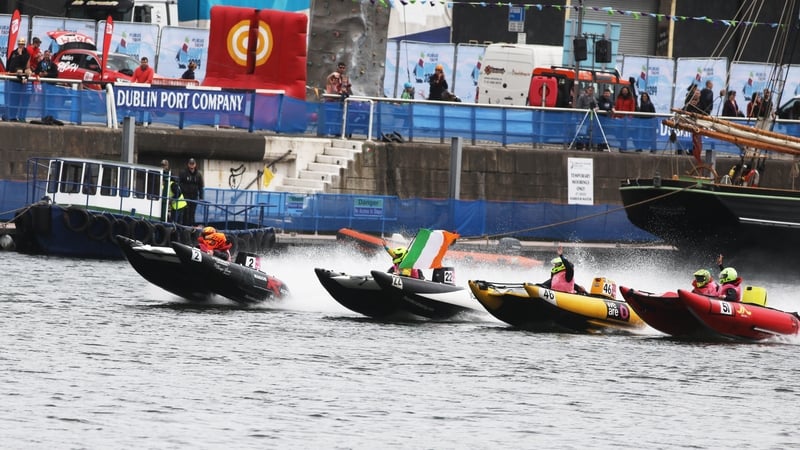
A man who collapsed and required brain surgery after taking part in a speedboat display on the River Liffey has settled a High Court action for €800,000.
Martin Pullen had jumped out a speedboat 10 times as part of the ThunderCat Racing display as part of Dublin Port Riverfest in June 2017.
The court was told the racing event is one of the world's most exhilarating watersports in which boats can fly up to six metres in the air.
Senior counsel Maura McNally told the court that Mr Pullen had jumped out of the speedboat "to effectively be rescued" as part of the performance.
The then 34-year-old had complained of recurring headaches and ultimately collapsed and vomited on Monday 5 June, 2017.
He was taken Beaumont Hospital where an emergency CT scan showed he had a type of internal head bleed.
Ms McNally said Mr Pullen was in the hospital neurology ICU for 23 days after an emergency craniotomy and remained under the care of the hospital for two months before returning home to the UK.
Ms McNally said it was their case Mr Pullen suffered an acquired brain injury, left side weakness, short term memory loss and the sight in his left eye is also affected.
The now 39-year-old from Chertsey, Surrey, had sued Voom Voom Ltd with registered offices in Hampshire, England and ThunderCat Racing Ltd with offices at Chandlers Ford, Eastleigh, England who it was claimed were the organisers of the display.
The court heard that the settlement figure of €800,000 includes damages amounting to €550,000 and legal fees of €250,000 and will be paid out by insurance company Axis Speciality Europe SE of London as the court heard the two companies sued have no assets.
In his action for damages it was claimed there was a failure to take necessary measures to ensure the activities was safe and free from risk of injury.
It was further claimed that Mr Pullen was allegedly directed to take part in the event when they knew or ought to have known that he did not have any or any adequate training such that he may carry out the events safely and without risk of an injury.
The settlement was reached without admission of liability.
The defendants also disputed whether Mr Pullen had an acquired brain injury and contended his memory loss was very mild.
There was also the issue of whether there was alleged contributory negligence on the part of Mr Pullen.
Mr Justice Paul Coffey approved the settlement and said the offer was fair and reasonable.
