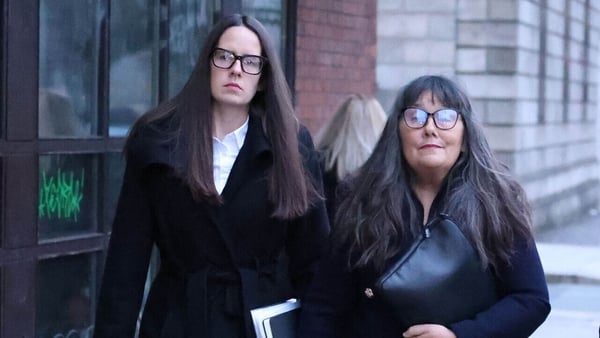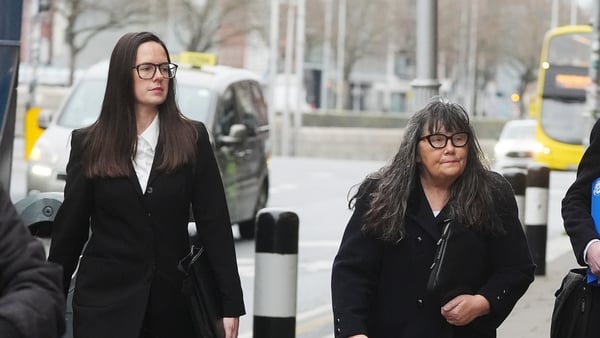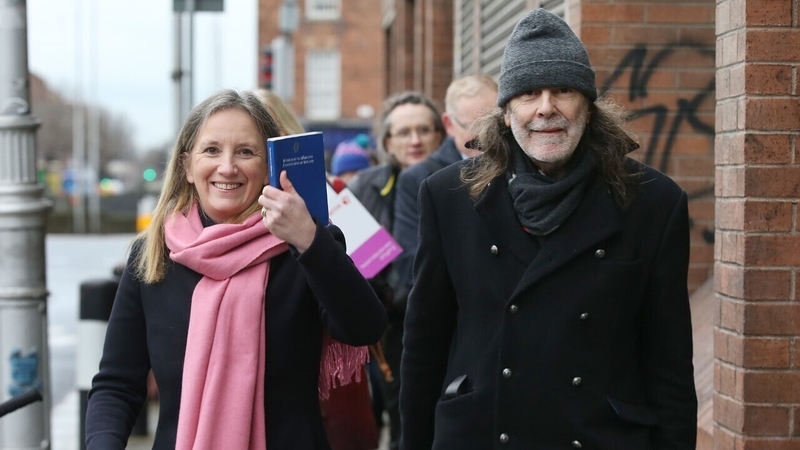

The Court of Appeal has reserved its decision on an appeal by John Waters and Gemma O'Doherty against the High Court's rejection of their challenge to the Government's public health restrictions to deal with the Covid 19 pandemic.
The court did not indicate when it would give its decision.
The two anti-Covid restriction campaigners claim Covid-19 is a "common cold" and described it as an "alleged virus" and an "alleged pandemic".
Measures taken by the State to deal with it were not based on science but on conjecture they allege.
Ms O'Doherty said most people did not know anyone who had Covid-19 or who had died from it.
Mr Waters and Ms O'Doherty claim the public health laws brought in by the State were unconstitutional and flawed.
But their case was dismissed by the High Court earlier this year, which found they had not put forward facts or expert opinion to support their case.
This morning, Ms O'Doherty said she hoped the Court of Appeal would respect the science in relation to an "alleged pandemic" and an "alleged virus".
She said the State parties had decided to embark on a completely new path never tested before in medical and scientific history by locking down the 99% of the population who are healthy to deal with the "common cold", which she said is what Covid-19 is.
Ms O'Doherty said they had asked the State for evidence that lockdowns, masks, social distancing, contact tracing or PCR testing were based on science, but they had not produced one peer reviewed scientific study.
She said these measures were based on nothing more than conjecture.
Ms O'Doherty said the respondents were experimenting on Irish people with vaccines that had not passed normal safety trials.
She said the lockdown was barbaric and having a "grotesque impact on the health of Irish people".
The average age of death from coronavirus was 83, which she said, was the age of life expectancy and the vast majority of Irish people would not be affected by the coronavirus.
Most people who died had "underlying conditions" and "their time was up anyway".
Ms O'Doherty accused the State of manipulating and massaging the figures in relation to death and said it was the "greatest scam ever perpetuated on the Irish people."
She said the damage from the lockdowns would be felt for generations to come.
There was a cure for the virus, she claimed, from hydroxychloroquine, vitamin C and zinc, but hospitals were putting people into intensive care and "bringing about their deaths".
Ms O'Doherty said what the State did was "absolutely disgusting" and "most of us know no one who has died and no one who has had it".
She said she had gone into hospitals "as an investigative journalist" to see with her own eyes where the pandemic was. They had been empty since last March, she claimed.
Mr Waters accused the Government of "making up law on the hoof" and said people were deeply affected by the stress of having to endure these measures.
He compared Ireland's response to the World War II emergency to the current situation.
Court of Appeal President, Mr Justice George Birmingham, suggested he might be better advised to concentrate on the current situation and "leave the past to the past".
But Mr Waters said he and Ms O'Doherty were lay litigants, not lawyers, and were talking about the lives of the Irish people and their children's lives, which he said had been "stolen from us".
He said the judges might be unmoved by that and he wished to "speak to" history as many factors had not been canvassed in public by the "deeply corrupt media".
Mr Waters told the court that the onus had been put on them to show the disproportionality of the measures taken by the State.
He said it was their case that it was up to the State to justify the proportionality.
Mr Waters went on to criticise the exclusion of members of the public from the court due to Covid-19 restrictions.
He said this was important in a case such as theirs where a doctor or scientist could come in and might have something relevant to tell the court.
He also said that yellow Covid-19 signs around the courtroom could give the impression that the court had already decided the case.
Mr Waters also suggested the presence of members of the public could "keep the media honest" as witnesses could come forward to contradict the media's reports of proceedings.
He claimed there was no evidence that the Government had assessed the cost of the lockdowns and there was no evidence that constitutional rights had been balanced against each other.
Mr Waters said there was no evidence that rights had been restricted only as much as strictly necessary and no evidence that there had been an assessment of when the restrictions would be terminated.
In response, Senior Counsel, Michael Collins said Mr Waters and Ms O'Doherty had failed to understand the test for success in such proceedings - that applicants must establish that they have an arguable case with a reasonable chance of success.
They must, he said, adduce "actual evidence" to support their argument. He said they seem to have misunderstood that the burden was not on the State to justify and explain the legislation but on the applicants to establish why they had an arguable case.
Mr Collins said Mr Waters and Ms O'Doherty were essentially seeking declarations that the public health regulations were unconstitutional.
This was, he said, inviting the court to second guess policy responses the Oireachtas had made to a worldwide health emergency and that was a wholesale invasion of the separation of powers.
He said the reasons for the legislation were set out in the preamble to it that there was a "manifest and grave risk to human life and public health" and there was a constitutional duty on the state to vindicate the right of citizens to life and to bodily integrity.
The reality of the pandemic and its effect on society were evident he said and the concern of the Oireachtas was fully justified.
Mr Collins said as this was an appeal against a high court ruling, there had to be some identification by the appellants of some error in the High Court judgment.
He said judicial review proceedings were not appropriate to challenge the constitutionality of regulations when no underlying decision of a State body was being attacked.
The nature of this challenge with its "sweeping generalised references to largely unidentified experts and reports" showed why Mr Waters and Ms O'Doherty had not established even an arguable case that the legislation was unconstitutional.
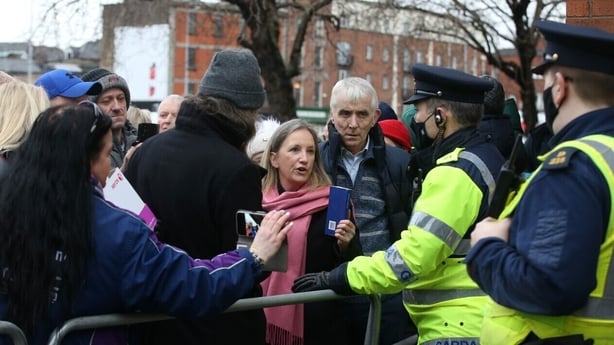
11 people arrested at protests outside court
Gardai say 11 people were arrested at a protest outside the Four Courts in Dublin while the appeal was going on inside.
They said that people gathered from around 9.45am on Inns Quay beside the courts and said they engaged with the protestors over a period of time.
But they said following a "persistent lack of compliance" with public health regulations and with directions from officers, public order gardaí began asking protesters for their names and addresses.
Six men and five women who failed or refused to provide names and addresses were arrested at various locations along the quays.
One man was charged and brought to court.
He has been remanded in custody to appear again before Cloverhill District Court tomorrow.
Three men and one woman were charged with offences and released on station bail.
One man and four women were issued with fixed payment notices and the final man has been released and a file has been sent to the Director of Public Prosecutions.