

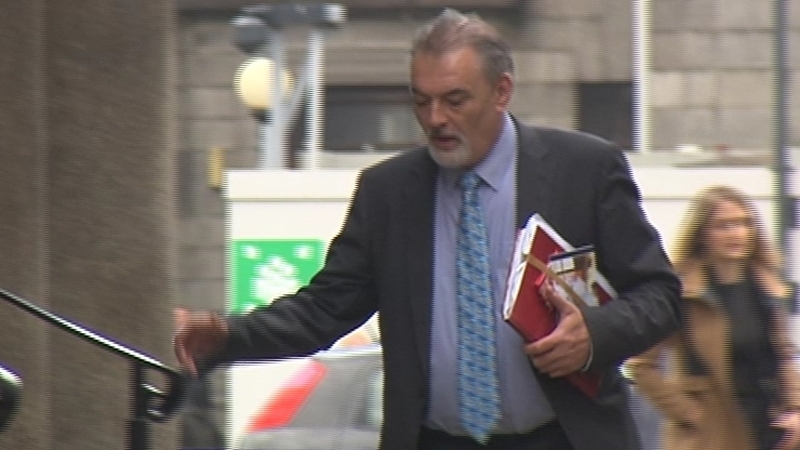
A second attempt by French authorities to have Ian Bailey extradited to face trial over the death of Sophie Toscan du Plantier is underway at the High Court.
French prosecutors want him to go on trial for the murder of the French filmmaker who was found beaten to death outside her holiday home in Schull, Co Cork in December 1996.
Mr Bailey was twice arrested and questioned in connection with her death but was never charged.
He has always denied any involvement in her death and has alleged a garda conspiracy to frame him for her killing.
At the High Court this morning lawyers for Mr Bailey said a the question of Mr Bailey's extradition to France had already been decided by the Supreme Court.
A second attempt to extradite him was an abuse of process.
Mr Justice Tony Hunt remarked that a potential difficulty with the application was that one arm of the State had repeatedly said there should be no prosecution while another arm of the State has said "yes, as long as it is somewhere else".
Senior Counsel Garrett Simons said that in March 2012 the Supreme Court identified an "absolute jurisdictional bar" to Mr Bailey's extradition to France in relation to the alleged offence. The existence of that judgment was "a complete answer" to the question of extradition, he said.
Mr Simons said the precise issue which was determined by the Supreme Court continues to apply and there had been no change in the factual circumstances or the legal context.
He said the Supreme Court made its decision on the basis of the difference in how France and Ireland exercise extra territorial jurisdiction and found there was no reciprocity which is required for an extradition to be allowed.
He said Mr Bailey's surrender was prohibited under section 44 of the European Arrest Warrant Act 2003 and that had not changed.
The Supreme Court had ruled that the requirement for reciprocity was not met because Ireland does not exercise extra-territorial jurisdiction on the same basis as the French.
The Irish State looks to the citizenship of an alleged perpetrator of a crime and not the citizenship of the victim. Mr Bailey is not an Irish citizen.
Decisions of the Supreme Court were "final and conclusive and that is hugely significant. Here, the Supreme Court has give an authoritative ruling and that creates a bar," Mr Simons said.
Where an issue has been fully decided it is then binding on the parties and the Minister for Justice could not ask the Supreme Court to determine and issue and then come back five years later and re-litigate it. It was in the public interest that there could not be endless litigation, he said.
Mr Simons said arguments put forward by the Minister in this case showed a complete lack of understanding of European law and were "astonishing".
He said there was no obligation under EU law to re-open a final judgement to give effect to EU law.
There was no requirement under EU law to be reactive to a new judgment of the CJEU if there was one, by setting aside an earlier national judgment.
The court was also told material put before the Supreme Court at the previous hearing was described by one of the judges as "dramatic and shocking".
That material was a record of a former DPP Eamon Barnes who described the garda investigation against Mr Bailey as "thoroughly flawed and prejudicial" and culminating in "a grossly improper attempt" to prosecute him.
Garrett Simons said in the current case the Minister's response to these allegations was to "wash her hands of them" and say they were not relevant to these extradition proceedings.
Mr Simons said that was a "wholly inadequate position for the Minister for Justice to make to serious allegations from a former DPP to suggest it is no business of this court court to look at that."
Mr Justice Tony Hunt asked: "nothing to see here?" Mr Simons replied that the Minister had sub contracted that matter out to the French authorities.
He said it was never the intention of the trust and confidence agreement between both States for one prosecution authority to be able to second guess the other.
He said it was an abuse of process to attempt to mount a parallel prosecution where our own prosecutor described the investigation as thoroughly flawed and prejudiced.
Mr Simons also said there was a six year delay in issuing the second European Arrest Warrant.
In the interim they had been told a decision had been made to charge and try Mr Bailey, and that decision had taken more than four years to emerge. He said this delay was "extraordinary" no explanation was given about this change of circumstances.
He said the Minister with "breathtaking arrogance turns up here and offers no reasoning, no justification to say the matter has moved on and that is disrespectful." He said it beggared belief that no explanation was sought from the French authorities about the timing and reasoning for Mr Bailey's status changing from a person wanted for questioning to a person wanted to be charged and tried.
He said it was another example of "slavish adherence" by the Minister to the framework agreement governing extradition as previously described by a Supreme Court judge.
Mr Bailey's legal team is also expected to argue that his surrender to the French authorities would breach of his fundamental rights including the right to a fair trial.
They will also challenge the validity of the second warrant on grounds that it was not issued with proper judicial oversight.
Lawyers for the Minister for Justice said the rule of law governing previously decided issues did not apply to extradition. Senior counsel Robert Barron said the fact that a decision was made not to execute a particular warrant does not preclude a fresh warrant being executed.
He said there was no case in Ireland in which surrender had been refused under a European Arrest Warrant on those grounds.
He argued that EU law applied to member states even if it meant departing from their national rules on previously decided cases.
This principle known as "res judicata" could not be relied on by national courts to decline to apply european union law.
Mr Barron also said the Minister for Justice had no power to refuse a warrant and was obliged under international agreements to put the warrant before the court for endorsement.
He said there were no grounds for criticism of the Minister in this regard. Mr Justice Tony Hunt asked if the Minister's role was so confined. "has it never happened that a minister says hold on a minute this has no chance, we should not waste time and money?"
Mr Barron it was not the role of the central authority to make any decision on the endorsement of the warrant.
He said if the court refused to endorse the warrant that is the end and person would not even hear of it.
"So there was no oppression in putting the warrant before the court," he said.
He said with the court having endorsed the warrant the Minister was now submitting that there was an obligation to surrender Mr Bailey.
Mr Barron said he will also ask the court to refer the matter to the Court of Justice of the European Union. Mr Barron was questioned at length about how a decision of the Supreme Court could be set aside in order to refer such a question to the CJEU.
The Minister will also argue that Mr Bailey's surrender to the French authorities is not precluded by sec 44 of the European Arrest Warrant Act and that it would not be in breach of his fundamental rights.
The case continues tomorrow but is expected to be adjourned for further arguments and a decision at a later date.
