


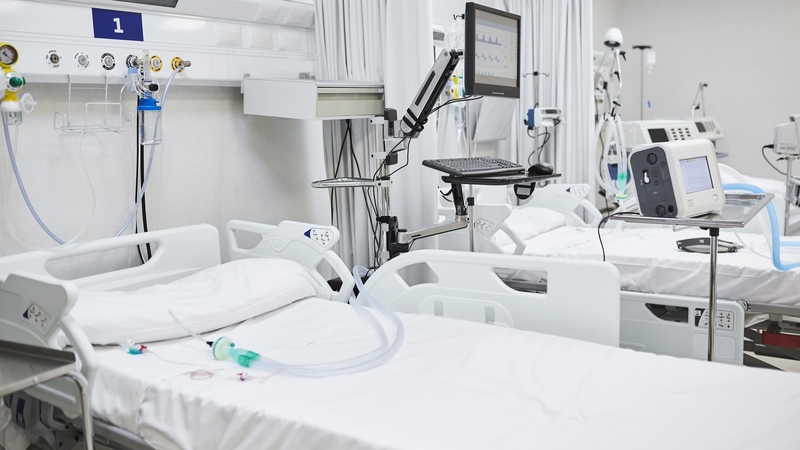
The Irish Annual ICU Audit annual report for 2021 has found that given the intensity of the pandemic at that time, Covid-19 patients accounted for 29% of all intensive care unit occupied beds that year.
Ireland lags behind the rest of the EU and OECD countries, with six beds per 100,000 population. The OECD average is 12.
The annual audit reports on care of patients in adult Intensive Care Units (ICUs) and focuses attention on activity in these units, the complexity of care provided and the resource requirements and areas for improvement.
Clinical Lead of the Irish National ICU Audit Report for 2021 Professor Rory Dwyer said units were under a lot of pressure at the time, and the surge in the need for beds was dealt with by using beds throughout hospitals.
The system coped, he said, adding that Ireland's health system did not run out of beds during the pandemic.
"ICU beds had been tight beforehand and then this surge in Covid patients was accommodated by a temporary increase in ICU beds by diverting a lot of resources to ICU from other areas of the hospital.
"There was a decrease in major surgery, which made some capacity and somehow the system coped.
"We came very close to not having enough beds for our needs but didn't reach that point. And to our awareness, any patient who would have benefited from an ICU bed with Covid was accommodated."
He added that "ideally we'd have much more beds".
"What has been targeted by the Department of Health is an increase to about 450 beds from what was 250 back in 2020. And we're slowly making progress towards that. I think that every gain of a bed is worthwhile.
"There are problems with building capacity and there are problems with recruitment even in staffing some of the beds that have been funded has been difficult.
"These ICU staff, medical and nursing are highly skilled and are in short supply in every country in the world.
"But we're slowly improving and each month we have more beds open, which is helping access to ICU."
We need your consent to load this rte-player contentWe use rte-player to manage extra content that can set cookies on your device and collect data about your activity. Please review their details and accept them to load the content.Manage Preferences
Prof Dwyer said that the finding of the report is that once you get into ICU, the quality of care is good.
"Outcomes are equivalent to international outcomes. There are problems with access.
"I think in Ireland, patients who maybe in other countries would get an ICU bed, don't get it after major surgery or who are seriously ill being cared for in the ward. But we're making progress towards improving that."
He said that the data suggests that outcomes would be better if after major surgery, there was an ICU bed for them.
"We had over 11,000 patients cared for in ICU last year and we try and make beds. We try and prioritise who would benefit most from ICU.
"But in an ideal world, we would have more beds."
He said that the target over the next number of years is 450 beds.
"We're funded about 325, not all of those are open, but there have been issues with waiting for a new build and waiting for staff to be in place to open.
"We're running about 305 beds open on a daily basis now."
In relation to organ donation, Prof Dwyer said that while this fell during 2021 to 3% from 4.7% it was generally because there was less trauma.
"So, if you have less head injuries, you have fewer donors.
"But there were logistical issues with shortage of ICU beds, impacts on not having as many patients who were brought to the point of becoming organ donors.
"There were issues with transfer, with transplant teams being able to move, being able to access units. There were issues with relatives getting into it."
He said that while 2021 was not a typical year, "it's important that we have the data to be aware of it and hopefully that will have improved."
