


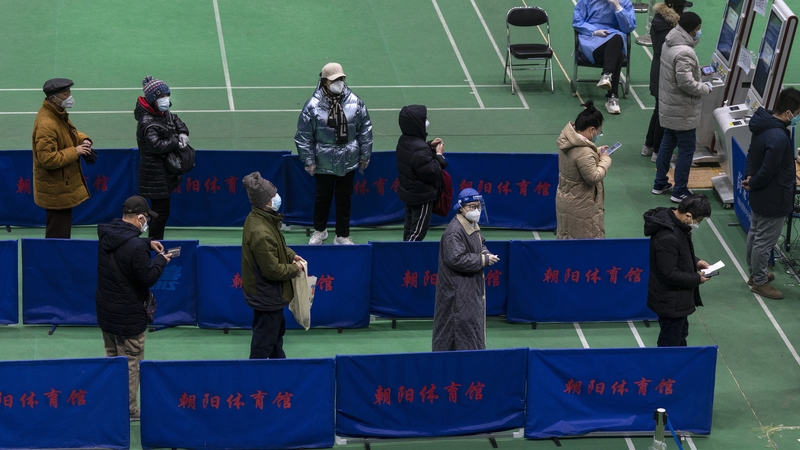
China has reported its first Covid-related deaths in weeks amid rising doubts over whether the official count was capturing the full toll of a disease that is ripping through cities after the government relaxed strict anti-virus controls.
Today's two deaths were the first to be reported by the National Health Commission (NHC) since 3 December, days before Beijing announced that it was lifting curbs which had largely kept the virus in check for three years but triggered widespread protests last month.
Officially China has reported just 5,237 Covid-related deaths during the pandemic, including the latest two fatalities, a tiny fraction of its 1.4 billion population and very low by global standards.
But health experts have said China may pay a price for taking such stringent measures to shield a population that now lacks natural immunity to Covid-19 and has low vaccination rates among the elderly.
Some fear China's Covid death toll could rise above 1.5 million in coming months.
Respected Chinese news outlet Caixin on Friday reported that two state media journalists had died after contracting Covid, and then on Saturday that a 23-year-old medical student had also died. It was not immediately clear which, if any, of these deaths were included in official death tolls.
"The (official) number is clearly an undercount of Covid deaths," said Yanzhong Huang, a global health specialist at the Council on Foreign Relations (CFR), a US think tank.
That "may reflect the lack of state ability to effectively track and monitor the disease situation on the ground after the collapse of the mass PCR testing regime, but it may also bedriven by efforts to avoid mass panic over the surge of Covid deaths," he said.

The NHC reported 1,995 symptomatic infections for 18 December, compared with 2,097 a day earlier.
But infection rates have also become an unreliable guide as far less mandatory PCR testing is being conducted following the recent easing. The NHC stopped reporting asymptomatic cases last week citing the testing drop.
China's chief epidemiologist Wu Zunyou on Saturday said the country was in the throes of the first of three Covid waves expected this winter, which was more in line with what people said they are experiencing on the ground.
While top officials have been downplaying the threat posed by the new Omicron strain of the virus in recent weeks, authorities remain concerned about the elderly, who have been reluctant to get vaccinated.
Officially, China's vaccination rate is above 90%, but the rate for adults who have received booster doses of the vaccine drops to 57.9%, and to 42.3% for people aged 80 and above, according to government data.
In the Shijingshan district of Beijing, medical workers have been going door-to-door offering to vaccinate elderly residents in their homes, China's Xinhua news agency reported yesterday.
Overseas-developed vaccines are unavailable in mainland China to the general public, which has relied on inactivated shots by local manufacturers for its vaccine rollout.
While China's medical community in general does not doubt the safety of China's vaccines, some say questions remain over their efficacy compared to foreign-made mRNA counterparts.
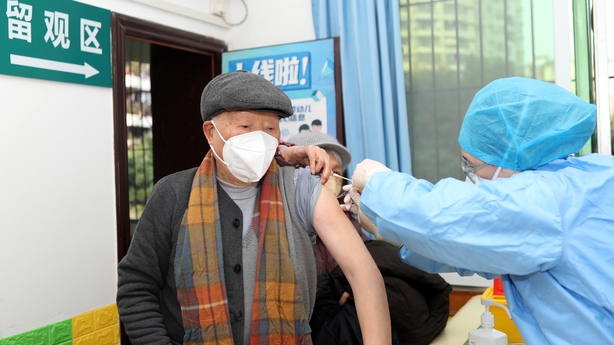
Dr Eric Ding, a US-based epidemiologist and health economist said China is facing a "cataclysmic surge in Covid cases" following the lifting of severe restrictions earlier this month.
"China right now is experiencing a cataclysmic surge much larger than Wuhan," Dr Ding told RTÉ's News at One.
"It's basically in dozens of major cities. This comes after China dropped its Zero Covid strategy.
"I think they dropped it too quickly because schools are closed again in Shanghai and many other cities.
"Hospitals are completely overwhelmed. Funerals are running 24/7. One crematorium has a backlog of 2,000 dead bodies.
"Epidemiology modelling says that you could be headed towards 100 million people getting infected and possibly one to two million people dying in the next half a year or so.
"I hope it does not create a really, really bad tsunami wave worldwide."
Dr Ding said early variants are now "highly evasive" against existing immunity, previous infections, older variants and previous vaccinations, and he called for better vaccines.
