


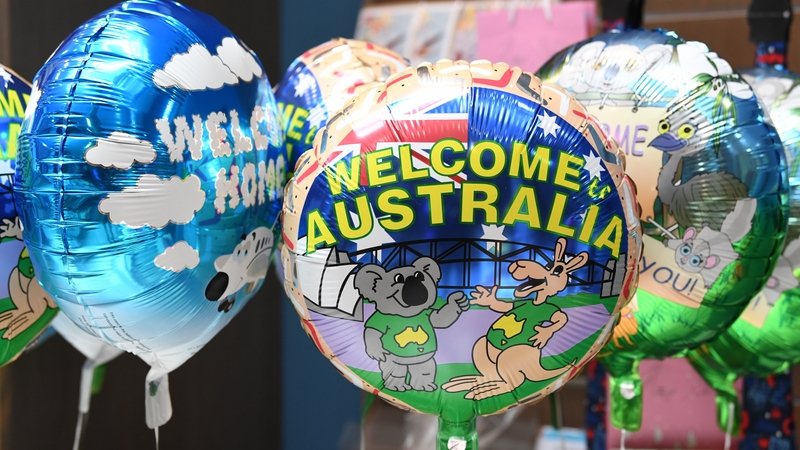
Australia will reopen its borders to tourists from 21 February, Prime Minister Scott Morrison has announced, ending some of the world's strictest and longest-running pandemic travel restrictions.
"It's almost two years since we took the decision to close the borders to Australia," Mr Morrison said after a meeting of the national security cabinet.
He announced the borders will reopen to all visa holders "on the 21st of February of this year," adding, "if you're double vaccinated, we look forward to welcoming you back to Australia."
Australia's borders shut in March 2020 in the hope of protecting the country against a surging global pandemic.
For most of the time since then, Australians have been barred from leaving and only a handful of visitors have been granted exemptions to enter.
The rules have stranded nationals overseas, split families, hammered the country's multi-billion-dollar tourist industry, and prompted often bitter debates about Australia's status as a modern, open and outward-looking nation.
Every month of border closures has cost businesses an estimated US$2.6 billion, according to the Australian Chamber of Commerce and Industry.
In recent months, rules have been gradually relaxed for Australians, long-term residents and students.
The latest decision will see almost all remaining caps lifted.
It comes after the country's long-standing "Covid-zero" policy was abandoned, vaccination rates rose and the once stellar track-and-trace system collapsed under a wave of Omicron cases.
Only a handful of countries remain closed to tourists -among them Japan, China, New Zealand and several Pacific Island nations.
For Australia's travel and tourism sector - which struggled as visitor numbers fell almost 98% percent compared to pre-pandemic levels - the news brought elation.
"We're very excited about being able to reopen," said Tony Walker, managing director of the Quicksilver Group, which operates cruises, diving and resorts across the Great Barrier Reef.
"The last couple of years have been incredibly difficult for us," he told AFP, urging people overseas to "come visit".
During the pandemic the firm went from 650 employees down to the 300 it has today.
Many tourism operators around Australia are experiencing staff shortages, given how few backpackers and working holidaymakers are coming to Australia.
Despite the announcement, travel within Australia will still be restricted.
The vast state of Western Australia remains closed to most non-residents. It is currently easier to travel from Sydney to Paris than Sydney to Perth.
Hong Kong's zero-Covid strategy under pressure as cases soar
Hong Kong is expected to report a record of around 610 new Covid-19 cases, broadcaster TVB reported, in the biggest test yet for the city's zero-Covid strategy as it grapples to contain a growing outbreak.
Around 300 others were found positive in preliminary tests, TVB said, citing an unnamed source.
The global financial hub, which is following mainland China's strategy of suppressing all coronavirus outbreaks as soon as possible, has seen cases soar since January with over 2,000 infections compared with just two in December.
The city recorded 342 cases yesterday, slightly below the previous day's record of 351 cases. Dozens of bank branches including outlets of HSBC and Bank of China said they would suspend operations from today to help curb transmissions.
Health Secretary Sophia Chan said over the weekend that she expects cases to rise "exponentially".
Hong Kong has become one of the most isolated cities in the world, with flights down around 90% due to strict coronavirus regulations and schools, playgrounds, gyms as well as most other venues shut. Restaurants close at 6pm local time, while most people, including the majority of civil servants, are working from home.
The economic and psychological tolls from the hardline approach are rapidly rising, with measures becoming more draconian than those first implemented in 2020.
Government quarantine facilities are also nearing their maximum as authorities struggle to keep up with their rigid contact tracing scheme.
Authorities hold daily briefings providing details on each infected person including where they went and ate. As cases surge however, methods including scouring credit card statements and transport records to identify close contacts are far tougher. There are likely hundreds of transmission chains in thecommunity, they said.
In total, Hong Kong has recorded 213 Covid deaths and around 15,000 cases since early 2020, far less than other similar major cities.
Around 80% of the city's 7.5 million residents have had at least one Covid-19 jab but the majority of elderly remain unvaccinated, government figures show.
Out of these around 40% have received the Chinese-made Sinovac vaccine, believed to be far less effective against the disease than the one produced by Germany's BioNTech, the other vaccine available in the city.
Japan to consider early approval for Shionogi COVID pill
Japanese Prime Minister Fumio Kishida said today that the government would consider granting conditional early approval for the oral Covid-19 treatment being developed by Shionogi & Co Ltd.
Mr Kishida told a televised parliamentary committee meeting that provided the drug's safety and efficacy are confirmed by clinical trials "we would like to review it promptly".
Shionogi separately said that new results from an ongoing clinical trial of the drug, known as S-217622, showed" significant difference" in antiviral effect compared to a placebo, as well as symptom improvement.
Chief executive Isao Teshirogi told reporters that the company could file for early approval of the drug as soon as next week, and that it could deliver one million doses by the end of March.
The Mainichi newspaper reported earlier that Japan is considering allowing Shionogi to start selling the antiviral oral tablets as early as this spring after giving the pharmaceutical company special permission to skip the final stage of the clinical trial.
Shionogi's shares rose 3% in Tokyo trading today, versus a 0.7% drop in the broader market.
