


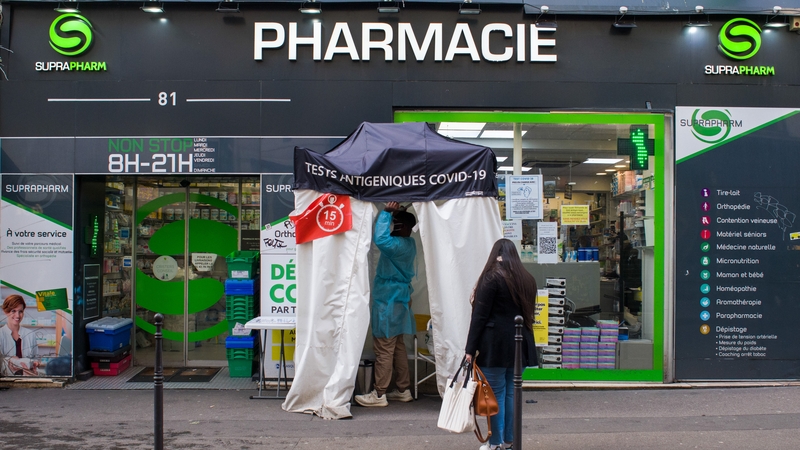
France set a record for new Covid cases over a 24-hour period today with 335,000 additional infections recorded, Health Minister Olivier Veran told parliament.
It was the first time that French cases breached 300,000, smashing the previous record established yesterday when 271,686 new Covid cases were recorded.
It comes as President Emmanuel Macron is facing anger from opponents and chaos in parliament after issuing a provocative warning to people not yet vaccinated against Covid-19.
He said that he would pressure them as much as possible by limiting access to key aspects of life.
We need your consent to load this rte-player contentWe use rte-player to manage extra content that can set cookies on your device and collect data about your activity. Please review their details and accept them to load the content.Manage Preferences
Opponents including rivals in the 2022 presidential elections accused Mr Macron of overstepping the line with the language of his comments, while the furore they caused prompted a new delay in the passing of legislation aimed at tightening France's Covid rules.
"As for the non-vaccinated, I really want to hassle them," he told the Le Parisien newspaper in an interview, using a word considered in France as vulgar slang.
"And we will continue to do this, to the end. This is the strategy," he said. He added this would mean "limiting as much as possible their access to activities in social life".
Mr Macron's comments came as the government seeks to push through parliament legislation that will make vaccination compulsory to enjoy cultural activities, use inter-city train travel or visit a café from 15 January.
No longer will it be possible to have a recent test or a recovery from the coronavirus to qualify for the country's Covid pass.
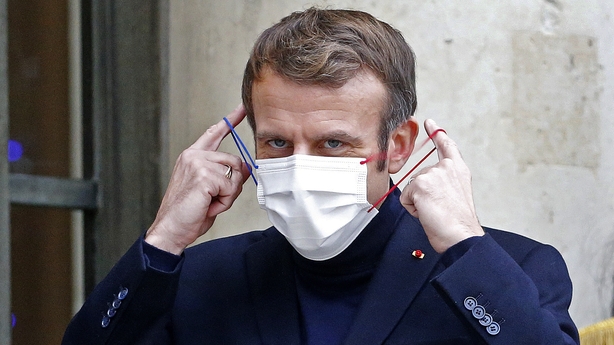
But the government was incensed when the opposition joined forces on Monday to hold up the passage of the legislation through parliament. After talks between the sides yesterday, debate resumed late in the day.
However consideration of the bill was suspended again early today following Mr Macron's remarks, with the president of the session Marc Le Fur saying the atmosphere in the chamber could not meet "conditions for a calm working environment".
The head of the right-wing Republicans (LR) in the lower house National Assembly, Damien Abad, slammed "unworthy, irresponsible and premeditated" remarks which showed "childish cynicism", while the president of the Republicans Christian Jacob said the faction "refused to endorse a text which aims to hassle the French".
The French president had said in his comments: "I am not going to put them (the non-vaccinated) in prison, I am not going to forcibly vaccinate them.
"And so, we have to tell them: from January 15, you will no longer be able to go to the restaurant. You will no longer be able to go for a coffee, you will no longer be able to go to the theatre. You will no longer be able to go to the cinema," he said.
The controversy has erupted amid an increasingly febrile pre-election atmosphere in France. Mr Macron said in the interview he wants to stand for a second term in April presidential elections but will only declare his intentions once he is sure.
Mr Macron's rivals accused the president, who in the initial phase of his time in office earned a reputation for sometimes tactless comments, of going too far with the language of his warning.
"A president should not say that," said the far-right candidate Marine Le Pen, accusing Mr Macron of wanting to make some French "second-class citizens."
Far-right pundit Eric Zemmour, who is also standing, tweeted that "as president I will stop hassling the French". Far-left candidate Jean-Luc Melenchon condemned Mr Macron's comments as "appalling".
Mr Macron, who swept to power in 2017 on a pledge to reform France and restore its status as a global power, is the overwhelming favourite to win the election but analysts caution his victory is far from certain.
His most potent rival could prove to be the LR candidate Valerie Pecresse.
It would be a sensation if Mr Macron were to decide not to stand, but he seems intent on keeping the suspense going for the next weeks.
"There is no false suspense. I want to," Mr Macron told the Le Parisien.
"Once the health situation allows it and I have made everything clear - inside myself and with respect to the political equation - I will say what it (the decision) is."
