


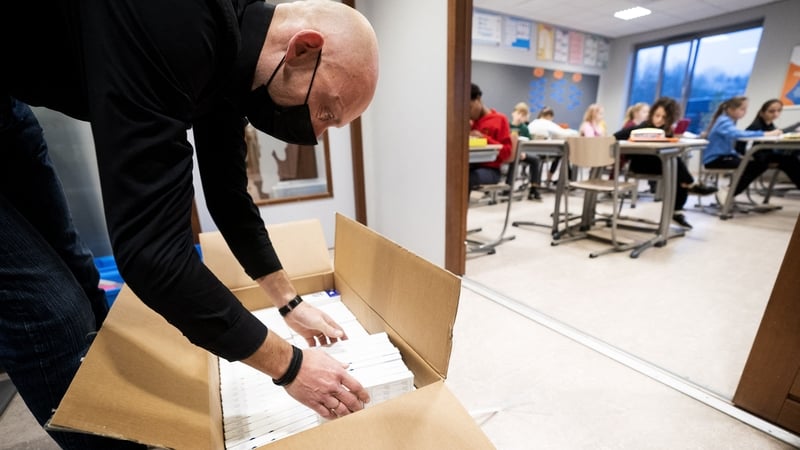
The Netherlands will shut primary schools next week and extend a night-time lockdown as fears grow over the Omicron coronavirus variant, Prime Minister Mark Rutte has said.
Schools will close from December 20 instead of on Christmas Day on December 25 due to concerns that children, among whom Covid-19 rates are the highest, could infect older relatives.
"This is obviously not the joyful message we had hoped for as Christmas approaches. But it's not a surprise," Mr Rutte told a press conference.
"We cannot ignore the warning signs about the Omicron variant."
The government will also extend until restrictions that mean shops, bars and restaurants must close between 5 pm and 5 am daily, and that people can only receive four guests at home until 14 January, he said.
The measures came into force on 28 November for an initial period of three weeks.
Coronavirus cases are highest per 100,000 among children of primary school, the Dutch public health authority RIVM said earlier.
The government said it had taken the decision to close schools early on the advice of its pandemic experts "now that there are major concerns about the emergence of the Omicron variant, which is spreading quickly".
"Because the Christmas holidays start directly with Christmas this year, children could unknowingly infect their older relatives, resulting in too much pressure on care," the government said in a statement.
The Dutch government's coronavirus restrictions have become increasingly unpopular, with riots erupting in cities including Rotterdam and The Hague over several nights in November.
Five people were wounded when police opened fire during the riots in Rotterdam.
Italy imposes swab for EU visitors
Italy has extended a Covid-19 state of emergency to 31 March 31 and ruled that all visitors from EU countries must take a test before departure, amid concerns over the spread of the Omicron variant of the coronavirus.
The state of emergency, which was introduced in January last year, gives greater powers to the central government, making it easier for officials to bypass the bureaucracy that smothers much decision-making in Italy.
It was set to expire at the end of December.
The Health Ministry's decision to impose a test on people arriving from European Union countries from 16 December to 31 January extends a requirement which was already in force for many non-EU countries.
Those who have not been vaccinated must also undergo a quarantine of five days on arrival.
The decision met with the disapproval of the European Commission, which favours common rules to travel within the bloc based on a so-called Green Pass certificate proving vaccination against the virus.
"These individual decisions of the member states will damage... the trust of the people that there are equal conditions everywhere in Europe," Commission vice president Vera Jourova told a news conference in Brussels.
Italian tour operators also expressed their disappointment. The Organised Tourism Federation said the tougher rules were "a fresh blow" to the hard-hit sector and called on the government to provide "immediate and adequate compensation".
Italy's daily coronavirus infections are rising steadily, with 20,677 new cases reported and 120 deaths.
Pressure on hospitals remains less acute than in nearby countries such as Austria and Germany, where the rise in cases in the so-called "fourth wave" of the pandemic began earlier.
Italy has so far reported 27 confirmed Omicron variant cases, the European Centre for Disease Prevention and Control said.
Italy has registered 135,049 deaths linked to Covid-19 since February 2020, the second-highest toll in Europe after Britain and the ninth-highest in the world.
