

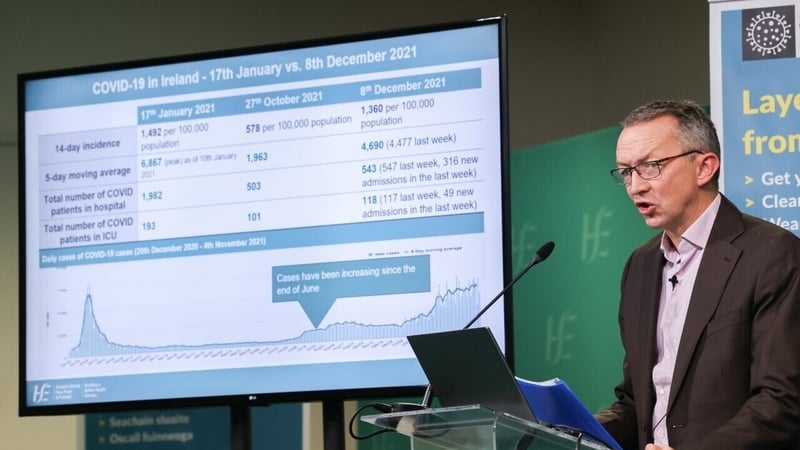
From recent data showing the disproportionate number of unvaccinated people being admitted to Intensive Care Units for treatment for Covid-19 to plans for further expansion of the vaccination programme, here are seven things we learned from the latest Health Service Executive briefing on Covid-19.
Unvaccinated people suffering disproportionately
Over the past two weeks, 'Of all the cases identified, unvaccinated individuals constitute about 13% of total positive cases - but they account for 46% of ICU admissions' HSE Chief Clinical Officer @CcoHse says | Live #Covid19 blog: https://t.co/QPWunLYVm5 pic.twitter.com/QoKbIGiDHp
— RTÉ News (@rtenews) December 9, 2021
HSE Chief Clinical Officer Dr Colm Henry said that examining data from the past two weeks, unvaccinated people account for about 13% of total positive cases - but 46% of ICU admissions.
"People who are unvaccinated are much more likely, if they acquire infection - they're much more likely to acquire infection first of all - and once they acquire infection they're much more likely to become seriously ill, whether it's hospitalisation or even admission to ICU," Dr Henry said.
Dr Henry said that there is a big difference in the conversion rate from cases to hospitalisations when you compare unvaccinated people to people who have been vaccinated.
Expect public health measures for some time
'Honestly, they're going to be needed for a sustained and long period of time. We don't see people not needing to wear masks and not needing to keep social distancing for some time to come' HSE Chief @paulreiddublin says | Live #Covid19 blog: https://t.co/QPWunMgwKF pic.twitter.com/wTP1uTd3Ys
— RTÉ News (@rtenews) December 9, 2021
HSE Chief Executive Paul Reid said that public health measures are not just about restrictions, but also include things such as wearing face coverings, social distancing, and proper ventilation.
He said that they are working, and that they are likely to be needed for some time.
Asked how long they might be needed, he said "The reality of it is we cannot predict what may happen in the next six weeks right now. We have uncertainty around Omicron, we have uncertainty even around the Delta variant ... we can't predict too far beyond that. And they're matters really for where this pandemic goes over the coming next year or so."
Mr Reid added: "There'll be greater experts than us in the HSE to maybe predict on that."
HSE considering advice on boosters for J&J recipients
On whether people who had the single-shot Janssen vaccine (J&J) can be moved up the #Covid19 booster priority list, @CcoHse said the HSE will be trying to incorporate NIAC advice on the vaccine into how the vaccine programme works | Live #Covid19 blog: https://t.co/lZzYyfj0rS pic.twitter.com/LrrRSDodFR
— RTÉ News (@rtenews) December 9, 2021
Asked about people who had received the single-shot Janssen vaccine (Johnson and Johnson) who are worried about the waning efficacy and whether they could be moved up the vaccine booster priority list, Dr Henry acknowledged that advice from the National Immunisation Advisory Council notes that people in this cohort should be offered an mRNA booster after three months.
He said that the HSE is working on reflecting NIAC advice as it continues the booster rollout.
Communication highlighted ahead of vaccination programme for children
On the vaccination programme for children aged 5-11, HSE vaccination lead Damien McCallion says planning is well under way. He says particularly for parents of young children providing clear information will be very important | Live #Covid19 blog: https://t.co/QPWunMgwKF pic.twitter.com/xcMOYdUjHR
— RTÉ News (@rtenews) December 9, 2021
Describing how the HSE is preparing the logistics of expanding the Covid-19 vaccination rollout to children aged 5-11, in line with NIAC advice, Damien McCallion said that officials will be particularly conscious of the need to have clear public health information available to the parents of young children.
He highlighted the success of such information campaigns in the broader vaccination programme to date.
Dr Henry noted that experts have been working on preparations on how to roll the vaccine out to children and prioritising how it should be distributed in anticipation of its approval.
Proportion of severe cases falling
'The link between cases and deaths - we could never say it's broken' but far fewer people have died or been hospitalised in the most recent surge in #Covid cases, thanks to vaccinations, HSE Chief Clinical Officer @CcoHse says | Live #Covid19 blog: https://t.co/QPWunLYVm5 pic.twitter.com/soioD63MRR
— RTÉ News (@rtenews) December 9, 2021
Dr Henry noted that the rate of cases of Covid-19 escalating to hospitalisations and deaths in earlier surges is no longer being seen; thanks to the rollout of vaccines.
He said that case numbers now 'dwarf' the number of people needing hospital and ICU treatment.
People advised not to wait for vaccine targetting Omicron
'For people wondering whether they should wait with the potential for a further vaccine emerging for Omicron specifically, the advice from all medical experts all across the world is don't wait' HSE Chief @paulreiddublin says | Live #Covid19 blog: https://t.co/lZzYyfABjq pic.twitter.com/UmAjckF9ya
— RTÉ News (@rtenews) December 9, 2021
Mr Reid urged eligible people to come forward for a booster vaccine as soon as it is available to them, cautioning against anyone putting off their booster in anticipation of a vaccine specifically targeting the Omicron variant of Covid-19 becoming available.
Over one million boosters and third doses
'We now have over 977,000 boosters and 95,000 additional doses administered, so a total of over 1,070,000' HSE Chief @paulreiddublin says | Live #Covid19 blog: https://t.co/QPWunLYVm5 pic.twitter.com/1WwPvQB8lC
— RTÉ News (@rtenews) December 9, 2021
Mr Reid noted that notwithstanding some issues with relatively high levels of non-attendance for booster appointments and people being given multiple appointments, the booster rollout is proceeding at speed, with over a million people having received a booster, or in the case of some immunocompromised people, a third dose.
