


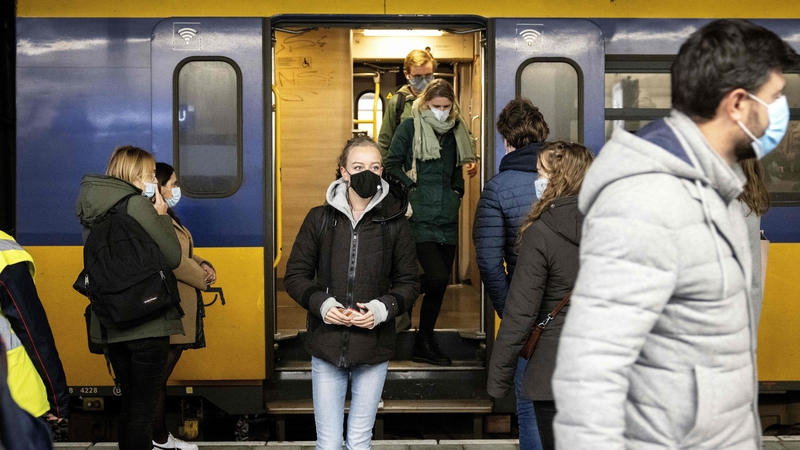
The Dutch government has decided to reimpose measures, including the wearing of face masks, aimed at slowing the latest spike in Covid-19 infections.
The use of a "corona pass", showing proof of a Covid-19 vaccination or recent negative coronavirus test, would be broadened as of 6 November to public places including museums, gyms and outdoor terraces, Prime Minister Mark Rutte said.
Coronavirus infections in the Netherlands have been rising for a month after most social distancing measures were scrapped in late September, and reached their highest level since July in the past week.
This has forced many hospitals to cut back on regular care again, to make room for urgent Covid-19 cases.
In a televised news conference, Mr Rutte called on all Dutch, vaccinated and unvaccinated, to stick to basic hygiene rules and to stay at home if they had symptoms of a possible infection.
"Our own behaviour is crucial, a very large part of our coronavirus policy depends on it," the prime minister said.
Face masks will be reintroduced in stores and other public places, while people are advised to work at home for at least half of the time.
The government next week could decide to broaden the use of the corona pass to the workplace, Mr Rutte said.
Dutch health authorities today recommended Covid-19 vaccine booster shots for older adults.
Around 84% of the Dutch adult population has been vaccinated.
As of today, new infections were up nearly 40% week-on-week to more than 300 infections per 100,000 people, approaching peaks previously seen in July 2021, and in December and October 2020.
The strain on hospitals is an immediate concern, as the country's National Institute for Health said admissions are up 31% in the past week, with unvaccinated patients accounting for most hospitalisations.
Among people testing positive in the past month, about 52% say they were unvaccinated, while 45% say they were fully vaccinated, according to RIVM data.
Earlier today the country's Health Council recommended that fully vaccinated adults aged 60 and older should begin receiving a booster shot.
Mr Rutte's government routinely adopts the council's recommendations.
Russian regions consider extra Covid curbs as deaths hit record
Several Russian regions said they could impose additional restrictions or extend a workplace shutdown to fight a surge in Covid-19 cases that has already prompted the government to re-impose a partial lockdown nationwide.
Russia reported 1,178 deaths related to Covid-19 today, its highest daily death toll since the start of the pandemic, as well as 39,008 new infections.
President Vladimir Putin last month ordered a week-long nationwide workplace shutdown from 30 October that could be extended by regional authorities as they see fit.
The Novgorod region has already announced it is prolonging the shutdown by a week.
Authorities in the Pskov region, which borders Estonia, Latvia and Belarus, said the QR code system used to access certain public facilities would remain in place during the New Year holidays.
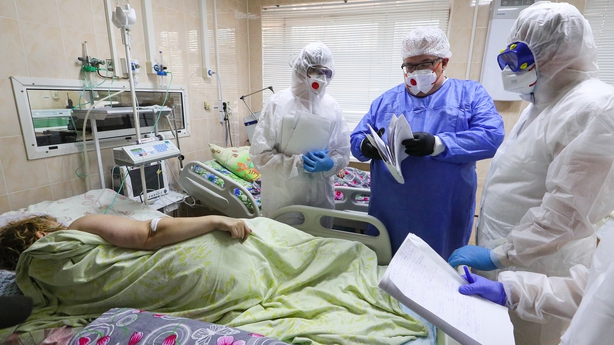
"It's possible that the use of the QR codes will be expanded and applied to other economic sectors," TASS news agency quoted Mikhail Vedernikov, governor of the Pskov region, as saying.
Authorities in three more regions - Komi, Amur and Ulyanovsk- said they could impose more restrictions if Covid-19 infection kept rising.
On Monday, Mr Putin said Russia could need the army's help to build field hospitals for Covid-19 patients or provide support to civilian medical facilities.
The defence ministry released footage today that showed military doctors treating Covid-19 patients at hospitals in Siberia's Khakassia region.
China urges families to keep stocks of daily necessities ahead of winter
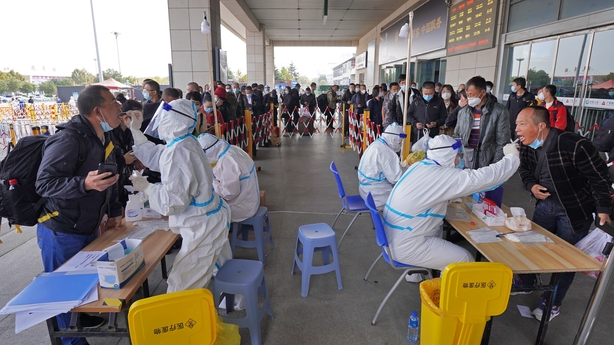
The Chinese government has told families to keep daily necessities in stock in case of emergencies, after Covid-19 outbreaks and unusually heavy rains that caused a surge in vegetable prices raised concerns about supply shortages.
The directive by the commerce ministry stirred some concern on domestic social media that it may have been triggered by heightened tension with Taiwan.
In response, the Economic Daily, a Communist Party-backed newspaper said the directive's purpose was to make sure citizens were not caught off guard if there was a lockdown in their area.
The ministry's statement urged local authorities to do a good job in ensuring supply and stable prices, and to give early warnings of any supply problems.
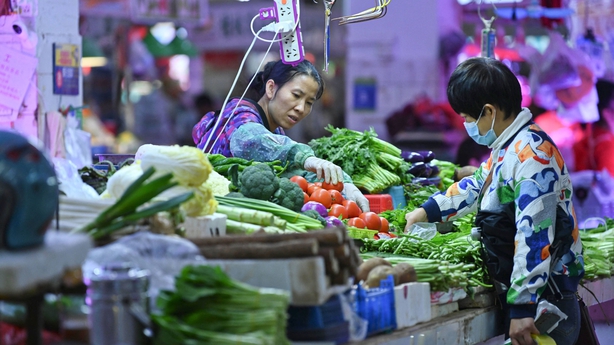
The central government typically makes extra effort to boost the supply of fresh vegetables and pork in the run-up to China's most important holiday, the Lunar New Year, which will fall in early February next year.
But this year those efforts have become more urgent after extreme weather in early October destroyed crops in Shandong - the country's biggest vegetable growing region - and as outbreaks of Covid-19 cases stretching from the northwest to the northeast of the country threaten to disrupt food supplies.
The commerce ministry added that local authorities should purchase vegetables that can be stored well in advance and also look to strengthen emergency delivery networks to guarantee smooth and efficient distribution channels.
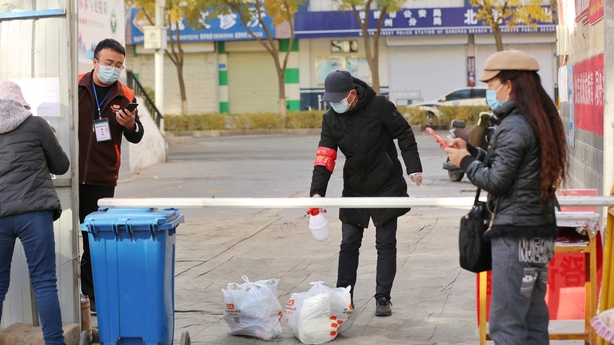
It added that information related to the prices and supply and demand of commodities should be released in a timely manner to stabilise the public's expectations.
China also plans to release vegetable reserves "at an appropriate time" to counter rising prices, according to a state TV report late on Monday.
It is not clear which vegetables China holds in reserves and how big those reserves are.
The state planning body has called for the timely replanting of vegetables, urging local governments to support fast-growing produce, according to the report.
Currently China has about 100 million mu (6.7 million hectares) planted with vegetables, the agriculture ministry has said.
Japan eases Covid-19 border curbs
Japan has confirmed plans to gradually ease Covid-19 border curbs, but fell short of demands by business lobbies to open up in line with major trading partners.
In relaxing its controls, Japan will take a phased approach, chief cabinet secretary Hirokazu Matsuno told reporters, responding to media reports that quarantine periods for business travellers would be cut to three days from ten.
The easing could start next Monday, while daily limits on the numbers of border entrants would be raised to 5,000 people later this month from 3,500, national broadcaster NHK said.
Domestic and foreign business groups have lobbied the government to ease border curbs to match other nations.
The US and EU allow entry for travellers from most countries with proof of Covid-19 vaccination.
Overseas business groups welcomed the shorter quarantine, but said the easing did not go far enough.
A bigger problem is the remaining hold on long-term visas, said Michael Mroczek, president of the European Business Council in Japan.
"Not being able to bring essential personnel to Japan is currently the No 1 issue for European industry," he said.
Japan cut its quarantine period for vaccinated people to ten days from 14 last month when it lifted its emergency measures in much of the country.
But as other nations adopted vaccine passport systems to smooth travel, Japan has stuck to its quarantine system.
Covid-19 cases have fallen dramatically as vaccinations have covered more than 70% of the population. New infections in Tokyo slid to nine yesterday, versus more than 5,000 each day during the August wave driven by the infectious Delta variant.
Covid-19 restrictions in Sydney to ease weeks ahead of schedule
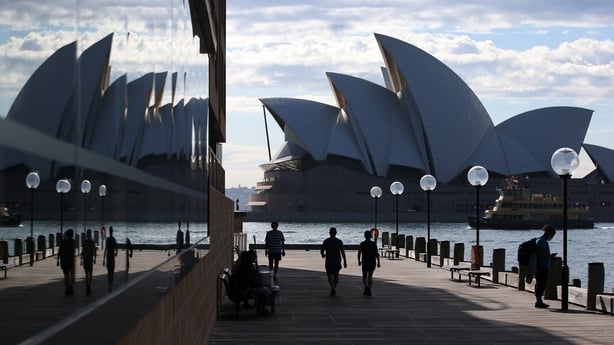
Australia's biggest city will lift more Covid-19 curbs for vaccinated residents ahead of schedule next week, while delaying freedoms it has promised for unvaccinated Sydneysiders as officials aim to boost inoculations.
Vaccinated people in the city of around 5 million will be allowed unlimited numbers of guests in their homes from 8 November.
Pubs and clubs will also be able to accommodate more guests and reopen dance floors, in changes that were initially planned to come into force on 1 December.
In contrast, unvaccinated people, who are currently barred from restaurants, non-critical retail stores, bars, gyms and other recreational facilities, will remain under the tougher restrictions until 15 December, or when New South Wales state's double vaccination rate reaches 95%.
"We have always wanted to open up in a measured way and incentivise vaccination rates," State Premier Dominic Perrottet told reporters in Sydney.
Around 88% of the state's population aged 16 and over has been fully vaccinated, but the first dose vaccination rate has been slowing as it nears 94%.
Australia yesterday lifted a ban on its residents flying overseas after more than 18 months and allowed quarantine-free entry fully vaccinated international travellers.
However, the changes initially affect only Sydney, Melbourne and Canberra, with other states and territories targeting differing timelines for reopening.
Australia had stayed largely virus-free for most of this year until a third wave in late June, spurred by the Delta variant, triggering further extended lockdowns.
The country has recorded about 173,000 cases and 1,756 deaths, with about 82% of infections attributed to the Delta wave.
New South Wales reported 173 cases today, up from 135 a day earlier, while Victoria logged 989 cases, the lowest rise in more than a month. The Australian Capital Territory logged eight new cases. Other states and territories are Covid free or have very few cases.
