


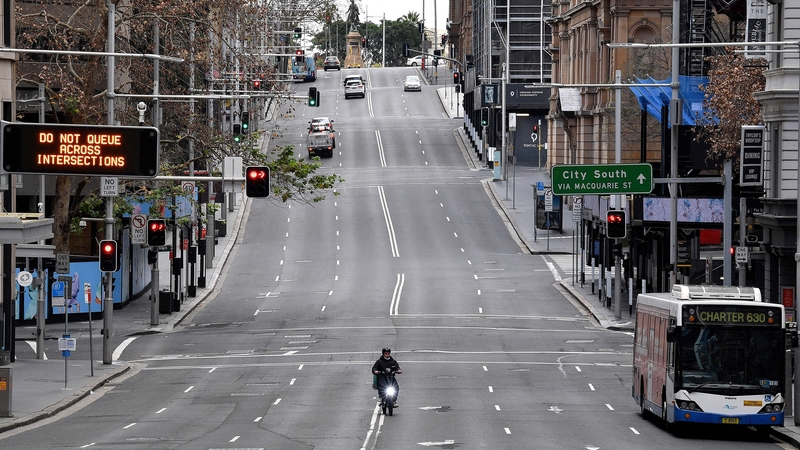
Sydney and some surrounding areas will enter a hard two-week Covid-19 lockdown today as authorities struggle to control a fast-spreading outbreak of the highly infectious Delta variant that has grown to 80 cases.
Parts of Sydney, Australia's biggest city, were already under lockdown due to the outbreak, but health authorities said cases and exposure sites were increasing too rapidly.
"Even though we don't want to impose burdens unless we absolutely have to, unfortunately this is a situation where we have to," said New South Wales state Premier Gladys Berejiklian.
Australia has been more successful in managing the pandemic than many other advanced economies through swift border closures, social distancing rules and high compliance, reporting just over 30,400 cases and 910 Covid-19 deaths.
But the country has confronted small outbreaks in recent months. These have been contained through speedy contact tracing, isolation of thousands of people at a time or snap hard lockdowns.
Rugby Australia was searching for alternatives sites for Australia's series-opening test against France, which was to have been played at the Sydney Cricket Ground on 7 July.
Today's lockdown in New South Wales will also include the regions of Blue Mountains, Central Coast and Wollongong, which surround Sydney, a city of five million people.
Under the rules in place through 9 July, people can leave home for essential work, medical care, education or shopping.
The rest of the state will have limits on public gatherings and masks will be obligatory indoors.
"There was no point doing it for three days or five daysbecause it wouldn't have done the job," Ms Berejiklian told a news briefing.
Her conservative state government was reluctant to impose the lockdown, but a growing number of health experts called for it, as Australia struggled with its vaccination rollout.
Michael Kidd, Australia's deputy chief medical officer, said 28% of people aged 16 or older have received their first Covid-19 vaccine shot. Of the 7.2 million administered doses, 5.8 million were first doses.
Although free, vaccines are available for now only to people over 40 and those in risk groups either due to their health or work. The Pfizer vaccine is administered to people 40 to 59 years old, and the AstraZeneca shot to those older.
Today, the case of a worker at the Granites gold mine in the Tanami Desert of the Northern Territory prompted the territory's authorities to order the isolation of more than 1,600 people in three states who had had contact with the worker.
The mine, owned by Newmont Corp, was put into lockdown.
Taiwan reports first domestic case of Delta Covid variant
Taiwan reported its first domestically transmitted case of the highly contagious Delta variant of the coronavirus on Saturday, tightening controls in a southern part of the island where the cases have occurred.
Taiwan is battling a cluster of domestic infections, almost all of them due to the previously globally dominant Alphavariant, though numbers are steadying and the outbreak has been comparatively small.
Six people in Pingtung county had been confirmed to have the Delta variant, including two who returned this month from Peru,where they are suspected of bringing the infection from, said Health Minister Chen Shih-chung.
One of them has been classified as a domestic infection, rather than within the family who arrived from Peru.
The government is carrying out mass testing in the area where the cases were reported, quarantining all suspected contacts. It has ordered supermarkets, restaurants and wet markets closed for three days, Mr Chen said.
"Now it has entered the community, and we are proactively working to contain it," he said.
Taiwan had previously reported five cases, all imported, of the Delta variant, which was first detected in India.
From today, the government will tighten border controls to keep out the variant, requiring arrivals from five countries, including Britain, to be placed in centralised quarantine facilities.
The Delta variant now comprises 96% of sequenced cases in Britain.
The broader picture of Taiwan's Covid-19 outbreak continues to improve, with Chen announcing 78 new cases, up only slightly from 76 the previous day, though controls on gatherings and public events remain in place.
Taiwan's tally of infections stands at 14,545 since the pandemic began, including 623 deaths.
Delta variant driving Covid surge in South Africa
The highly-contagious Delta variant is driving the surge in new Covid-19 infections in South Africa, the government and scientists said today as the country mulled tighter restrictions.
The hardest-hit country in Africa recorded 18,762 new infections today - its highest daily figure since January -- taking the total number of laboratory-confirmed cases to 1,895,905, of which 59,621 have been fatal.
"We are in the exponential phase of the pandemic with the numbers just growing very, very, extremely fast and will keep growing in the next weeks," Tulio de Oliveira of the Network for Genomic Surveillance in South Africa told a virtual briefing.
To curb the spread, "we are going to need that we go to hard, tighter restrictions... and that needs to be done urgently," Koleka Mlisana, the head of a government ministerial advisory committee on Covid-19 said during the briefing.
Health officials across the world have been alarmed by the rapid spread of the Delta variant first seen in India.
World Health Organization chief Tedros Adhanom Ghebreyesus said yesterday that Delta is the most contagious Covid-19 variant and it has now reached at least 85 countries.
