


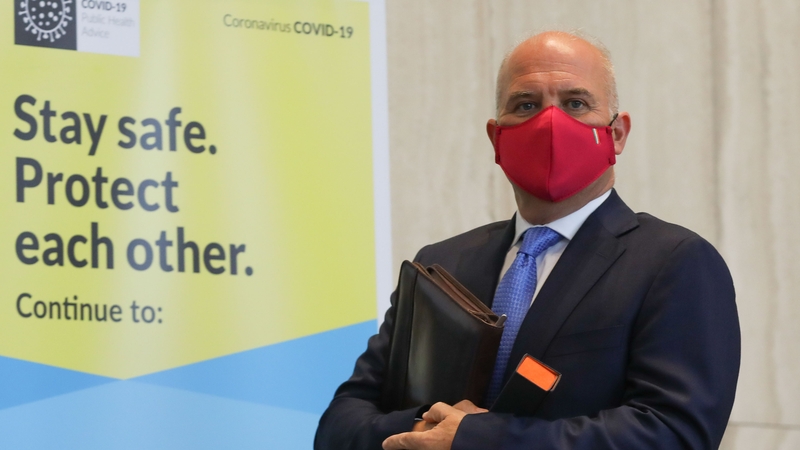
The Chief Medical Officer has said he was "absolutely shocked" by the crowds that gathered in parts of Dublin city centre today.
Dr Tony Holohan said the scenes in the South Great George's Street, Exchequer Street, and South William Street area were "like a major open air party".
On Twitter, Dr Holohan said: "This is what we do not need when we have made so much progress."
Drove into Dublin City Centre to collect someone from work at 815 PM. Absolutely shocked at scenes in South Great George's St, Exchequer St, South William St area. Enormous crowds- like a major open air party. This is what we do not need when we have made so much progress.
— Dr Tony Holohan (@CMOIreland) May 29, 2021
It comes as the Department of Health has been notified of 464 confirmed new cases of Covid-19.
The number of people with the disease in ICU is 35, three fewer than yesterday. In total, there are 90 Covid patients in Irish hospitals.
As of midnight, Friday 28 May, we are reporting 464* confirmed cases of #COVID19.
— Department of Health (@roinnslainte) May 29, 2021
35 in ICU. 90 in hospital.
*Daily case numbers may change due to future data review, validation and update.
In Northern Ireland, one person with coronavirus has died and there have been 68 positive cases reported in the past 24 hours. A total of 1,695,321 vaccines have been administered.
Today's reported death was the first in 11 days in Northern Ireland.
Meanwhile, the roll-out of the Covid-19 vaccination programme in Ireland continues apace with up to 300,000 vaccinations expected to be administered next week.
A new 30-booth vaccination centre that will operate seven days a week will open in UCD over the next ten days.
An additional vaccination centre in Drogheda will provide extra capacity for the Louth and Meath region.
The vaccination centre in Limerick is being moved to Limerick racecourse to provide extra capacity with 40 vaccination booths.
Elsewhere, GPs are expected to have completed second dose vaccinations for the vast majority of the over-70s population by the end of next week.
There is growing concern however, about potential implications for the vaccination programme.
It comes after the National Immunisation Advisory Committee said it is considering whether those who received a first dose of AstraZeneca should be switched to an mRNA vaccine for their second dose.
The Irish Nurses and Midwives Association met the HSE yesterday to discuss the matter as healthcare workers are due to start receiving their second dose of the AstraZeneca vaccine next week.
We need your consent to load this rte-player contentWe use rte-player to manage extra content that can set cookies on your device and collect data about your activity. Please review their details and accept them to load the content.Manage Preferences
Children must be part of vaccination plan
Infectious diseases specialist at Cork University Hospital Professor Mary Horgan has said children need to be considered as part of Ireland's vaccination programme.
"The more people we vaccinate, even young people who are less likely to be critically ill, they can spread the infection. So the more we immunise the safer we all are."
She also said she hopes antigen testing is used more as an "additional tool" to keep people protected.
She said 40% of Covid cases are asymptomatic so antigen testing would be welcome where they are looking for infectiousness at a given point in time.
While acknowledging there is a reluctance by some to antigen tests, she said the HSE is rolling out pilot schemes endorsing antigen testing including in settings such as meat processing plants.
Separately, a senior research officer in the ESRI's Behavioural Research Unit has said many people are still feeling worried about Covid-19, describing the levels they have observed as "relatively high".
Speaking on RTÉ's The Business, Deirdre Robertson said while it is not like the levels of fear and worry that prevailed in January when it was at a "real peak", it remains quite high as cases and deaths from coronavirus continue to occur.
"On a scale we use of one to 10 it is somewhere between six and seven," she said, adding that it is the biggest factor in how people will behave.
Her comments come as the country prepares for a further reopening of society and the economy from next month.
She said the behavioural tendencies that the ESRI is monitoring show the differences between individuals and how they are feeling.
"Those who are more worried are less likely to go on social visits. As long as there are still reports of high cases, people will remain cautious."
She said people have developed habits of not being indoors with other people and that it might take some time for people to be less worried about this prospect.
Their observations also show those who are vaccinated are more socio-active than those who are not, she added.
Speaking on the same programme, Managing Director at Altair Advisory Patrick Edmond said as Ireland prepares to reopen to international travel, there is an opportunity for tourism to flourish.
He said before the pandemic Irish tourist numbers were growing "pretty steadily" year on year.
He said the main target has been the number of tourists but he thinks the question needs to be asked whether the focus should be on continuing to growing those numbers or instead the quality of tourism and how that can benefit all parts of the country.
He noted that "over-tourism" is becoming an increasingly topical subject in the industry.
He said while Ireland is not "over-touristed", he believes attention should be given to spreading the benefits of tourism around the entire country instead of focusing on a small number of tourist hotspots.
Separately, Chief Clinical Officer of the Health Service Executive Doctor Colm Henry has warned against people letting their guard down with regard to public health guidelines following yesterday's Government announcement on the phased reopening of the economy and society.
Dr Henry said the rapid spread of the virus is still a possibility particularly because of the variant first identified in India, and public health guidelines must be adhered to in order to avert the spread.
He said that means continuing to wear masks and complying with social distancing rules.
Asked about travel to the UK, Dr Henry said medical experts are still of the opinion that people should not travel anywhere abroad particularly without full vaccinations.
Referring to the EMA approval of the Pfizer/BioNTtech vaccine for teenagers aged 12-15, Dr Henry said it makes sense to vaccinate this cohort as the campaign to vaccinate them against the flu last winter illustrated.
Without a vaccine this age group can still contribute to the spread of the virus, said Dr Henry.
