


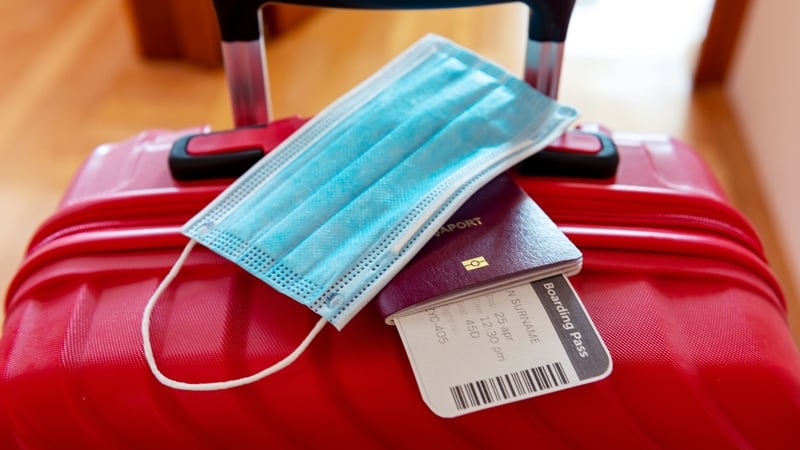
The HSE cyber attack is not expected to slow down Ireland's ability to join the EU Digital Covid Certificate to help reopen travel within the EU, according to a Government minister.
Speaking on RTÉ's Prime Time, Minister of State for Public Procurement and e-Government Ossian Smyth said the EU was due to pass legislation for the certs by 26 June and Ireland should be ready to sign up to the system "within a week" of that date.
This would mean it comes into effect here by early July.
Earlier, EU leaders welcomed the introduction of the bloc-wide Covid-19 pass that they hope will unlock a tourist surge this summer.
The 27 member states want the EU Digital Covid Certificate to be launched 1 July, to turn the page on coronavirus restrictions that have crimped Europeans' cherished freedom of movement.
Coupled with a separate plan to let in fully vaccinated travellers from countries outside the EU, to be defined by the middle of June, Europe believes its vital tourist industry could claw back some of the losses racked up since the start of the pandemic.
European Commission chief Ursula von der Leyen told a media conference after the summit that more than 300 million Covid-19 vaccine doses will have been delivered by the end of this week, rising to 400 million next month.
"If we continue like this, we have confidence that we will be able to safely reopen our societies," she said, adding the EU was on track to meet its goal of fully inoculating 70% of adults by late July.
"Progressively, we should return to the ability to move freely throughout the European Union," European Council President Charles Michel said.
EU countries and the European Parliament struck agreement last week on the legislation to come into force mid-June for the Covid certificate.
Ms Von der Leyen said all the technological infrastructure would be ready by 1 June.
The leaders of Greece, Spain and Croatia, whose economies strongly rely on tourist spending, were particularly effusive about the common document.
They all had wipe-out summer seasons last year, but are already starting to welcome back foreign travellers, ignoring Brussels' plea to coordinate at an EU level.
Luxembourg's prime minister, Xavier Bettel, pointed out that a scannable QR code on the certificates will stymie the "hugely copied" PDF files of test results or vaccinations that some people were using to cross borders.
The EU's Covid certificate will show the bearer's vaccination status, or whether they have immunity from a Covid infection they have recovered from, or the result of a Covid test.
Conscious that the EU has procured up to 4.4 billion vaccine doses over the next two years - far more than it needs for its population of 450 million - leaders have rallied to a pledge made at a G20 summit in Rome last Friday to share 100 million doses to countries in need by the end of this year.
Denmark and Sweden each promised three million doses from their stocks at the summit. Germany, Italy and France had already pledged higher amounts.
German Chancellor Angela Merkel said she also pushed leaders to agree a mechanism to "react quickly and cohesively" if worrying new coronavirus variants popped up.
The Brussels gathering of EU leaders today also looked at ways to share out the burden on battling climate change, to meet the target of cutting emissions by 55% over the rest of this decade.
Ms Von der Leyen's commission has been tasked with mapping out the next steps, including potentially unpopular ones such as slapping carbon taxes on cars and buildings.
The first day of the summit yesterday was overshadowed by Belarus, which sits just outside the EU's eastern borders, forcing down a Ryanair passenger plane on Sunday to arrest an opposition journalist and his companion who were on board.
EU leaders unanimously blasted the action and moved to cut Belarus out of European airspace as part of a package of sanctions that will be developed further.
