


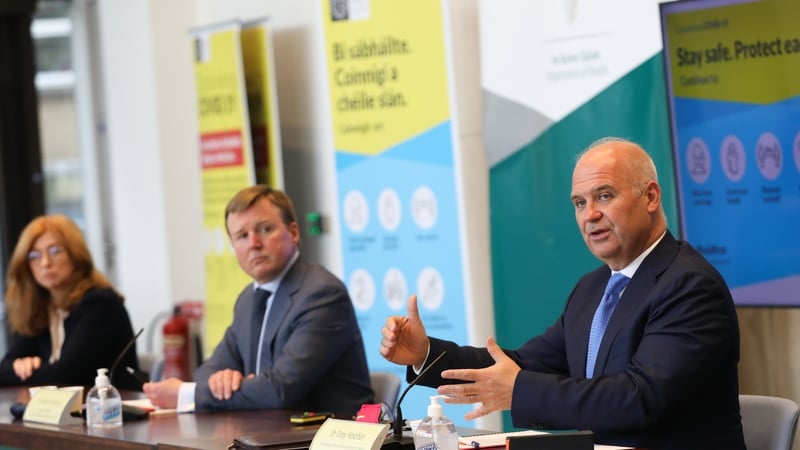
The Covid-19 briefing at the Department of Health heard concerns in relation to a variant of the virus first detected in India.
It follows confirmation of 524 further confirmed cases while the number of patients being treated for the virus in intensive care remains at 38.
Here are five things we learned from the latest National Public Health Emergency Team briefing.
NPHET concerned over Indian variant cases
The Chief Medical Officer has said that the National Public Health Emergency Team is "genuinely concerned" about the number of cases of the so-called Indian variant in Ireland.
Dr Tony Holohan said that data from Public Health England, due to be published today, is likely to show a decrease in effectiveness of the vaccine in the prevention of transmission of this variant after the first dose.
"In broad terms, you could characterise the virus here at the moment as, for the most part, the sky is blue but there is a black cloud on the horizon which is the Indian variant," he said.
"In broad terms… the sky is for the most part blue, but there is a black cloud on the horizon"
— RTÉ News (@rtenews) May 21, 2021
.@CMOIreland says while the situation at the moment is stable, there is "genuine" concern around the Covid-19 variant first identified in India | More: https://t.co/t9FtwuKk9F pic.twitter.com/orgykew6CJ
Dr Holohan said that there are suggestions that the variant could be over 50% more transmissible than a variant of the virus first detected in the UK.
"We think there is good enough reason to believe that there certainly is a transmission advantage, it could be as big as that [50%], but we can't conclude that it's definitely going to land at plus 50%," he said.
Dr Tony Holohan says there are suggestions that the so-called Indian variant could be over 50% more transmissible than a variant of the virus first detected in the UK | https://t.co/uwPbQrlClJ pic.twitter.com/YPV8qFxWRB
— RTÉ News (@rtenews) May 21, 2021
72 cases of Indian variant detected in Ireland
Dr Cillian de Gascun, Director of the National Virus Reference Laboratory, has said that 72 cases of the so-called Indian variant (B.1617.2), have been detected in Ireland.
He said 13 cases of this variant were acquired in data received by the NVRL over the last 24 hours.
Dr de Gascun said there were 59 cases identified earlier this week.
.@CillianDeGascun says there are now 72 confirmed cases in Ireland of the Covid-19 variant first identified in India, adding that there has been evidence of onward transmission | More: https://t.co/t9FtwuKk9F pic.twitter.com/VVL2WapdBK
— RTÉ News (@rtenews) May 21, 2021
He said people should take the variant that originated in India seriously as we do not want it to get out of control.
"It is important people continue to take this seriously"@CillianDeGascun says the concern with the B1617.2 variant is that there are 72 cases despite interventions, adding its important people adhere to Covid-19 measures to not allow it get out of hand | https://t.co/t9FtwuKk9F pic.twitter.com/upkoZUtNVR
— RTÉ News (@rtenews) May 21, 2021
'Very stable' number of Covid patients in ICU
The Chair of NPHET's Epidemiological Modelling Advisory Group has said the number of people hospitalised and in ICU are "very stable", as is the daily incidence rate.
Professor Philip Nolan said despite "severe limitations to the volume and detail of data" received due to the cyber attack on the HSE, NPHET has "reliable data" on the key indicators of disease.
"We have a clear sense that of the indicators of severity of the disease, and they are stable," he said.
"We're looking at very stable incidences"@President_MU says indicators of severity of disease are stable, with the 7-day moving average remaining the same as last week, and the 14-day average slightly down | More: https://t.co/t9FtwuKk9F pic.twitter.com/I8PmubYoH6
— RTÉ News (@rtenews) May 21, 2021
Prof Nolan said the 7-day moving average is the same as 13 May at 431.
He said this may change a couple of percent due to detailed data received in the coming days.
Contact tracing system restored last Friday despite cyber attack
Dr Tony Holohan said that the contact tracing system for Covid-19 was back up and running last Friday afternoon, despite the cyber attack on the HSE's IT system.
He said that NPHET believes the case numbers being reported are reliable.
"What we're generating our case numbers from now is from a derivative of a total number of positive cases that are detected at laboratories each day, but we think it's a reliable number," he said.
Chief Medical Officer Dr Tony Holohan has said the contact tracing system for Covid-19 was back up and running last Friday afternoon, despite the cyberattack on the HSE's IT system | https://t.co/uwPbQrlClJ pic.twitter.com/zEvgldHsCT
— RTÉ News (@rtenews) May 21, 2021
Leaving Cert students urged to be cautious
The Chief Medical Officer urged this year's Leaving Cert students to be cautious.
Dr Tony Holohan said that students should restrict their social contacts ahead of the exams and that nobody wants to end the year by becoming infected and not being able to sit the exams.
He said: "For Leaving Cert students who are coming close to the point of finishing school, it is important to taking the opportunity to restrict your social contracts as much as possible."
"Meet up by all means, but do so safely and outdoors"
— RTÉ News (@rtenews) May 21, 2021
.@CMOIreland urges Leaving Cert students to restrict their social contacts ahead of exams, adding that nobody wants to end the year by becoming infected and not being able to sit the exams | More: https://t.co/t9FtwuKk9F pic.twitter.com/aDbVopz0HR
