


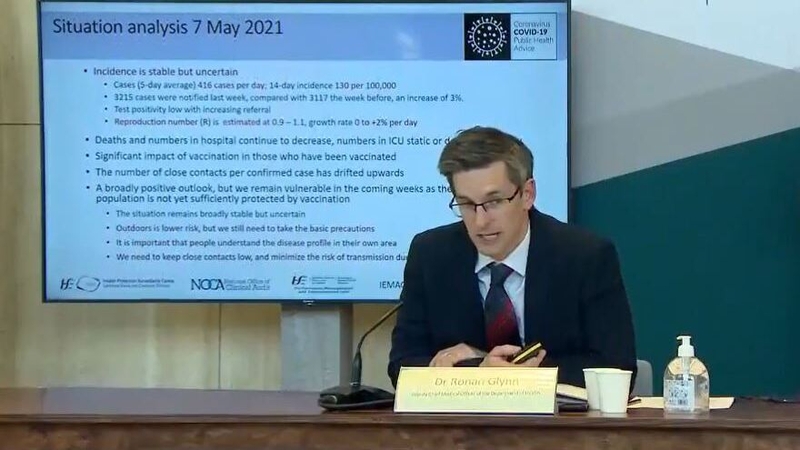
Overall situation 'stable but uncertain'
Deputy Chief Medical Officer Dr Ronan Glynn told this afternoon's briefing that the overall situation was "stable but uncertain".
He said that while deaths and hospitalisations were down, and the impact of vaccines was being felt, people still needed to be on their guard as restrictions are eased next week.
"The overall profile is stable but uncertain... keep your contacts low"
— RTÉ News (@rtenews) May 7, 2021
.@ronan_glynn says while deaths and hospitalisations are down, and the impact of vaccines is being felt, people still need to remain careful moving into next week | More: https://t.co/zimWxIlhUS pic.twitter.com/48Cm0k3bau
He said the number of close contacts per case has risen slightly from 2.6 to 2.8, and that as restrictions are eased next week they should keep their contacts low, and only meet up outdoors.
He also said that the R number at the moment currently stands at around 1.
Counties with high incidence being monitored
Dr Glynn also said that in addition to the high incidence rate in Donegal, several other counties are also being closely monitored given their rising incidence rates.
"There are a number of counties which for a variety of different reasons have a higher disease incidence at present... in particular Kildare, Dublin, Roscommon, and we've seen outbreaks in Cavan as well," he said.
"There are a number of counties which for a variety of reasons have a higher disease incidence"
— RTÉ News (@rtenews) May 7, 2021
.@ronan_glynn says Kildare, Dublin, Cavan and Roscommon are being monitored closely ahead of the easing of measures next week | More: https://t.co/zimWxIlhUS pic.twitter.com/p0ZKacfRON
"As we move into next week and the easing of measures, it becomes all the more important for people across the country to understand the disease profile in their area," he added.
Slight increase in incidence among younger people, but a fall in older people
Dr Glynn told the briefing that no cases were no new cases today in people over the age of 85, but there have been modest increases in the younger age groups which they "will need to keep eye on".
"We have seen slight increases in the 5-12, 13-18, and 19-24 age groups, so we need to keep an eye on that," he said, adding that incidence in those over 75 had dropped off.
Dr Glynn said the the increase in younger age groups were, in overall terms "relatively modest"
"We have seen slight increases in the 5-12, 13-18, and 19-24 age groups, so we need to keep an eye on that"
— RTÉ News (@rtenews) May 7, 2021
.@ronan_glynn says incidence in older age groups is continuing to drop, but has risen week-on-week in younger age groups, although only modestly | https://t.co/zimWxIlhUS pic.twitter.com/6L6lfYxsie
GPs still seeing cases of non-essential travel, inter-house mixing
Dr Ray Walley of the National Covid-19 GP Liaison Committee outlined to the briefing examples of problematic cases GPs are continuing to see, however he said they are now seeing fewer of them.
Dr Walley said there are still cases of children visiting households outside their immediate family, and after a few days they realise they are symptomatic. Unfortunately then, he said, two or three households are then affected.
.@WalleyRay outlines cases GPs are continuing to see, albeit fewer in number, saying they're seeing people making non-essential travel returning from holidays symptomatic, and seeing children visiting other households who become symptomatic days later | https://t.co/zimWxIlhUS pic.twitter.com/yDAbHyRkAY
— RTÉ News (@rtenews) May 7, 2021
He said GPs are also coming across people engaging in non-essential travel, and when they come back from holidays they become symptomatic.
He said that these are a minority, and that people are contacting GPs early and out of hours.
He also said that they have concerns with some patients talking about going up to Northern Ireland to go shopping and visit restaurants.
Concern about over-the-counter sale of antigen tests
Chief Medical Officer Dr Tony Holohan told the briefing there was "genuine concern" over the inappropriate use of antigen tests which people can buy off shelves.
He said that shops are free to sell what they sell, but said it is about what people do themselves
"That represents a real risk to our pandemic response"
— RTÉ News (@rtenews) May 7, 2021
.@CMOIreland says antigen tests should only be used in strictly controlled circumstances, adding that he is concerned that people could just go to a shop and buy one, and not use them properly | More: https://t.co/zimWxIlhUS pic.twitter.com/0mT91H5HRB
He said antigen testing has a role to play but only in strictly controlled circumstances, where they know that the test is going to work, they understand what the result means, and the performance of the test is not going to lead to people getting what he called "inappropriate reassurance"
Dr Holohan said that NPHET are concerned that someone could walk into a shop and buy a pound of sausages, charcoal for a barbeque and an antigen test and then think they don't have to abide by the restrictions.
He said that that represents "a real risk to our pandemic response".
'No surprise' if eased restrictions lead to further cases
Dr Holohan told the briefing there was "no question" that increased activity would lead to increased social contact and in turn, increased transmission.
He said people needed to engage in such activity in ways that reduce risk of transmission, adding that if people listen to all of the advice that is given then maybe the risk of transmission will remain low.
"It won't surprise us"
— RTÉ News (@rtenews) May 7, 2021
.@CMOIreland says the increased activity that comes with eased restrictions will lead to more social contact and potentially lead to more transmission, adding that such activity should be done in a way that reduces risk | More: https://t.co/xWeiNmQRPO pic.twitter.com/i9sceSrOlH
"It won't surprise us that there would be an increase in transmission, but that's not the only thing we'll look at," Dr Holohan said.
Dr Holohan also added they "could not rule out the possibility" of further restrictions being imposed if the level of increase in numbers was high enough to require it.
