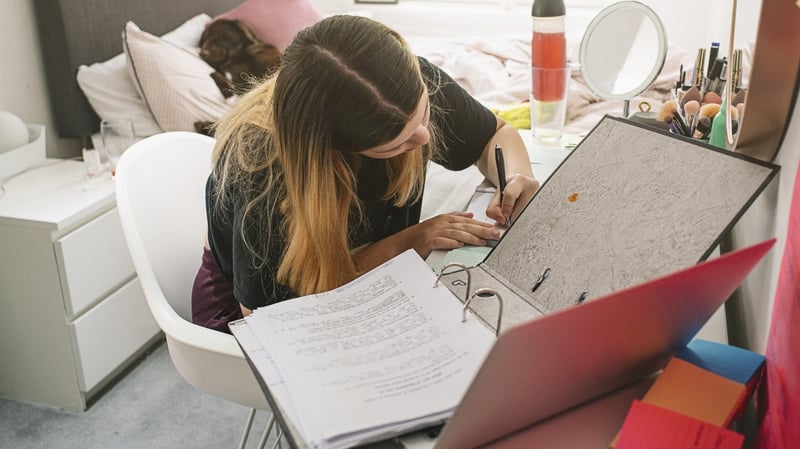

More than half of 12-year-olds and 22-year-old students who took part in a recent study experienced difficulties with remote learning during the pandemic.
While those from low-income families were less likely to have internet access or a quiet place to study.
The survey was carried out by the ESRI and Trinity College Dublin into the Covid-19 experiences for children and young adults participating in Growing Up in Ireland study.
It found that only half of students in both age groups said it was 'always true' that they had a quiet place to study while learning at home.
Just 19% of primary and secondary school students surveyed said it was ‘always true’ that they had access to online classes - this compared to 74% of third level students.
The older cohort also had better access to computers for remote learning with 91% of 22-year-olds versus 74% of 12-year-old's saying that it was ‘always true’ that they could access one.
60% of parents of 12-year-olds in the lowest income group said their internet connection or devices were ‘very’ or ‘mostly adequate’ versus 80% of parents in the highest income group.
More of the parents in the highest income group said that their 12-year-old 'always' had a quiet place to study (75% vs 53%), but when children themselves were asked the gap narrowed: 51% vs 47%
The survey found that the pandemic negatively impacted some student's transition from primary to secondary school.
Among the 12-year-old's surveyed, those who started secondary school in September 2020 were more likely to report negative experiences around the return to school, including finding schoolwork more difficult (13% versus 6% said this was 'always true'), and fewer said teachers went over material to help catch up (33% versus 48% said this was 'always true) and felt safe from Covid-19 infection in school (35% versus 51% said this was 'always true').
The survey of 12-year-olds, their parents and of 22-year-olds was carried out in December 2020, just as Ireland was relaxing Level 5 restrictions after the second wave of Covid-19 in the Autumn.
Also dealing with home schooling, it asked them about their lifestyles and work.
Over a third of 22-year-olds and a quarter of 12-year-olds were in a household with at least one person who was thought to be at increased risk of severe COVID-19 disease, and low-income families in both cohorts were more likely to report living with someone vulnerable to severe disease from contracting the virus.
Many participants in both age cohorts reported increases in symptoms of low mood and the consumption of 'junk food and sweets' during the pandemic this was more common for girls and young women.
More than one-in-five 12-year-olds (22%) were in the 'low mood' group.
18% of the children in this group said it was 'always true' that they found it difficult to settle back into school, 51% of this group said they were worried about a family member being affected by the virus and 15% said they argued with their parents more than usual.
Almost half (48%) of 22-year-olds had elevated scores on the measure used of depressive symptoms, up from 27% two years ago when they were aged 20.
Amongst 22-year-olds who were in employment before or during the pandemic, almost half (46%) had lost their job or were temporarily laid off.
Dr Aisling Murray, Senior Research Officer at the ESRI and one of the report's authors, said that, "this snapshot of changes to the lived experience of Growing Up in Ireland participants is important not just for the short-term impact but the potential 'shift' in the life-course pathways for individuals; especially given the timing around milestone transitions for 12-year-olds starting secondary school and 22-year-olds taking their first steps on the career ladder".
As part of the study, 3,901 surveys were completed by parents, 3,301 were completed by 12-year-olds and 2,277 22-year-olds completed a survey.