

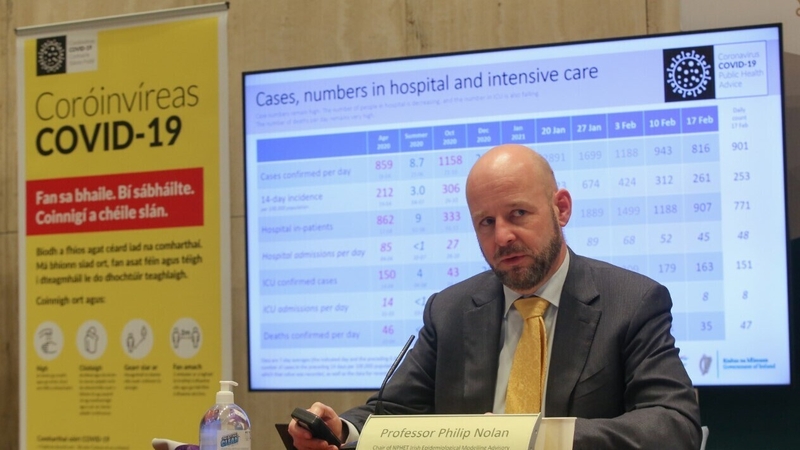
From higher proportions of Covid-19 in urban areas being in line with expectations, to comments on Vitamin D, here are six things we learned at this evening's Covid-19 briefing.
Community effort is the most essential measure
'The ultimate and the strongest tool that we have is people's buy-in and people's willingness to protect themselves and their families at an individual level. If we lose that, nothing else will work,' Deputy CMO Dr @ronan_glynn says | https://t.co/co6xNmheQO pic.twitter.com/gQAnAXNeRv
— RTÉ News (@rtenews) February 18, 2021
Responding to a suggestion that the primary "lever" by which public health officials are trying to control Covid-19 is the community, Deputy Chief Medical Officer Dr Ronan Glynn said "that is absolutely the case" and said it is the same the world over.
He said that if the public do not go along with the measures officials implement then nothing will work.
Retrospective contact tracing
'We have been calling for retrospective contact tracing since last August', Deputy CMO Dr @ronan_glynn says, but adds 'We have a public health resource that was very limited pre-pandemic and has been pushed to its absolute limit' | https://t.co/co6xNmheQO pic.twitter.com/Kh3CnjTlYm
— RTÉ News (@rtenews) February 18, 2021
Dr Glynn said that NPHET would like to see retrospective contact tracing, and has been calling for it since August.
However, the Deputy CMO added that the health service has limited resources, and public health workers are struggling to keep up with current contact tracing.
Vitamin D
'We are not against Vitamin D' Deputy Chief Medical Officer Dr @ronan_glynn says. 'I am absolutely recommending Vitamin D as a general positive thing that people can do, but that's different from saying that it's going to prevent someone from ending up in hospital with #Covid' pic.twitter.com/XmdW1AjEkj
— RTÉ News (@rtenews) February 18, 2021
Dr Glynn said that many people In Ireland, do not get enough Vitamin D, and every person over 65 in the country should be taking a supplement.
However, he said there is no robust evidence at the moment that Vitamin D has an effect on preventing people becoming seriously ill with Covid-19.
"We have to be very careful about what we recommend to people to put into their bodies or the reasons that people put something into their bodies," Dr Glynn said.
He said he recommends Vitamin D as a generally positive thing people can do, but that that is different from saying it will prevent people from ending up in hospital with Covid-19.
AstraZeneca vaccine and older people
On the decision not to recommend the use of the AstraZeneca vaccine for those aged over 65, HSE Chief Clinical Officer Dr Colm Henry (@CcoHse) says 'You make the decision based on the evidence you have now, not the evidence you think is going to come to you in a month's time' pic.twitter.com/b9Fyrn14NE
— RTÉ News (@rtenews) February 18, 2021
HSE Chief Clinical Officer Dr Colm Henry said that older people have had a "horrendous" experience with Covid-19, and the relative risk for older people is so much higher.
He said you use the most effective vaccines for the people who are at higher risk.
Dr Henry said it may well be that the real-world evidence shows higher efficacy for the AstraZeneca virus in older people than has been proven to date, but that we must make decisions on the evidence we have now rather than what we might expect to happen later.
Higher rates in Dublin
On the rising proportion of #Covid19 cases in Dublin, Prof Philip Nolan says it's not unusual the disease remains at higher levels in urban areas as it recedes across the country as a whole. It's not just Dublin; rates are higher in other urban areas too | https://t.co/co6xNmheQO pic.twitter.com/ifN3Fivy6r
— RTÉ News (@rtenews) February 18, 2021
With Dublin accounting for close to half of the latest cases, concerns have been expressed about the rate of infection in the capital.
However, Prof Philip Nolan noted that it is not only Dublin that is affected, with other urban areas also showing higher proportions of cases compared to the national average.
He said that is to be expected as the level of the disease recedes across the country as a whole.
When cases were very low during the summer, Dublin also accounted for close to half the national case count.
Concern over plateauing in metrics despite improvements
Prof Philip Nolan says the number of people being admitted to hospital per day has plateaued at around 50 new cases per day, which is a cause for concern | https://t.co/hVyWwAavS9 pic.twitter.com/S7S1nuUwJx
— RTÉ News (@rtenews) February 18, 2021
Prof Nolan also noted that while the situation is improving, the rate at which cases and hospitalisations are falling has decreased.
He said this could be attributed to the B117 variant of Covid-19, which is more transmissible, and that we are now having to work even harder than ever to achieve the same levels of suppression of the disease.
Prof Philip Nolan says progress is still being made in the suppression of Covid, however the rate over the number of cases decreasing per day has slowed down. He says it is "almost certainly" because 90% of transmissions are due to the B117 variant | https://t.co/hVyWwAavS9 pic.twitter.com/u6IHQLavNO
— RTÉ News (@rtenews) February 18, 2021
