


A US official has told a World Health Organization meeting that the United States would join a programme to boost Covid-19 testing, diagnostics and vaccines as officials urged it to increase financing for a global response to the pandemic.
WHO chief Tedros Adhanom Ghebreyesus welcomed the announcement which follows confirmation last month that the US under President Joe Biden will remain in the Geneva-based agency.
Former President Donald Trump criticised the agency and halted funding.
"We want to underscore the commitment of the United State sto multilateralism and our common cause to respond to this pandemic and improve global public health," Colin L McIff, Acting Director at the Office of Global Affairs in the US Department of Health and Human Services, said.
The virtual WHO Facilitation Council aims to help fill a $27 billion funding gap for the WHO-backed programme, called the Access to COVID-19 Tools Accelerator, that is aimed at broadening global access to Covid-19 fighting tools.
The US had previously been an observer to ACT.
Washington, the top donor to the WHO, has already pledged $4 billion for the global pandemic response.
First sitting US congressman dies after Covid diagnosis
A Republican congressman from Texas who was being treated for Covid-19 has died, his office said, the first sitting member to died after battling the coronavirus.
House of Representatives congressman Ron Wright, 67, who had also suffered from cancer in recent years, died on Sunday in a Dallas hospital, where he and his wife were taken after catching the virus.
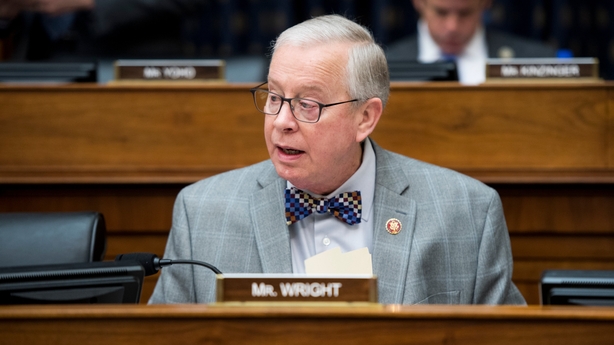
His death comes after House member-elect Luke Letlow died on 29 December due to the disease, just days before the 41-year-old Republican was to be sworn in.
Mr Wright announced on 21 January that he had tested positive for the Covid-19 but was "experiencing minor symptoms."
"I feel okay and will continue working for the people of the 6th District from home this week," his statement said at the time.
But his condition took a turn for the worse and for the past two weeks, he and his wife Susan were hospitalised for treatment. He died with his wife at his side, according to a statement from his office.
US President Joe Biden called Mr Wright a "fighter who battled bravely against both cancer and Covid-19," and said in a statement that his and his wife Jill's prayers were with the congressman's family.
Republican congresswoman Liz Cheney expressed her condolences in a statement for her "friend & colleague."
"Ron's commitment to public service, his tremendous work ethic & his commitment to conservative values inspired us all," she wrote.
The United States has battled the world's largest outbreak of the virus, with 463,000 people dying from the disease.
UK consider tighter travel restrictions
Travellers arriving in Britain from abroad will have to take two coronavirus tests during quarantine, the government is expected to confirm later.
Health Secretary Matt Hancock is due to announce that people told to isolate at home will be required to get a test two and eight days into a mandatory ten-day quarantine period.
The new measures, which critics say come too late to curb the spread of the virus, are aimed at halting new variants.
But the health ministry said Britain's response had been informed by experts leading to "some of the toughest border regimes in the world".
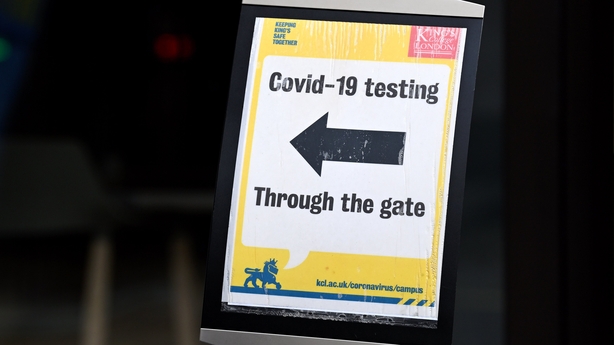
"Enhancing our testing regime to cover all arrivals while they isolate will provide a further level of protection and enable us to better track any new cases which might be brought into the country, and give us even more opportunities to detect new variants," a spokesman said.
Environment Secretary George Eustice confirmed that announcements on the new quarantine regime would be made in parliament later.
"We have to be ever mindful of the risk of other variants entering the country," he told BBC radio.
Prime Minister Boris Johnson's government has been under pressure to tighten rules for international travellers, following criticism the regime was too lax.
New mandatory hotel quarantine rules for travellers returning from dozens of countries deemed "high risk" from Covid-19 are due to start from 15 February.
The new rules will require all UK citizens and permanent residents returning from countries on a travel ban list to self-isolate in a government-approved facility for ten days.
Other visitors from the 33 countries currently on the list, which includes all South American nations and South Africa, are currently barred from visiting Britain under virus lockdown rules.
Time to wear a better mask, experts say
As new, more transmissible variants of the coronavirus spread, experts say it is time to consider using a medical-grade respirator, or wearing a surgical and cloth mask together.
Scientists have agreed for some time the main way the virus is spread is through the air, rather than surfaces.
Added to this is the greater contagiousness of emerging variants, like B.1.1.7, which takes a smaller viral load to cause symptomatic Covid-19 compared to the more common strain.
When authorities first recommended people wear face coverings, proper masks were in extremely short supply and the public was encouraged to fashion makeshift solutions out of T-shirts or bandanas. But these are far from ideal.
Linsey Marr, a professor of civil and environmental engineering at Virginia Tech, who studies airborne disease transmission, told AFP: "How well a mask works depends on two things: filtration and fit.
"Good filtration removes as many particles as possible, and a good fit means that there are no leaks around the sides of your mask, where air - and viruses - can leak through," she said, adding even a small gap could lead to a 50% reduction in performance.
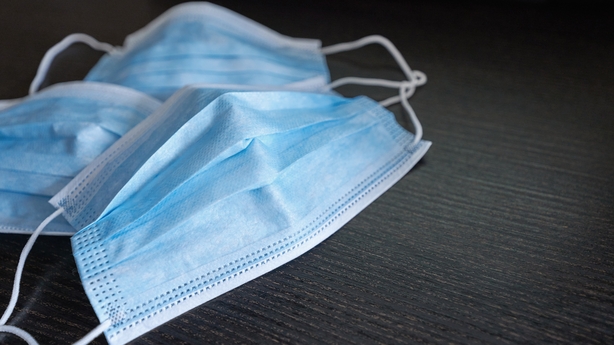
The best materials for blocking small particles include non-woven polypropylene, which is used to make N95s and many surgical-type masks, and the HEPA filters in planes. Among fabrics, tightly woven cotton works best, she added.
"If you wear a cloth mask, choose one that has multiple layers, ideally one with a pocket that you can slip a good filter material into," said Prof Marr. "Or you can double mask by wearing a surgical-type mask with a tight-fitting cloth mask over it."
Surgical masks are made of material that filters things out well, but they tend to be loose, so adding a cloth mask on top holds down the edges and reduces leaks.
Adding an additional layer improves filtration -- if one layer traps 50 percent of all particles, combining two gets to 75 percent.
Masks that have a metal nose bridge help ensure a snug fit, as do straps that tighten around the head, not just the ears. Braces that improve the fit of surgical masks are now available on the market.
Another option is getting hold of N95s, or their international equivalents such as KN95, FFP2 etc.
Easter Island begins vaccinating residents against Covid-19
Authorities on Easter Island began vaccinating residents against Covid-19, distributing 120 doses on the first day.
Situated 3,500km off Chile's coast, the island - renowned for its ancient, giant humanoid monoliths - has not reported a single coronavirus case in more than 300 days.
Medical personnel and people aged over 80 were among the first to receive the jabs, Easter Island mayor Pedro Edmunds said, adding that authorities estimate 8,000 people will be immunised -- about 80% of the island's 10,000 people.
A shipment of 1,200 doses of the vaccine produced by Chinese laboratory Sinovac arrived Thursday aboard the Chilean island's weekly supply plane.

The island will receive a total of 16,000 doses, and the vaccination process will continue Tuesday and Wednesday for people over 70.
While mainland Chile has recorded 755,000 cases of Covid-19 with more than 19,000 deaths since the start of the pandemic, Easter Island has not recorded a single case in more than 300 days after suspending all tourist visits.
With no tourism, the island's main economic sector, the island's inhabitants have had to turn to an ancient Polynesian tradition based on taking care of oneself and sharing resources within the community.
