


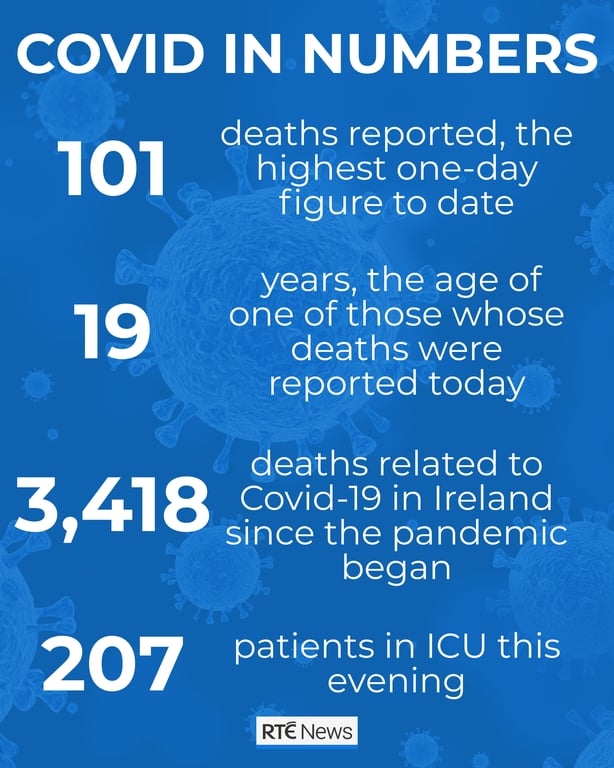
The Department of Health has been notified of 101 further coronavirus-related deaths and 879 new cases.
In a statement, the National Public Health Emergency Team said that 83 of the deaths occurred in January, and 18 happened this month.
This is the highest number of deaths reported by the Department of Health since the outbreak of the pandemic last year.
Previously, the highest number of Covid-related deaths reported on a day was 93 deaths on 19 January.
The age range is 19 to 103 years, while the median age of those who died is 85 years.
There have been a total of 3,418 coronavirus-related deaths in Ireland.
Over 920 deaths notified to health authorities in January, had a date of death in January.
It compares with 164 deaths with a date of death in November and 176 deaths with a date of death in December.
The number of confirmed Covid-19 cases now stands at 198,424.
The number of Covid-19 patients in hospital is 1,388, with 207 in ICU.
Of the cases notified today, 419 are men and 459 are women. 56% of the cases are under the age of 45, while the median age is 41.
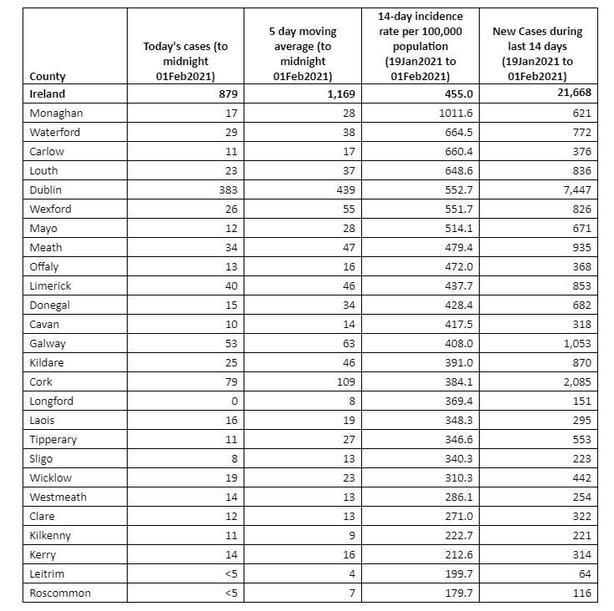
NPHET says that 383 of the new cases are in Dublin, 79 in Cork, 53 in Galway, 40 in Limerick, 43 in Meath and the remaining 290 cases are spread across 20 other counties.
The Chief Medical Officer has said that high mortality is related to the surge of Covid-19 infection several weeks ago.
Dr Tony Holohan said: "This is the highest number of deaths we have reported on any single day of the COVID-19 pandemic so far.
"The high mortality we are experiencing as a country at the moment is related to the surge of infection we saw several weeks ago, and the hospitalisations and admissions to ICU that followed as a direct result.
We need your consent to load this rte-player contentWe use rte-player to manage extra content that can set cookies on your device and collect data about your activity. Please review their details and accept them to load the content.Manage Preferences
"Although we have seen great improvement in the level of infection being reported, we have a long way to go and incidence needs to decline much further.
"The best way to honour those who have died from Covid-19, and those who loved them or provided care for them, is to follow the public health advice.
"Stay at home unless absolutely necessary, and encourage your friends, family and colleagues to do the same.
"What we can have control over today is the outlook of this disease in the weeks to come. Your positive actions matter, and they add up at a collective level. Please keep it up."
When the third, current wave of Covid-19 swept across the country last month, public health officials warned that the "sad reality" was that there would be increased mortality.
On 14 January, Deputy Chief Medical Officer Dr Ronan Glynn said that there were "going to be difficult days and weeks ahead as we report these numbers".
Five days later, when 93 deaths were reported, HSE Chief Clinical Officer Dr Colm Henry said "sadly, there will be more".
He said that high levels of disease and infection in the community feeds through to hospitals.
"Many of those people will become sick, many of them will require intensive care and sadly some of them will die", he said.
Today, exactly two weeks later, a new daily high was reached as 101 deaths were notified.
The 14-day incidence rate per 100,000 of the population now stands at 455.0.
The counties with the highest rate are Monaghan (1011.6), Waterford (664.5) and Carlow (660.4).
The counties with the lowest rate of incidence are Roscommon (179.7), Leitrim (199.7) and Kerry (212.6).
NPHET has said it has examined the existing evidence on the role of Vitamin D and Covid-19, in relation to potential beneficial pharmaceutical and lifestyle interventions in the community.
It said that while "circumstantial evidence" exists to suggest an association, to date there is insufficient high-quality evidence to support any change to existing recommendations.
The issue is dealt with in the most recent letter from Dr Holohan to the Minister for Health, on 28 January, and published today.
However, NPHET agreed that efforts should be made to increase awareness of existing guidance which recommends that all adults aged 65 and over should take a daily supplement of 15 micrograms of Vitamin D for bone and muscle health.
The situation in hospitals continues to be very pressurised, with University Hospital Waterford dealing with 98 Covid-19 patients, the largest number of any public hospital.
The Oireachtas Health Committee today heard that 1,543 people died due to Covid-19 in nursing homes, with 369 of those having occurred in the month of January.
Meanwhile, the Minister for Health has said that the first delivery of around 35,000 doses of the AstraZeneca vaccine should happen next week.
Separately, the Government is insisting this evening that it will have legislation ready within weeks to use hotels for mandatory quarantine.
Additional reporting Laura Hogan, Fergal Bowers, Micheál Lehane, Tommy Meskill
