


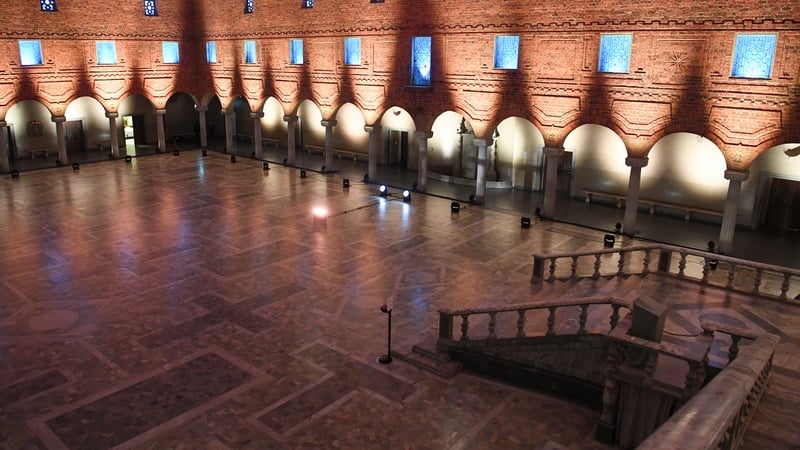
Stockholm's Blue Hall, where leading scientists, politicians and royalty gather for the glittering Nobel Prize banquet, will be used to vaccinate the Swedish capital's citizens against Covid-19, a city commissioner said.
The 1,500 square metre hall, which each year hosts Sweden's most sought-after social event, will soon be a temporary venue for Stockholmers to receive their shots.
The large space is seen as ideal for administering vaccines.
"The vaccination process is very demanding. Sports halls and large premises such as the Blue Hall are suitable for effective and infection-proof vaccinations," Stockholm finance chief Anna Konig Jerlmyr said.
The black tie and ball gown event was cancelled last due to the pandemic - the first time it had been cancelled since 1956, when it was dropped in protest at the Soviet Union's invasion of Hungary.
Earlier, Swedish daily Dagens Nyheter reported that the country's Health Agency has paused Covid-19 vaccine payments to Pfizer and is seeking clarification over the amount of doses available in each vial.
Sweden is seeking clarity on the number of doses it has been billed after Pfizer charged for six doses in each vial rather than the agreed upon five doses. Sweden now want the EU Commission and Pfizer to reach an agreement on how many doses there are contained in each vial.
"Until then, we have told the company that we must wait with the invoices that are available until we get clarity on what applies," Chief Epidemiologist Anders Tegnell told Dagens Nyheter.
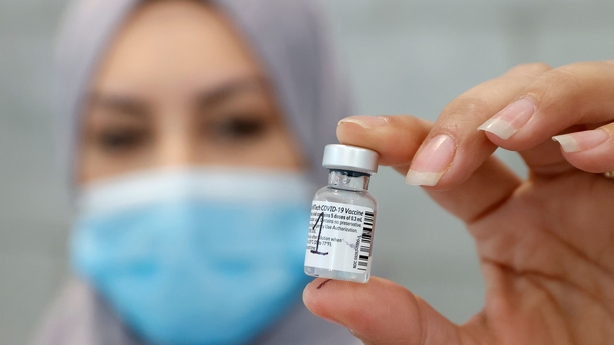
Pfizer Sweden declined to comment to Reuters on the repor tbut told Dagens Nyheter it had charged for six doses per vial.
EU and Pfizer originally agreed that each vial contained five doses, but it was later discovered that six doses could be extracted if a special syringe was used.
"This is unacceptable. If a country only has the ability to extract five doses, it has received fewer doses for the same price," Sweden's vaccine coordinator Richard Bergstrom told the newspaper.
Sweden has a death toll from the virus of more than11,000. Its death rate per capita is several times higher than its Nordic neighbours, but lower than several European countries that opted for lockdowns.
The black tie and ball gown event was cancelled last due to the pandemic - the first time it had been cancelled since1956, when it was dropped in protest at the Soviet Union'sinvasion of Hungary.
NZ's borders likely to stay closed in 2021
New Zealand's borders are likely to remain closed for much of the year as health officials assess global vaccine roll-outs, Prime Minister Jacinda Ardern has said.
Ms Ardern said the emergence over the weekend of New Zealand's first case of community transmission in more than two months showed the danger Covid-19 still posed to a nation hailed for its response to the coronavirus.
She said her government would not re-open its borders, which have been effectively closed to all but returning citizens since last March, while the pandemic was still raging worldwide.
"Given the risks in the world around us and the uncertainty of the global roll-out of a vaccine, we can expect our borders to be impacted for much of this year," she told reporters.
Still, Ms Ardern said New Zealand would continue to pursue "travel bubbles" with Australia and Pacific island nations, which have also been largely successful at keeping out or containing the virus.
Plans to open a travel bubble by the end of March were thrown into question when Australia suspended quarantine-free travel for Kiwis in response to the latest case of community transmission.
Ms Ardern said the case - a 56-year-old New Zealander who recently returned from Europe - was "well under control" and criticised Australia for reimposing quarantine for New Zealanders.
She said she made her feelings known in a call yesterday with Australian Prime Minister Scott Morrison.
"If we're to enter a trans-Tasman travel bubble, we need to give people confidence they won't see border closures at very short notice over incidents that we believe can be well managed domestically," she said.
Officials in Canberra said the restrictions on New Zealanders were being imposed "out of an abundance of caution".
New Zealand Health Minister Chris Hipkins said 15 close contacts of the infected woman had tested negative for the virus, which has been identified as the more contagious South African variant.
He said investigators were probing how the woman was infected during her compulsory two-week quarantine, including the possibility it spread through the hotel's air-conditioning system.
German minister calls for 'Europe's fair share' in vaccine distribution
German Health Minister Jens Spahn has backed European Union proposals to introduce restrictions on Covid-19 vaccines leaving the bloc, saying Europe should have its "fair share".
The EU has proposed setting up a register of vaccine exports amid frustration over delays in deliveries of AstraZeneca's Covid-19 shot and other supply problems.
"I can understand that there are production problems butt hen it must affect everyone in the same way," Mr Spahn told ZDF television.
"This is not about Europe first but about Europe's fair share," he said, adding it therefore made sense to have export limits on vaccines.
AstraZeneca told the EU on Friday it could not meet supply targets for its vaccine up to the end of March - a further blow to the EU's pandemic efforts after Pfizer announced a temporary slowdown in supplies this month.
Mr Spahn said it was encouraging that the number of new coronavirus cases was falling in Germany and, if that trend continues, a decision can be taken on what to do about restrictions.
"One thing is clear, schools and nurseries were the last to close and if there is an easing of restrictions, they will be first (to re-open)."
Sweden pauses Pfizer vaccine payments, seeks clarity on doses - DN daily
China's Lunar New Year air travel season fizzles as Covid cases rise
China has discouraged travel in what is normally the country's busiest time of year in an effort to limit the spread of Covid-19.
Airline bookings made as of 19 January for Lunar New Year travel have plunged 73.7% compared with the holiday period in 2019, according to data from travel analytics firm ForwardKeys provided to Reuters.
ForwardKeys did not provide 2020 data, saying the early days of the Covid outbreak distorted the numbers.
Bookings had been down 57.3% from 2019 as of 1 January, with the situation deteriorating due to outbreaks leading to tighter restrictions.
Those who decide to travel must present a nucleic acid test with negative results taken in the seven days before they return home for the new year holiday, when millions of people are traditionally on the move.
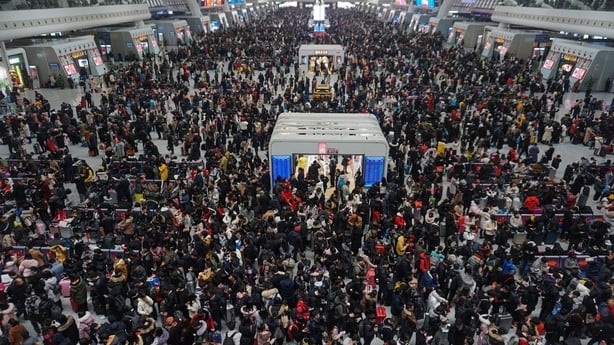
Beijing has reported new Covid-19 cases for 11 consecutive days and nationwide case numbers, while tiny by the standards of most Western countries, are at ten-month highs.
Many employees working for state-owned companies or government agencies have been told not to travel without management approval, state media reported.
The Civil Aviation Administration of China (CAAC) said that passengers who bought tickets for flights scheduled from 28 January to 8 March are entitled to full refunds, as the government looks to reduce population flows over Lunar New Year.
Domestic airline capacity had recovered to 2019 levels by the end of last year when there were almost no cases, though ticket prices remained low.
