



European officials have warned against Covid-19 complacency and said measures to control a surge in infections as winter approaches must continue despite hopes that new vaccines can bring the pandemic under control.
This week's announcement by Pfizer of a potentially effective vaccine spurred optimism that an end to months of crisis could be in sight, sending financial markets soaring and fuelling public longing for a nearly normal Christmas.
But health authorities and leaders across Europe urged people to continue complying with restrictions as it became clear that vaccines would not come soon enough for many virus sufferers and shrinking economies.
"It would be irresponsible to soften the lockdown now," French Prime Minister Jean Castex told a news conference, warning that, despite signs of a slowdown in infections, gains were fragile. France has the highest number of cases in Europe.
"The pressure on our hospitals has intensified enormously," Mr Castex said, adding that lockdown measures imposed at the end of October would continue until at least 1 December.
Pfizer and its German partner BioNTech will only be able to produce enough vaccine this year to treat 25 million people, if approval is secured - not nearly enough to ease the winter strain on health systems.
Covid-19 has claimed more than 1.2 million lives worldwide since it first emerged in China late last year, according to the latest tally by the AFP news agency.
In Italy, which reported 636 deaths and 37,978 cases today, and in Germany, which has also seen infections climb back to levels seen earlier in the crisis, officials said any return to normal would take time.
"We really must grit our teeth for a couple more months," said Lothar Wieler, head of Germany's Robert Koch Institute for infectious diseases.

Greece has reported 3,316 new infections, its highest daily tally since its first cases surfaced in February, according to official data.
The latest jump in infections brings the total number of cases in the country to 66,637.
It also registered 50 deaths, taking the number of fatalities to 959.
A resurgence in cases since early October has forced Greece to reimpose a nationwide lockdown until the end of this month.
UK records highest daily total of Covid-19 cases
The UK has reported 33,470 new cases of Covid-19, its highest daily total to date, as the government struggles to control a second wave of infections going into the winter.
The figure recorded yesterday was 22,950.
A further 563 people have died within 28 days of testing positive for Covid-19, bringing the total to 50,928.
The UK death toll is higher than the other worst-affected countries in Europe and the number of people killed by coronavirus is only higher in the United States, Brazil, India and Mexico.
Today's data on the number of deaths within 28 days of a positive Covid-19 was not immediately available.
Meanwhile, Covid-19 infections in England rose sharply in October with double the number of cases reported by the end of the month compared to the beginning ahead of the reintroduction of the lockdown, a large study led by Imperial College London has said.
It shows that over one in 80 people were infected after more than 160,000 people were tested between 16 October and 2 November, double that reported in early October.
The head of the World Health Organization, Tedros Adhanom Ghebreyesus, said countries should not pin all their hopes on rapid vaccination.
"We may be tired of Covid-19 but it is not tired of us," he told the Paris Peace Forum, an annual event focused this year on fostering global cooperation to beat the pandemic.
"European countries are struggling, but the virus has not changed significantly, nor the measures to stop it."
US hospitals again under pressure as Covid cases rise
After several weeks of rapidly rising coronavirus cases, hospitals around the United States are once again overwhelmed, forcing local authorities to take new measures to cope with the pandemic.
A record 65,368 people were in hospitals with Covid-19 across the country yesterday, marking the second day in a row and second time ever that the tally passed the 60,000 mark, according to the Covid Tracking Project.
Around the country officials were scrambling to stop the spread.
The mayor of Chicago, the third biggest city in the US, has announced a new stay-at-home advisory that will be effective from 16 November.
"I'm issuing a Stay-at-Home Advisory asking all Chicagoans to only leave their homes for essential needs, including work and school," Lori Lightfoot said.
In New York state, Governor Andrew Cuomo announced that any establishment with a liquor license, including bars and restaurants, would have to close at 10pm beginning tomorrow. The rule will also apply to gyms.
New York City was the early epicentre of the nation's coronavirus pandemic, but hotspots have since popped up across the country, leaving practically no geographical region unaffected.
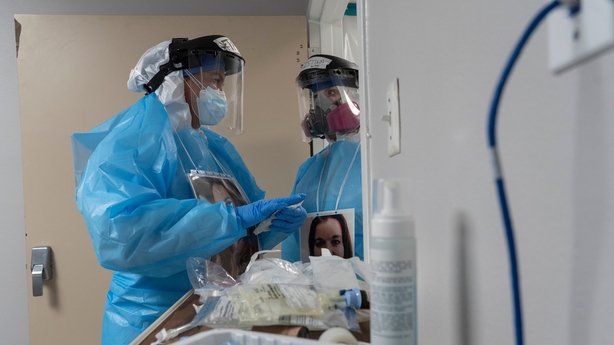
One such locale is the border city of El Paso in western Texas, a state where coronavirus cases have now exceeded one million.
More than 1,000 people are hospitalised in the county of El Paso alone, a substantial portion of the state's nearly 6,800 hospitalisations.
Cases are so high that Texas Governor Greg Abbott has requested a military medical centre be converted for intake of non-Covid patients in order to free up space in hospitals. County officials, meanwhile, have requested additional mobile morgues.
The situation in El Paso is typical of the difficulties local governments are facing in the United States, where President Donald Trump has downplayed the epidemic and left handling of the health crisis to state, county and city officials.
In North and South Dakota, more than one in 2,000 residents is currently hospitalised with Covid-19, according to the Covid Tracking Project.
North Dakota Governor Doug Burgum this week authorised health workers who test positive to continue working in coronavirus units in order to cope with the "enormous pressure" on the state healthcare system.
