


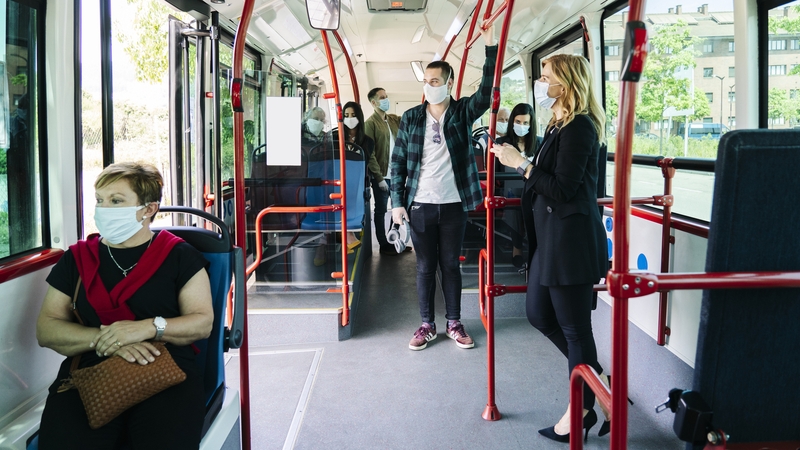
A row has erupted after the Spanish government announced that the entire city of Madrid is to be put under a partial lockdown as it steps up measures to fight the coronavirus.
Madrid's regional government reacted furiously to the new restrictions that affect mobility and gatherings, setting the scene for a political battle which could be dragged into the courts.
"The situation in Madrid is complex and worrying," Spanish Health Minister Salvador Illa told reporters, saying that of 11,016 new cases diagnosed in Spain over the past 24 hours, nearly 44% were in the Madrid region.
"That's why we have agreed to adopt these measures but we're aware that hard weeks lie ahead."
He was speaking after talks with Spain's 17 autonomous regions who are responsible for public healthcare and managing the pandemic.
Spain is struggling with the highest number of new cases within the European Union with a rate of around 300 per 100,000 inhabitants.
In the Madrid region, the rate stands at more than 780 per 100,000.
The announcement of the partial lockdown sparked a backlash from Madrid's top health official Enrique Ruiz Escudero who suggested the region could fight it through the courts.
"This is not legally enforceable," he said, insisting the situation was "stable" and accusing the central government of pedalling "a message of alarm and agitation".
Spanish Prime Minister Pedro Sanchez's left-wing administration has been locked in a standoff with Madrid's right-wing administration over its management of the crisis.
If the measures are published in the official government bulletin, as they plan to be, Madrid's regional government "would assess what kind of decisions were necessary," Mr Ruiz Escudero said.
After the talks with regional leaders, Mr Illa said they had agreed "by a broad majority" to impose restrictions in all areas with more than 100,000 residents within their jurisdiction if three conditions were met.
The region must have reported more than 500 cases per 100,000 inhabitants over the previous 14 days; it must have 35% or more intensive care beds occupied by Covid-19 patients, and positive results in at least 10% of PCR tests.
In the affected areas, there will be restrictions on mobility, all bars and restaurants will be forced to limit their opening hours and seating capacity, while social gatherings will be reduced to just six people.
Madrid is currently the only region with areas that meet all three criteria - including parts of the capital, which has three million residents.
The greater Madrid region has 6.6 million residents and so far, the authorities have imposed a partial lockdown on just over one million of them, mostly in poorer areas south of the city.
There, people cannot leave their neighbourhood except for work, school or medical reasons.
But they are not confined to their homes and can circulate freely in their own district although parks are closed and bars and restaurants can only operate with limited opening hours and seating capacity.
It is not immediately clear how the new mobility restrictions will work, with details to be published in the official government bulletin in the coming days.
Spain is fighting a second wave of the virus, which has killed more than 31,000 people and infected close to 760,000 in what is the highest infection rate within the EU.
Italy considers extending emergency until 31 January - reports
Italy is considering extending until 31 January next its state of emergency over the Covid-19 crisis, two national newspapers have said.
The emergency, set to expire the middle of this month, gives the central government greater powers.
The Dailies Il Messagero and Corriere della Sera newspapers said a cabinet meeting discussed the issue last night.
Czech, Slovak state of emergency
The Czech and Slovak governments have declare a state of emergency from 5 and 1 October respectively, as infections grow in both countries.
Prague will ban fans from stadiums and place strict attendance limits on indoor and outdoor events for two weeks, while in Slovakia a mask-wearing requirement will be imposed outside unless a safe distance can be observed.
India's infections rise to 6.31 million
India's coronavirus case tally has increased by 86,821 in the last 24 hours to 6.31 million, data from the health ministry showed, as the country eased more restrictions to combat the economic hit from the pandemic.
Deaths from Covid-19 rose by 1,181 to 98,678, the ministry said.
Millions on the move as China eyes holiday bounce
Hundreds of millions of people in China are enjoying their first major national holiday since the country tackled its coronavirus outbreak, filling airports and train stations.
The Golden Week holiday marks the founding of the People's Republic of China in 1949 and sees an annual movement of people trying to get home or take holidays.
South Africa reopens borders
South Africa is reopening its borders to all African countries from today while barring tourists from around 50 nations with high infection rates, including the UK, France, India, Russia and the United States.
The continent's most industrialised economy shut its borders at the start of a strict nationwide lockdown on 27 March to limit the spread of the virus.
Additional reporting Reuters
