


The chairman of the Private Hospitals Association has said the time frame of the public/private hospital partnership is "not totally open ended" but private hospitals will play their part as required.
Speaking on RTÉ's Today with Sean O'Rourke, Dr Josh Keaveny said the initial agreement is for three months with an option for the Health Service Executive to add an additional two months, and then after that it is negotiable.
"The Government feels that by five months, the hope is that we'll have passed crisis stage", Dr Keaveny said.
"But we've been quite clear with the Government that if the pandemic remains a serious problem, we will continue in the partnership".
He said that considering the number of hospitals involved and the scale of the issue, he feels negotiations went "quite quickly".
The cost will be assessed on the costs of running hospitals and of things like disposables, he said, and a formula has been worked out between the Private Hospitals Association and the HSE.
He added that they do not know what the partnership will cost the taxpayer because they do not know how long this will go on for.
All patients will be admitted as public patients, he said, and there will be "no money changing hands" within private hospitals.
He also said it is "absolutely crucial" that the private sector continues to function.
Read:
More coronavirus stories
"And that we can treat the patients who require either rehabilitation or step down treatment. There's a huge number of people who will require ongoing treatment that's non-covid and the private hospitals would hope to do that", Dr Keavney added.
Social distancing 'will not be enough' to contain Covid-19
The public has been warned that the adherence to social restrictions by the public will not be enough to contain the spread of Covid-19.
The chair of the Irish Epidemiological Modelling Advisory Group has said the growth rate of Covid-19 cases has fallen to around 15%.
This, Professor Philip Nolan said, is a testament to the way the public have undertaken social restrictions, but he warned this will not be enough to contain the spread of the disease.
The specific circumstances include travel to and from work for essential work that cannot be done from home; to shop for food, household goods or collect a meal; to attend medical appointments, collect medicines and other health products.
Other exemptions include farming, the care of animals and leaving home for vital family reasons such as providing care for the elderly or vulnerable.
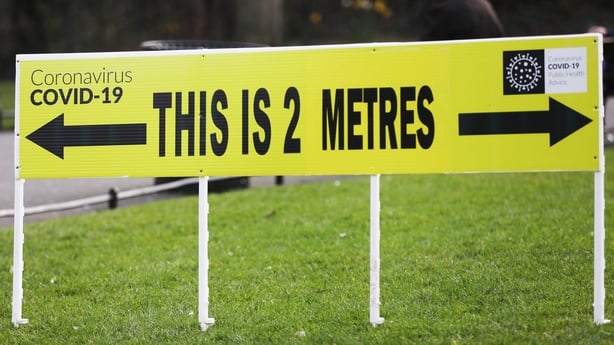
People can leave their home for brief physical exercise, but only within 2km of their home. People must also adhere to physical distancing during this time.
Prof Nolan, a member of the National Public Health Emergency Team, said we do not yet know what the impact of further restrictions that began last Friday will be.
It will not be until the end of next week, he said, before the impact of those measures will be seen and then we will know, with a greater level of certainty, what we should do next.
Prof Nolan said we "genuinely do not know" when the virus will be at its peak and the objective is to slow the virus so much that the peak occurs very late and is very low.
He added that we will be living with this virus for "quite some period of time" and we must adapt how we live and operate to account for the fact that the virus is there "at low level in our community".
Speaking on RTÉ's Morning Ireland he said that how the disease behaves over the next number of months remains to be seen.
Concern as people delay attending EDs for non-virus related issues
Meanwhile, a consultant in emergency medicine has said we need to ensure that people who are cocooning do not think they cannot go to hospital for other medical conditions.
Dr Fergal Hickey from Sligo University Hospital said they are seeing a delay in people who are experiencing stroke or heart attack symptoms coming to hospital.
Speaking on the same programme, he said: "We are seeing people turning up the following day, when the time window for treatment is only a matter of hours.
"We need to be very careful with our advice on cocooning that we don't give the impression that if you have a medical emergency, you're not to do anything about it.
"The opposite is the case. If you have a medical emergency, treat it as a normal medical emergency".
Dr Hickey said all emergency departments are currently operating as streaming systems, meaning patients being treated for Covid-19 are being separated from those who are there for other reasons.
He acknowledged that many people may avoid hospitals due to a fear of dying alone, but said the strict visiting rules are there to protect the public.
"We cannot have visitors in emergency departments or hospitals in general except for end of life care, and even under very restricted circumstance", he said.
"It's bad enough for a person to die but if they ended up being the vector of transmission that affected, infected or killed other people, nobody would want that.
"So I think people need to understand that the visiting rules are there for very good reasons".
Dr Hickey said we are succeeding in what we are trying to do as a society, but there is a price to be paid for that - and that price is cocooning and social isolation.
There have been 54 deaths linked to Covid-19 in the country, with 2,910 confirmed cases of the virus.
Around 80% of cases of Covid-19 will be a mild to moderate illness, close to 14% have severe disease and around 6% are critical.
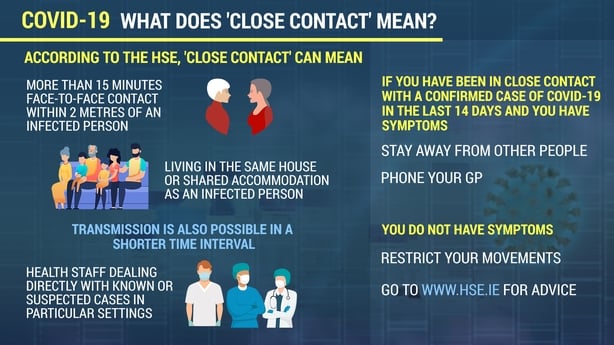
Generally, you need to be 15 minutes or more in the vicinity of an infected person, within 1-2 metres, to be considered at-risk or a close contact.
But there are higher risk settings, where transmission is possible in a shorter time interval, where health staff are dealing directly with known or suspected cases in particular settings and may need personal protective equipment.
