
The Taoiseach has described the Great Famine as the most traumatic event in Ireland's recorded history.
Micheál Martin said nowhere suffered greater mortality than Connacht with the loss of nearly half a million people.
He was speaking at the 19th National Famine Commemoration in Portumna, Co Galway.
This is the first time the State Commemoration has taken place in Galway.
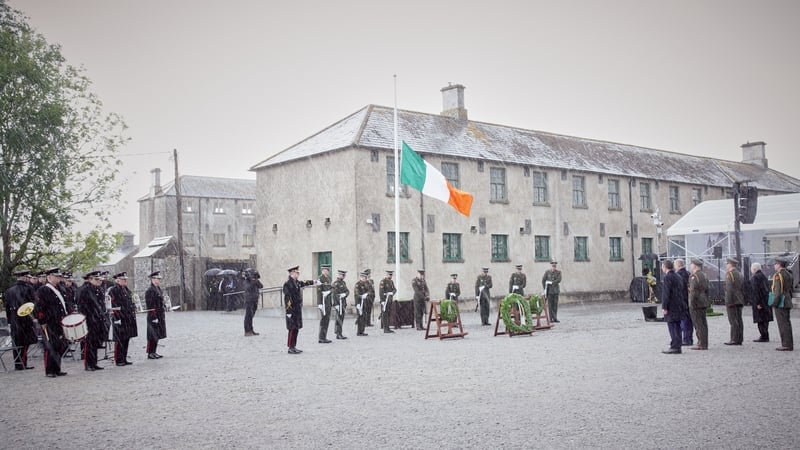
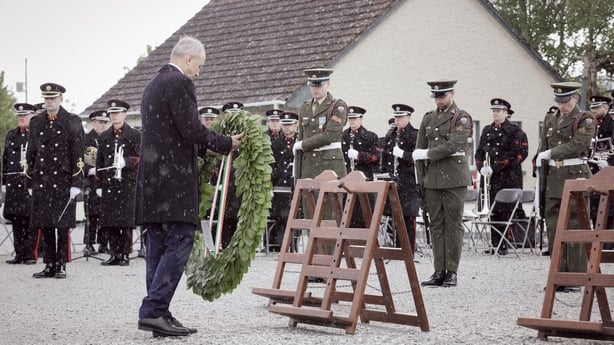
Hundreds of people attended the wreath laying ceremony and military honours on the site of the old Portumna workhouse and graveyard.
In his keynote address, the Taoiseach said that by the end of 1846, all workhouses in Galway were full, squalid and perfect sites for diseases like cholera and typhus.
"Its destructive intensity brought a scale of death and dispossession which is almost impossible to comprehend. After the worst was over nothing would ever be the same again.
"We became a nation where emigration touched every family. To be Irish now meant to have deep connections thousands of miles away.
"A relentless determination not to face the same helplessness became a defining Irish characteristic. It was not just politically radicalising; it changed the very fabric of our society and identity.
"So, it is important that we take time to gather and to reflect - to solemnly remember and to seek understanding."
The Taoiseach said that when people look at the modern world, there is no such thing as an unavoidable famine. At all times and in every circumstance, they result from the action and inaction of others. He said places like Sudan and Gaza are seeing mass hunger because of conflict and disregard for basic humanitarian values.
"We take all these lives, each a tragedy in its own way, and hold them in our hearts. We take lessons from them and in their lessons and in their memory, they live a little again within the Irish of today.
"We remember when the world saw our Famine and responded with relief, and so we as a nation see the same hunger and suffering in other countries, we too respond with help, with aid, with comfort," Mr Martin said.
The event was hosted by Minister for Culture Patrick O'Donovan.
He thanked the team of the Irish Workhouse Centre and "the people of Portumna who have opened their town to us to facilitate this opportunity to remember".
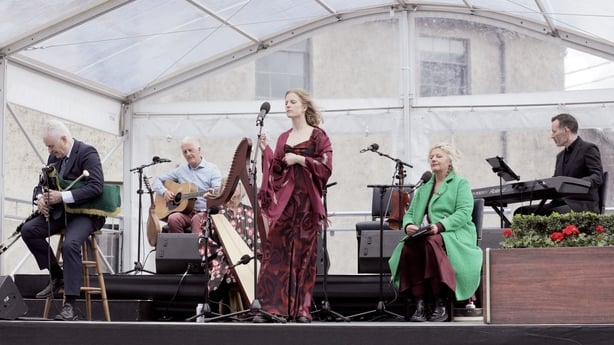
Cathaoirleach of the County of Galway, Councillor David Collins, introduced community and creative performances. They included The Famine Song written by Johnny McEvoy and sung by Cathal Sweeney.
A new composition called The Workhouse Lament was written and performed by Ger Fahy.
The poem, Na Fataí Bána (The White Potatoes) written in 1846 by Peatsaí Ó Callanáin, was recited by 85 year old Pádraig O'Conghaile. It is a haunting Irish language lament by a small tenant farmer from Athenry.
Róisín Mannion sang Crucán na bPáiste (the burial place of the children) by Brendan Graham.
Following prayers for the victims of the Famine, led by Chaplain to the Defence Forces Fr Paschal Hanrahan, the Taoiseach unveiled a commemorative plaque and children from 5th class at St Brendan's National School in Portumna assisted in the planting of a native Irish oak tree to mark the occasion.
There was a solemn laying of wreaths followed by a minute of silence before the playing of Piper's Lament and Last Post.
The national flag was then raised to full mast and the ceremony concluded with the national anthem.