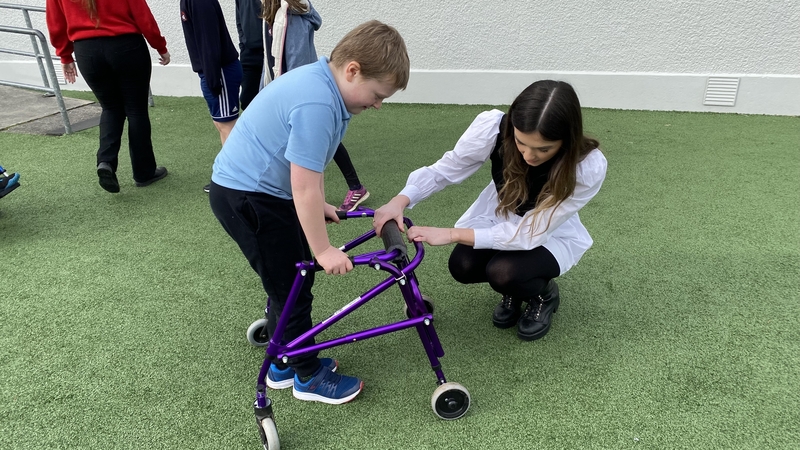

A programme designed to break down barriers and demystify mobility equipment for children with special needs is running at the Claddagh National School in Galway.
It is the first of its kind in the country and focuses on what pupils can achieve together despite their differences
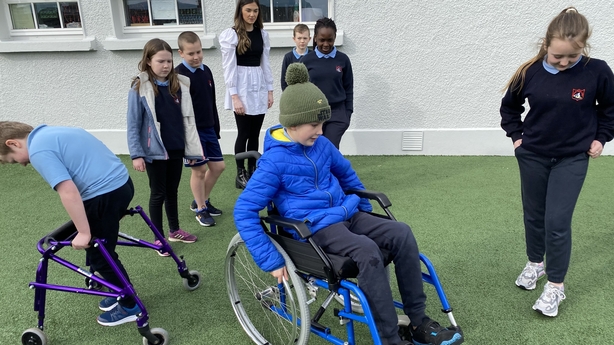
A team of occupational therapy students from NUI Galway have brought in wheelchairs and walkers to fourth class pupils at the school.
The ability awareness workshops are being run over seven weeks with the focus on inclusiveness and what can be done together. It is a can-do approach moving away from labels and diagnoses.
We need your consent to load this rte-player contentWe use rte-player to manage extra content that can set cookies on your device and collect data about your activity. Please review their details and accept them to load the content.Manage Preferences
Emer Healy is one of the occupational therapists taking part in the NUI Galway programme.
"Over the past academic year, myself and three other students have been coming into this school and showing children that it's not so important how we do things but rather that we can do them.
"We're trying to show the students that there are so many ways of doing things. We compare it to people wearing glasses. They are using them to see better. It's the same with people using wheelchairs, walkers, hearing aids. They are enabling them to do the things they want to do every day. Everyone has their differences but we can still do things the same as others," she added.
"It's all about inclusion and everybody being able to do things together. We're aiming to equip children with strategies so they feel confident enough to include children with different needs in their games and conversations."
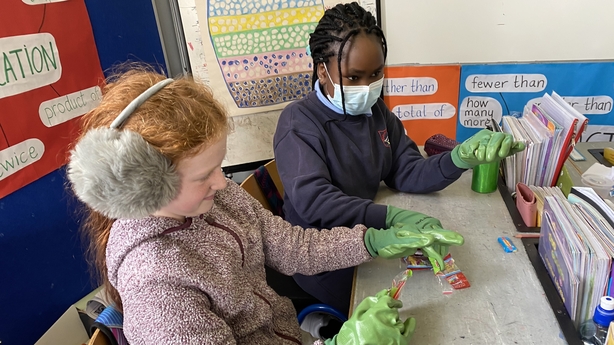
Sensory differences were also explored. Pupils wore gardening gloves to open sweet wrappers as a way of learning about DCD - a condition that affects motor skills and coordination.
Understanding the condition means children can help their pals with physical tasks and activities.
The students also show how there are many ways of saying the same thing and another strand of the course is an introduction to sign language.
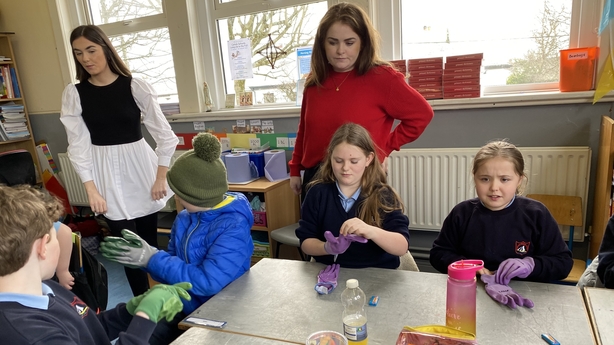
Teacher Aimee Ríordan said it has been a privilege to have the NUIG students in the school.
"At any age this programme would be useful, but I'd love to see it rolled out from an early age in schools everywhere. It's very much a holistic approach to looking at disability. The focus was on all of us not being so different as we look. We are all the same. Everyone can do the same thing, just in a different way," she added.
There are many ways of saying the same thing and pupils got their first introduction to sign language
Dr Hazel Killeen at NUI Galway is the overall co-ordinator of the programme.
"It's not about making a list of all the things a child can't do. It's acknowledging limitations but the focus is very much on what they can do," she explained.
"The programme emphasises the strengths of all children and they learn about difference within the context of what they all have in common. It's about inclusive play with a move away from labels and diagnoses. There's no particular way that anything has to be done. The children can explore ways of doing things that suits them and they get the job done.
"Children are so curious in the first years of life. They ask questions along the lines of why is that boy using something to walk with...they're so curious...and I guess we have to be able to answer those questions. If those questions aren't answered they stop asking and that hardens into social barriers when they're older."
The project will be rolled out to seven schools in the Galway area in September and it is hoped that in time, it will be introduced to schools nationwide.