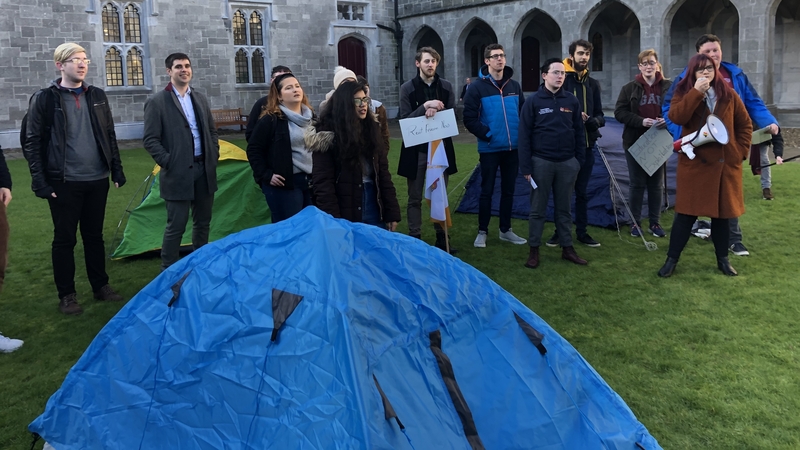

Students at universities around the country have been protesting today against rent increases planned for on-campus accommodation.
At UCD and NUIG students erected tents in prominent locations to highlight their opposition to the move.
A similar protest has been ongoing at UCC since Tuesday.
Students at Trinity College blocked the main entrance to the university at lunchtime over fears that TCD will also move to increase student accommodation costs.
UCD has decided to increase rents for students by 4% every year for the next three years. UCD and the other three universities affected are all located in Rent Pressure Zones which means that 4% is the maximum annual increase allowed under legislation.
The Students Union at UCD, which has organised today's action, says that on-campus rents have increased by 76% over the past decade.
Calling for a reversal of the latest decision to increase rents by a further 12% over three years it says young people are being locked out of access to higher education as a result of high costs. It says the university is only catering for affluent students and is ignoring the student voice on the issue.
However, UCD says the increases are necessary to fund additional and badly needed student accommodation that is currently under construction.
The college currently provides places for 4,000 students, most of whom live on-campus. An additional 1,000 places will come on stream next year.
Students currently pay up to €11,600 in rent for the 9 month academic year.
UCD says the average rent paid by students for college accommodation is lower, at €7,500.
At NUIG, where rents will also increase by 4%, dozens of students are involved in a 24-hour 'tent' protest.
President of the Students Union there, Clare Austick, said the cost of rent on campus at NUIG was currently around €750 a month.
Students say the 4% hike will place an intolerable burden on those already struggling with the cost of living while studying in third-level education.
We need your consent to load this rte-player contentWe use rte-player to manage extra content that can set cookies on your device and collect data about your activity. Please review their details and accept them to load the content.Manage Preferences
At today's protest students spoke of being forced to sleep on friends' sofas because they cannot afford somewhere to live.
At both NUIG and UCD others spoke of long commutes to college every day. UCD student Eoin Fagan told RTÉ News that he spent up to four hours daily travelling to and from college from his family home in north county Dublin, because he cannot afford to rent.
NUIG will hold a meeting in the coming weeks to discuss the situation.
Students at UCC began their 'tent protest’ earlier this week. They have pledged to remain camped on the UCC Quad, day and night, until UCC reverses its decision to increase rent at its five accommodation blocks by 3%.
The UCC students’ union says that more than 50 students are involved in the protest on a rotational basis.
They say more than 300 staff at the college have added their names to a letter from students to UCC President Patrick O'Shea urging him to meet the demands of the Students' Union.
Students at Trinity College meanwhile blocked the front entrance of the university over lunchtime over fears they have that that college too will increase rents by 4% for the coming academic year.
A college spokesperson said that there were no plans "at present" to increase on campus rents.
The spokesperson went on to say that "at some stage an increase of some sort is likely to be considered, but it is too early to say what that would be or when it will be discussed".
TCD students fear that an increase will be decided on at the college’s May finance committee meeting, which takes place at a time when many students have finished up for the year and are therefore not around to protest.