

For a time, the tech term 'wearable' was largely referring to smart watches and fitness trackers.
These were the devices that you could strap onto your wrist to monitor the likes of your movement, workouts and sleep – while most would also feed you notifications from your phone.
But in a short space of time, the wearable market has exploded into a whole universe of different products.
There are smart rings that can monitor your vitals and movement. There are continuous glucose monitors (adapted from what some people with diabetes use to monitor their blood sugars) that track your energy intake through the day. There are smart glasses like the Meta Ray Bans which use cameras to "see" what’s around you. There are AI smart pins that can clip onto your clothes, ready for your questions and commands.
Many Bluetooth headphones are now classed as ‘wearables’ because of how much more they do beyond playing music – like handling relaying information and tracking your activity.
If you’re so inclined, you can even spend $600 on smart socks that, apparently, track your stride and how your foot lands when you run.
Well-worn tech
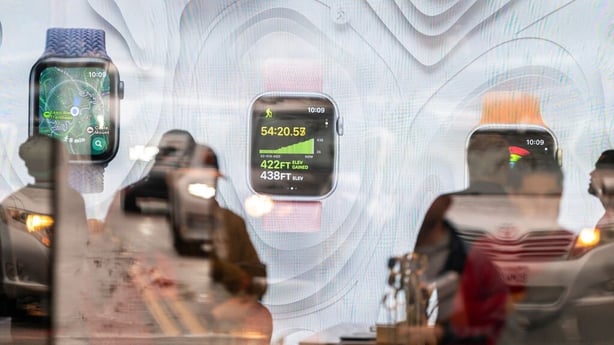
This explosion in wearables options, unsurprisingly, comes alongside a boom in sales in the category.
It’s always hard to pin down a figure like this – and it depends in part on how broad of a definition you want to give to the term ‘wearable’ – but numerous projections put the value of sales anywhere between $100 billion and $200 billion this year alone.
When you look at specific companies, that seems entirely plausible.
Last year Apple’s wearables division alone had sales of more than $36.5 billion (that would cover the Apple Watch and its AirPods headphones, though it would also cover a handful of other products like its smart speaker and some accessories).
In revenue terms, wearables are now bigger for Apple than iPads and Macs.
It’s of growing importance to Meta too – they sold seven million Meta Ray Bans last year, up from the two million sold in 2024.
At around €500 a pop, that would represent €3.5 billion in sales.
And Meta are clearly seeing this as an area of growth for them – given how hard they are pushing content filmed on their glasses on the likes of Facebook and Instagram.
However you measure it, though, it is clearly a rapidly growing market.
One projection suggests the market will be worth more than €500 billion by 2035 – and that’s in part because a lot of companies, like Samsung, Google, Meta and Apple, are pushing out more and more products in this area.
Meta recently unveiled some new models of smart glasses, while Google has announced it was also going to make smart glasses again – having tried and failed with a similar product more than a decade ago.
Apple is also rumoured to be working on a pair of its own – which could be officially announced as soon as September.
Private eyes
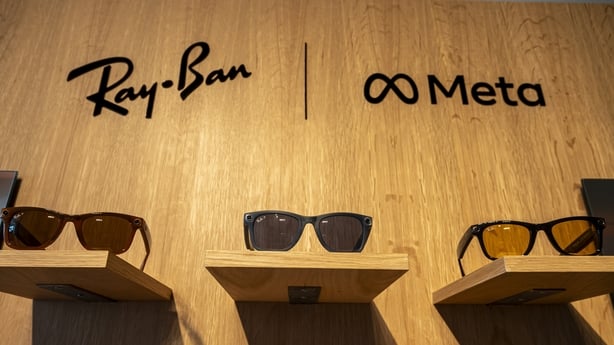
But that means the privacy issues created by this kind of technology – which is already concerning many – is only likely to grow.
Of course it has long been possible for people to covertly record others – especially since the creation of the video phone and the smartphone. But these kinds of devices make it even easier.
Because the technology involved has gotten so small that it can fit into what look pretty much like regular glasses frames – and, at a glance, it’s very hard to distinguish smart glasses from regular glasses.
In the case of the likes of the Meta Ray Bans, they have an LED that comes on when something is being recorded – and they say the camera stops functioning if you try to cover that light up.
But, even still, that’s not necessarily going to be easy to spot in the moment – even if you’re quite close to the person recording. And depending on the situation and light conditions – like the kind of sunny day we’ve been enjoying recently – a small LED is not going to stand out.
And you can see that reality in the content that is now filtering online – especially on Meta’s platforms. It is clear that, often, the people who are appearing in the videos don’t know that they’re being recorded.
In recent months many women have spoken about cases where they were approached on the beach or in the gym by a man asking for their number – and they only found out weeks later that it was all being filmed when they stumbled across the video online.
There are some content creators who are doing this kind of thing on a systematic basis.
Meanwhile there are others who are building an audience by posting videos where they trying to provoke or prank unwitting members of the public to get a reaction, which they film on their smart glasses and publish online.
It means that people are unwittingly having videos of them – often reacting in a way that doesn’t paint them in the best light - shared with the world for someone else’s financial benefit.
Law less
What many of those people are also discovering is that, legally, there’s no an awful lot they can do about it.
There’s no legal requirement to get someone’s consent to film them when they’re in a public place – or even to inform them that they’re doing so.
Essentially you have no legal right to privacy when you are in public.
That’s not an absolute right – there are limits and grey areas involved. For example, if someone is persistently filming or photographing you, that could potentially tip over into harassment – which is illegal.
If they’re using your image for commercial gain – which ultimately some of these content creators are – that could create an issue too. There could even be a GDPR implication if there’s a commercial entity involved.
And then there are other considerations when it comes to private property – like a shop or a pub.
Again, legally you probably don’t have a reasonable expectation of privacy when you’re in a place like that. But the owner could have a policy that forbids recording, and they could ask a person to leave their premises if they’re in breach of that.
Overall, though, there’s a relatively high bar to pass before anything could be done to stop people covertly using their smart glasses when out and about.
In the case of Meta, its guidelines do ask users to make it clear to people when they are recording – and not to record in private spaces like changing rooms or toilets.
However that policy puts the onus on the user – and there’s no suggestion that a user would be punished, or have the technology limited in any way, if they were found to be in breach of those guidelines.
It is worth bearing in mind, though, that while most of the focus around people’s privacy has been focused on smart glasses – and, understandably, Meta’s smart glasses, many other wearables are creating the same kinds of issues.
Other companies are also selling smart glasses, while those AI pins often feature a camera too.
There are even reports that Apple is working on earbuds that have cameras built-in – although it’s not clear if they’ll be cameras to record what’s in front of you, or infrared cameras that monitor a user’s pulse or blood oxygen.
Through the looking glass
But these privacy concerns are not entirely about the people who unknowingly find themselves in front of a pair of someone’s smart glasses.
Because the users of these glasses are at risk of giving away more than they realise – even if they’re being careful about what they record and share with these devices.
The videos they record – even the ones they keep to themselves - are backed up to the cloud. That means they go to a server in a data centre (or, more likely, servers in multiple data centres around the world).
And there’s a chance there’s a person somewhere in the world who’s looking over that.
Earlier this year Swedish newspapers Svenska Dagbladet and Göteborgs-Posten published a report into Kenyan firm Sama, which was a contractor for Meta.
Its staff were tasked with reviewing some videos recorded on Meta Ray Bans to help train Meta’s AI.
But some workers there complained about some of the content they were required to sift through as part of that job. That included seeing people’s sensitive information like their bank details, but also videos featuring users’ naked partners, people using the toilet, or some having sex.
And again, these weren’t necessarily videos they had shared or publicised themselves.
Even if all of the people involved were fully aware that this was being recorded – and had consented to that – they probably hadn’t realised they were consenting to someone else being able to watch that too.
Meta says it does have systems to anonymise these videos before they go to moderators – like blurring faces - though workers at the moderation company said that doesn’t always work.
(By the way – that company has since lost its contract with Meta – though Meta says that has nothing to do with the complaints employees made about what they were seeing.)
Worn out

But even besides the camera, there are other potential privacy issues for users.
After all a wearable is just another device that’s gathering information about you – and they’re generally laden with sensors beyond the cameras at the front.
They might have things like heart rate sensors, body temperature sensors, or GPS built-in. And all of that can be very informative – especially when it’s put together.
Someone who had access to that kind of information would not only be able to see your movements and get a good idea of your work and social activities – but they’d probably be able to learn a lot about your health, your level of fitness and maybe even more personal things around your cycle.
At the very least, that could impact the kinds of ads that could be targeted at you – that’s assuming the information is not put to even more concerning uses.
So anyone buying a wearable of any kind should take the time to see what kind of data the device is gathering – and then who has access to that.
And that isn’t necessarily just the device-maker; depending on the permissions on the device and on your phone – which generally acts as a conduit for a wearable - there could be other apps tapping into all of that information as well.
And while this isn’t a privacy issue, there are other ways that wearables can weigh on a user.
People who are trying to keep a better track of their activity levels, wellness or fitness can suffer from data anxiety – where they become too focused on meeting goals and targets. Or else they end user suffers from a feeling of shame when their wearable tells them they were less active today than they should have been.
And there’s a danger even from the likes of the notifications too.
Often wearables are sold as a way of getting you away from having your head buried in your phone, but you may just be replacing one device with another – one that has an easier-to-access screen that’s constantly pinging you with information.
That can impact your ability to focus and even contribute to you becoming distracted – which could be detrimental and potentially even dangerous.
A good look

All that being said, there are potentially positive applications for much of this technology.
While for many people wearables like AI pins and smart glasses are a nice-to-have or a novelty, there are some people for whom this kind of technology is a game changer.
One of the most obvious examples of that are people who are blind or visually impaired.
Here’s a device that they can wear which can subtly interpret what’s around them and make that accessible to them. That might be as simple as the AI reading a message or road-sign to the user, or helping them to better make their way around an unfamiliar location independently.
And there are plenty of non-creepy applications for people – like being able to live translate something that’s in front of you, or getting contextual information about what’s around you. Or simply getting directions without you having to walk around staring at your phone.
Even the camera itself has some wholesome applications. For example, the idea of being able to record a nice moment with your child or a loved one, without having to have a physical camera or smartphone sitting between you and them.
Unfortunately, though, it’s hard to make that kind of use case possible without leaving the door open to the less desirable ones.