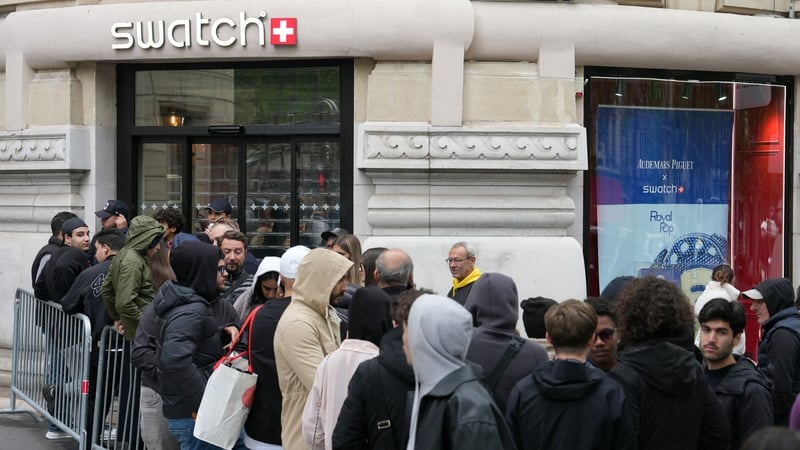

This day last week thousands of people in cities around the world – including Dublin – lined up to get their hands on a highly-coveted item.
Some had camped for days to try to secure prime positions in the queues – though in many cases even they would have left empty-handed.
In a handful of locations, the hype and frustration spilled over into fighting.
All of this was the result of a collaboration between two Swiss watch brands. Swatch; which people will know for their relatively cheap, high-colour time-pieces; and Audemars Piguet; which are known for extremely expensive, high-end watches.
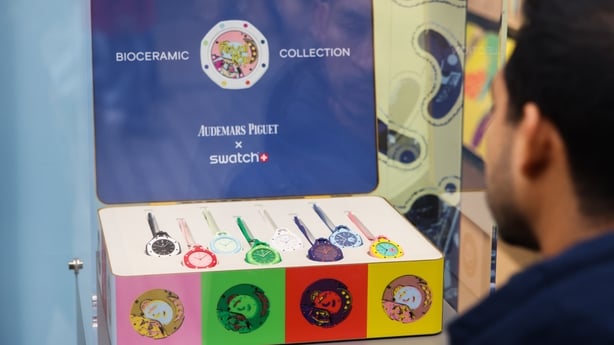
They have launched a collection of eight different pocket watch-style items called the 'Royal Pop' collection, a combination of Swatch’s Pop Art-style watches and AP’s iconic Royal Oak line.
Each one was priced at between €385 and €400 - expensive for a Swatch, but very cheap for an AP. And they were made available in 220 Swatch shops around the world – including its one on Grafton Street in Dublin - on Saturday last.
Demand was so strong that most shops sold out almost immediately. Some had to close their doors due to the crowds outside getting out of hand (though Swatch told BBC News that there had only been issues in 20 of the 220 stores that sold the watches over the weekend).
Why are so many people keen to spend €400 on a Swatch watch?
It’s impossible to know the exact ratio, but at least some of those queuing were more interested in making a profit than owning the watch.
In the hours and days after the watches first went on sale, sites like eBay and Vinted were full of Royal Pop watches for sale – generally at twice to three times their retail price.
Some news agencies even reported that successful buyers were being offered twice the price for the watch as they left the shop.
But it’s just as clear that many of those queuing wanted to spend their money to actually own the thing.
Some of those may have been under the impression that it was a limited edition item – as these kinds of cross-brand collabs tend to be.
However the marketing material does not specify that this is in the case. In fact, Swatch’s own website says the collection will remain available for ‘several months’. That means there’s a very good chance that anyone who wants a Royal Pop watch will be able to get one at face value, even if they didn’t get it on day one.
But many others won’t care how rare or otherwise the watch is – they want it because it gives them access to what is generally a very elite club.
Because while €400 is expensive for Swatch, it’s extremely cheap for an AP watch.
Their watches tend to sell for thousands or – more often than not - tens of thousands of euro each. Some of their watches have been resold for millions of euro.
So this is a brand that’s generally out of reach to most consumers – especially younger consumers – meaning this collab offered a chance for them get one of their products for "cheap".
And we’re seeing this kind of thing happen more and more with consumer brands – in what is being called a high-low collab.
This sees a high-end brand or designer partner up with a high street brand or retailer to make something that’s luxury but accessible.
There was another example of this earlier this month, when people queued for hours outside H&M’s shop on College Green in Dublin in order to buy some of the items from their collaboration with Stella McCartney.
Or there’s the collaboration between Uniqlo and JW Anderson – the brand of Derry-born designer Johnathan Anderson, who’s currently the creative director of Dior. JW Anderson items tend to cost hundreds of euro a piece – or in some cases more. But you can currently buy some of their Uniqlo items for around €30.
Can we blame social media for these consumer frenzies?
It’s definitely playing a part in the way these things take shape nowadays.
The Swatch X AP collab was teased online at the start of the month, but with next to no details about what was going to be sold. And they did that knowing that fashion and watch fans would build the hype for them – far better than any carefully-crafted marketing campaign would manage.
They then only released images of the products themselves days before they went on sale.
And of course social media has helped to fuel FOMO and super-charge hype trends. It also gives additional currency in being one of the first to own an exclusive or coveted item. That’s not to mention how digital technology has made it easier for people to resell those same items for a profit.
All that being said, these kinds of consumer frenzies are nothing new – and they certainly pre-date the internet.
Like what?

You could arguably go all the way back to the 1600s for the first record of a consumer frenzy – which was the ‘tulip mania’ phenomenon in The Netherlands in the 1630s.
And as a warning to all of the Royal Pop scalpers – this is also seen by many to be the first example of an investment bubble and stock market crash.
The tulip was first brought to Europe from Asia in the late 1500s, and for a while they were just something that botanists were interested in. But once it was discovered that they tolerated the Dutch climate quite well, they began to be grown in more and more places around the country.
And because they were quite unlike the flowers people were used to seeing in Europe, and had much more vivid colours, they suddenly became highly sought after– and a luxury item among rich Dutch people.
That saw the price that flowers and bulbs were selling at sky-rocket, from around 1634 onwards.
How frenzied did this frenzy get?

There are reports that at the peak of the mania one particular variant – the Semper Augustus, which had striking white and red stripes on the petals – sold for 10,000 guilders. That would have been enough to buy a very nice canal house at the time, and is the equivalent of roughly €140,000 in today’s money.
(By the way, it turns out the Semper Augustus wasn’t really a unique variant of tulip – it was just from a bulb that carried a virus that caused it to split into two colours. Apparently that virus also weakened the bulb and made it less likely to divide into new bulbs, which is why that exact type of tulip no longer exists.)
Of course one of the features of the tulip is that they only bloom for a week or two - so this frenzy developed around something that was essentially unavailable for most of the year.
But rather than cool the market, this simply created a different way for it to be fuelled. People began to buy and sell forward contracts, offering to pay X amount for next year’s crop.
That, in turn, led to a speculative market where those contracts were sold on again and again over the following months, as people proved willing to pay a premium to get their hands on more flowers in the future.
This continued through to early 1637 – so the frenzy grew for around three years – until it collapsed suddenly.
Eventually people weren’t able or willing to spend the crazy prices that tulips had risen to. Struggling to sell on the expensive contracts they’d bought, investors panicked and tried to sell at a discount, which just pushed the price lower.
Quite quickly, the while market collapsed.
Now all of this happened on the fringes of the Dutch economy, so it didn’t really have an impact on the country as a whole.
That being said, a lot of people did ultimately lose a lot of money, as they were caught holding expensive contracts for flowers that weren’t worth anything close to what they paid.
What are some more modern consumer frenzies?
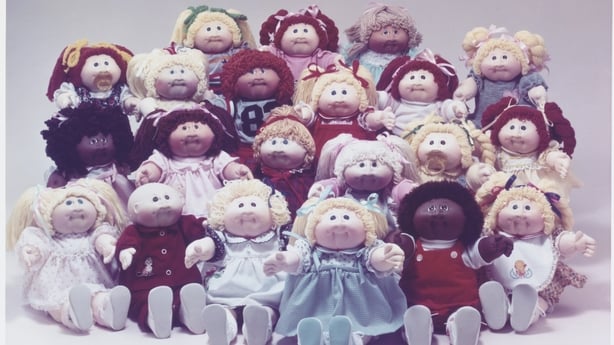
Depending on your vintage, you may remember the Cabbage Patch Dolls, which blew up in popularity in the early 1980s.
The fact that they weren’t made to look like other dolls – or actual human babies – seemed to be part of their appeal. So too was the backstory that the company behind them – Coleco - built around their origin, and the fact that they insisted people were adopting them, rather than buying them.
And the company – and retailers – were caught completely unawares by the resulting demand.
In 1983 riots broke out in many shops in the US as people tried to get their hands on the dolls. There are reports of people breaking limbs and shop-keepers wielding baseball bats amid all of the madness.
Coleco sold 3.3 million dolls in the US in 1983 – it would have been more had they been able to keep up with demand. In 1984 global sales hit 20 million – the company had $2 billion in revenues that year alone.
Though much like the tulips, the company over-extended, over-shipped and the consumer lost interest.
By 1986 sales had fallen to $800m. By 1988, when the company went bust, sales had practically fallen to zero.
It was a slightly different story for Toy Story...

Yes Disney has always been the master of merchandising – but this is one of the few times they got it badly wrong.
It, and a lot of other seasoned toy experts lost out on millions of dollars as a result.
Because back in 1995, Toy Story was seen by many as an interesting experiment more than a potential blockbuster. It was the first feature-length 3D animated movie, and the first feature-length film by this quirky-but-untested studio called Pixar.
As a result, there wasn’t a huge amount of hope for its success. And when Disney went to what was its main toy partner, Mattel, to see if they wanted to make toys for it, they declined.
The contract was then offered to others, including Hasbro, who also passed.
Part of the reluctance was the 3D element. Many worried it would be a repeat of the experience with Tron – which, though today considered a cult classic, was a major flop at the time of its release.
Toy Story’s release date was also sandwiched between two more obvious Disney blockbusters – Pocahontas and Hunchback of Notre Dame – and toy-makers figured they would be the toys kids wanted.
In the end, a small Canadian firm called Thinkway Toys took the contract to make Toy Story toys.
The film came out in late November 1995 – and of course ended up being a smash hit. So much so that Thinkway couldn’t come close to matching demand, and so shops around the US, and ultimately the world, just didn’t have stock to sell.
Again, that led to fights and riots – and people offering four times the sale price for Buzz Lightyear toys.
It was estimated that Disney and Mattel missed out on around $300m in sales because of their mis-step.
Thinkway was of course one of the winners – but even it could have made far more in sales had it been more prepared for demand.
But with a fifth instalment around the corner, it’s safe to say Disney and Co have more than made up for that lost revenue since 1995.
They even made a joke about the toy shortage in Toy Story 2, though in the process they tried to pin the blame the problem on the shops – rather than Disney and the toy-makers.
What about the big kids’ toys?
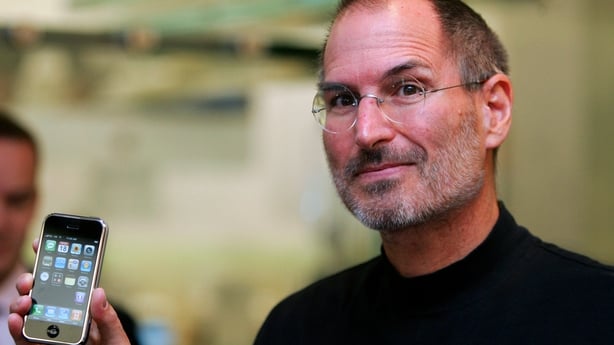
Arguably one of the most hyped products in living memory was the first iPhone.
Unveiled by Steve Jobs in January 2007, it didn’t hit the shelves in the US until late June of the same year.
Part of the reason for the gap was that Apple was trying to keep the device under wraps – because ramping up manufacturing and filing the necessary paperwork before it was unveiled would have led to leaks.
That meant that most European consumers couldn’t officially get their hands on one until the end of 2007 – while here in Ireland it took until March 2008 before it could be bought in shops.
But that long lead-in time did serve to build up huge amounts of anticipation – and many people queued for long periods to pick one up. Many others also quickly turned to eBay to flip the device for a quick profit.
However that particular frenzy did give us one classic, early YouTube moment.
A news report from a queue in Dallas features a woman who, with $100,000 in hand, proudly tells the reporter of her plan to buy as many iPhones as possible which she will then sell at a marked-up price on eBay.
She is then seen offering to buy a place in the queue – eventually giving $800 to Marc*, who’s first in line.
But once she goes into the shop, she is told that they have a strict ‘one device per customer rule’, to help ensure as many people can get a phone on the day.
That means the scalper walks away with, at best, one iPhone to flip on eBay. She’d also needs to sell it for more than a $800 premium in order to make up for the money she spent to skip the queue.
Meanwhile the shop’s policy means that Marc – having sold his prime position – is still able to pick up a phone on the day. At a cost of $500, he’s also able to do so – and stock up on accessories – without spending a cent of his own money.
*This just so happens to be Marc Rebillet – who is now a successful musician and well-known YouTuber.