Forty years after one of the worst disasters in human history, the dark legacy of nuclear energy still looms large.
The Chornobyl explosion of April 26, 1986, left dozens of towns and villages in Ukraine and Belarus deserted and it could take centuries for the soil in the exclusion zone to become fully radiation-free.
The effect on the rest of Europe was chilling, discouraging some nations from adopting or expanding nuclear energy.
However, the energy shocks of the last couple of years and new technology have rekindled the nuclear conversation in Europe.
In March, the European Commission chief called Europe's post-1990s nuclear reduction a "strategic mistake," leaving it dependent on volatile fossil fuel imports.
Ironically, Ursula von der Leyen was a minister in Angela Merkel’s government when Germany decided to fully phase out nuclear power plants.
The country's last nuclear plant shut in 2023.
France took the opposite path, making nuclear the foundation of its energy policy and arguing that its stable and low-carbon nature is key to industrial competitiveness.
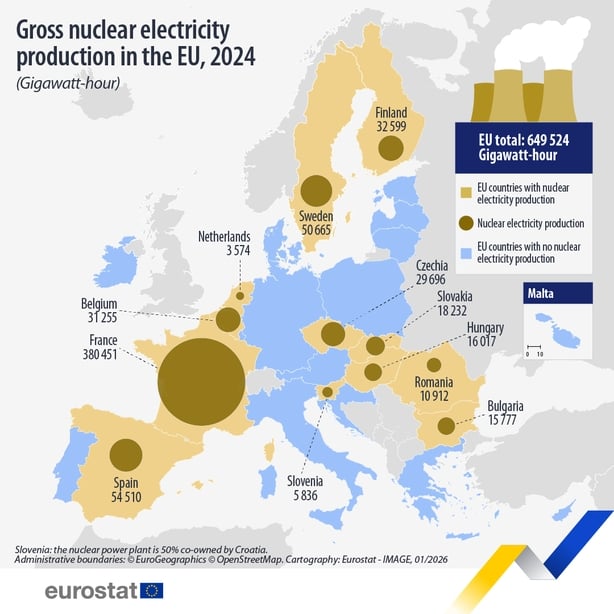
France is Europe's biggest nuclear energy producer, and the technology accounts for two thirds of its energy mix.
Speaking alongside von der Leyen at the Nuclear Energy Summit in March, President Emmanuel Macron said that "technology has evolved" and "lessons have been learned" from the Fukushima disaster in 2011 - "so we can now say that nuclear energy is safe."
Sweden is funding new reactors to replace its 1970s-80s fleet, which supplies one-third of its largely fossil-free electricity.
Oil-market volatility has some countries, including Ireland, tentatively reconsidering past bans.
Earlier this month, Tánaiste Minister Simon Harris said he has "no ideological opposition" to nuclear power. Minister for Public Expenditure Jack Chambers added that Ireland "should have a debate" on it.
Similarly to Ireland, Denmark has a constitutional ban on nuclear power since 1985, but is now considering building small modular nuclear reactors to complement its renewable sources.
New technology
There is a "momentum" around nuclear power, professor in energy economics in the UCD School of Economics Dr Lisa Ryan told RTÉ News.
Beyond the volatile fossil fuel market, there is a wave of optimism driven by new technology.
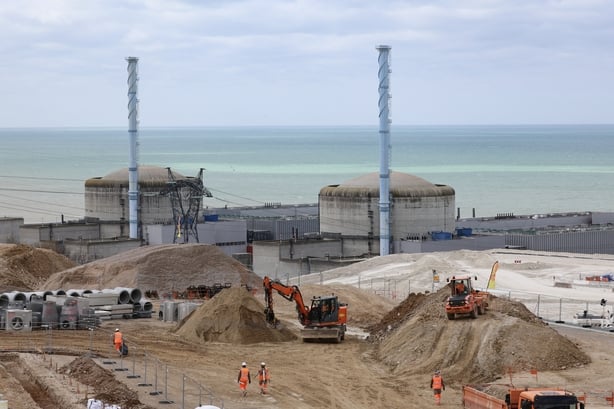
In Normandy, construction is underway on a new generation of reactors called EPR2, with the development expected to cover the entire energy demand of the region.
France’s main distributor Électricité de France said EPR2 reactors are safer, by offering more protection from blackouts with additional generators and greater level of containment with stronger walls.
But it is small modular reactors that are causing most excitement in the sector.
SMRs are nuclear reactors with a capacity of up to 300 megawatts per unit - about one-third the capacity of traditional reactors.
They can be added to a grid where a regular plant would be too big, which could suit Ireland, and demand is around 5-7 gigawatts - below the output of a traditional nuclear station.
"The idea is that you can build them in factories, and then assemble on site, which should bring down cost, and make them more standardised," Dr Ryan explains.
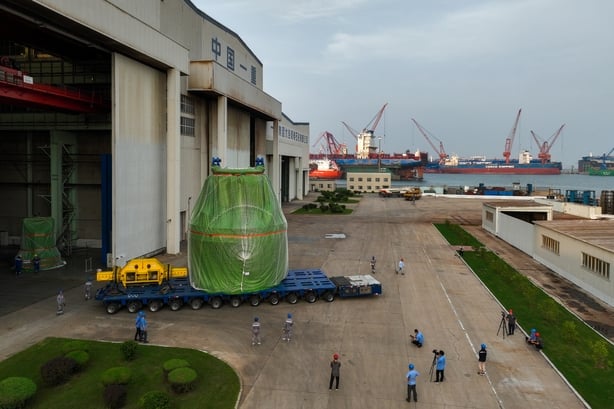
US companies like NuScale, Oklo and Nano Nuclear Energy are at the forefront of developing the technology, while the UK government is set to invest £20 billion (€23bn) to put Rolls-Royce produced SMRs in Wales by 2030s.
For countries like Ireland, which need to find a solution for low-wind periods, small modular reactors looked like the "promising hope", Dr Ryan said.
But for now, there are no small modular reactors in commercial use in western nations.
The only SMRs in the world already operating or close to operation are in Russia and China.
Opposition to nuclear remains strong
Germany's Environment Minister Carsten Schneider criticised von der Leyen's "backward-looking strategy" on nuclear power, saying that wind and sun "have long been driving the energy transition".
The government in Austria argues that "nuclear energy cannot be reconciled with the principles of sustainable development".
"This is something of which also other countries must be convinced."
Unlike Ireland, Austria got much closer to adopting the technology by building its first plant in 1970s. But Zwentendorf AKW never became operational, with a 1978 referendum banning nuclear power altogether.
Permanent and safe storage of nuclear waste is one of the key issues.
Most of it is currently kept in concrete-and-steel containers called dry casks, which is seen as a temporary solution.
This year, Finland is set to become the first country in the world to start disposing of nuclear waste permanently, by burying it underground in a facility called Onkalo on the country’s western coast, 15 km from the nearest town.
What about the nations most severely impacted by the Chornobyl tragedy?
Both Belarus and Ukraine currently produce nuclear energy.

Ukraine's dependence on nuclear has risen to about 70% since Russia launched its full-scale invasion, due to the destruction of other generating capacity in air attacks.
Europe’s biggest nuclear power plant is in Ukraine’s Zaporizhzhia region, but that is occupied by Russian troops and remains disconnected from Ukraine’s grid.
Belarus launched its own power plant six years ago, with Russian expertise and funds, and with limited public consultations, under longtime strongman Alexander Lukashenko.
Just 50 km from Lithuania, the EU neighbour ruled out buying the power from the Astravets facility.
"It didn’t give more energy security to Belarus," Dr Maria Falaleeva, consultant in climate policy and Eastern Europe told RTÉ News.
She said that the Russian-built, Russian-monitored plant has deepened Minsk’s dependence on Moscow, while safety concerns and public distrust persist amid lack of transparency.
"In the country where Chornobyl disaster had a huge impact, why would we need to repeat its legacy?"
Nuclear energy in Ireland
According to KPMG’s research released in February, 32% of Irish adults back nuclear power plants, up from 28% last year, while opposition remains at around 45%.
Proponents of the technology here, like the '18 to 0' group, argue that without nuclear Ireland is unlikely to reach its climate targets.
"Integrating 18% nuclear energy could decarbonise Ireland’s power sector by 2037, with the remaining power being supplied predominantly by renewable energy," it says.
Despite optimism around small nuclear reactors, the wait for it could be too long, Dr Lisa Ryan from UCD said.
"Let other countries invest in it, develop the technology first and make it operable, and then maybe we can adopt it in the future decades."
Dr Ryan argues that it would make more sense for Ireland to "do one thing at a time".
"We started well with the Arklow [wind bank] back in the early 2000s, but we haven't built a single one since … If that is really a priority, let's get that done."