


European shares contined to fall this afternoon, as surging oil prices exacerbated inflation worries with the US- Israeli war on Iran showing no signs of slowing down.
Shares in London were down 1% this afternoon, while the Paris CAC lost 1.7% and the Frankfurt DAX sank 1.4%.
The Dublin market was also lower, falling by 1.3%, with Kingspan, Cairn Homes and Ryanair all heading down.
Oil surged more than 15% with prices just shy of $120 a barrel, as concerns over drawn out shipping and supply disruptions gripped markets due to an expanding conflict in the Middle East.
Iran named Mojtaba Khamenei to succeed his father Ali Khamenei as supreme leader, signalling that hardliners remain firmly in charge in Tehran.
In Europe, banks, which were in the epicentre of the sell-off last week, extended declines with a 3.2% fall. Tech stocks fell 3.1%.
On the flip side higher crude prices pushed energy stocks 0.1% higher, while defence firm Leonardo added 1.4%.
Attention now turns to comments by ECB President Christine Lagarde while board member Piero Cipollone and euro zone finance ministers are due to speak at Eurogroup meeting later in the day.
Data showed German industrial orders fell more than expected month-on-month in January.
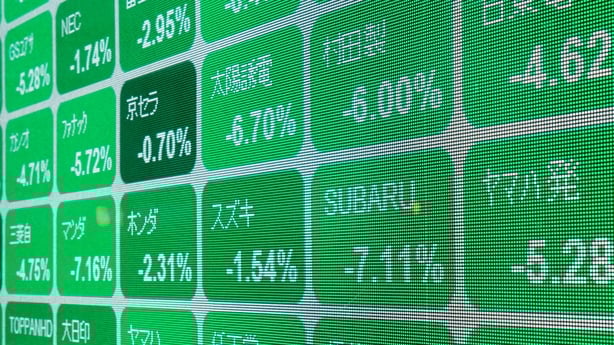
Earlier, stock markets in Japan and South Korea fell sharply today after oil prices soared above $100 per barrel for the first time in almost four years.
Japan's Nikkei index of stocks closed down more than 5% and South Korea's Kospi by 6%, on the back of turmoil in the Middle East.
US President Donald Trump dismissed the spike in oil prices as a "small price to pay" to eliminate Iran's nuclear threat, reiterating the White House's insistence that the rise is temporary.
"Short term oil prices, which will drop rapidly when the destruction of the Iran nuclear threat is over, is a very small price to pay for USA, and World, Safety and Peace," he wrote on social media yesterday.
"ONLY FOOLS WOULD THINK DIFFERENTLY!" he argued.
Maritime traffic in the Strait of Hormuz - through which 20% of global crude and gas passes - has all but halted since the war began on February 28.
Japan, the world's fourth-largest economy, is also the fifth-biggest importer of crude, with some 95% from the Middle East and around 70% of passing through the Strait of Hormuz before the conflict.
Prime Minister Sanae Takaichi said on March 2 that Japan holds emergency oil reserves equivalent to 254 days of domestic consumption.
Kyodo News reported on Friday, citing an unnamed source, that the Japanese government was considering releasing some of its oil reserves.
South Korea is the world's fourth-largest importer of crude. The biggest is China.
