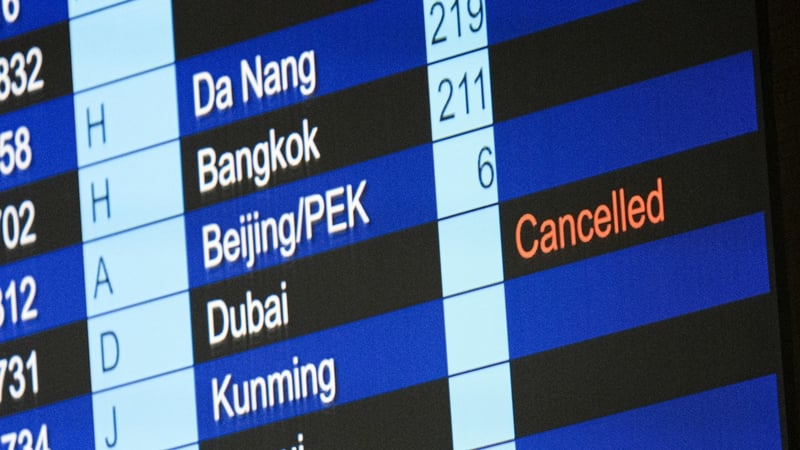

Thousands of flights have been cancelled around the world in the past four days with no de-escalation in the US-Israeli war with Iran in sight.
The uncertainty is likely to force travellers to cancel or reschedule travel plans, in the most severe disruption to global aviation since the COVID-19 pandemic.
With airports in Dubai, Abu Dhabi and Doha still mostly shut, the impact on the aviation sector has been "massive" according to aviation and crisis management expert Anita Mendiratta.
Speaking on RTÉ's Morning Ireland, she said that airlines are now trying to "manage effectively the lack of use of the Middle Eastern air corridor."
That corridor normally accommodates around 30% of international travel between the West and the East.
The closure of the Dubai airport, which usually sees 1,200 aircraft movements a day, has been particularly damaging for global operations.
Among the airlines that suspended their flights to and from the Middle East are KLM, Air France, British Airways, Lufthansa, Turkish Airlines as well as regional giants Qatar Airways, Etihad Airways and Emirates.
Affected by the crisis herself, Ms Mendiratta spoke to RTÉ from Bangkok where she had to travel in order to return from New Delhi to London.
The detour will also include a stopover in China before she reaches her destination.
"I'm blessed to be in the industry and knew that if you want to go west, you have to go far east," she explained.
We need your consent to load this rte-player contentWe use rte-player to manage extra content that can set cookies on your device and collect data about your activity. Please review their details and accept them to load the content.Manage Preferences
As tens of thousands of passengers found themselves in a similar situation, airlines and tour operators are working with local authorities to repatriate stranded customers.
German tourism group TUI said it will begin to offer flights back home to customers who stranded in the Middle East.
Alternatives to Gulf airlines showed a surge in passenger bookings and ticket prices on routes like Hong Kong-London, according to Reuters.
With Russian skies mostly off limits to Western airlines since it launched full-scale invasion of Ukraine, carriers are now squeezed even further with the war in the Middle East, forcing many to add more flying time and fuel to circumvent war zones.
Some airlines have oil hedges that would help partially offset the fuel price increase, but other carriers are unhedged.
Airlines are now hoping for "safe recovery of air access," Ms Mendiratta noted.
When safety is restored, companies are expected to ensure that crew and aircraft - currently scattered around the world in the wrong places - can get to where they need to.
Trade environment is also being impacted with cargo aircraft disrupted by the conflict in the Middle East.
The full recovery of flights that were interrupted would be a "long cleanup process for the backlog," the aviation expert noted.
"We're still in the thick of the crisis, so it's not as if we can now start looking at full recovery," she added.