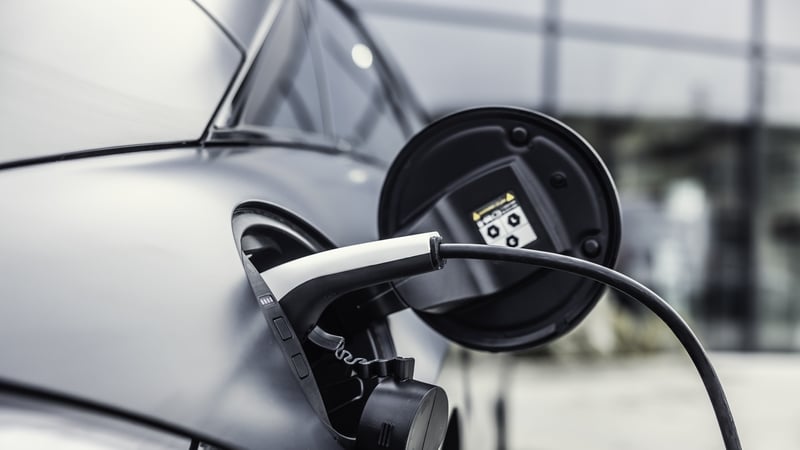

The future is "still electric" but it's "looking Chinese rather European".
Following recent reports on global car giants retreating from their EV strategies, independent motoring expert for Carzone Conor Faughnan told RTÉ News that European manufacturers "have fallen behind the Chinese producers".
Earlier this week, it was revealed that Stellantis, the maker of Fiat, Peugeot and Jeep, is resurrecting some of its diesel models in Europe, including the Peugeot 308 and DS No 4 hatchback.
The new strategy came to light soon after the company announced €22.2 billion of charges as it scales back its EV strategy.
In December, a similar move was announced by Ford Motor in the US, which is ending the manufacture of several electric-vehicle models, and taking a $19.5 billion writedown.
Back in Europe, Volkswagen's Porsche said in September it would delay the launch of its newest EVs, while extending production of combustion engine models.
Under the pressure from automakers, Brussels reversed its plan to phase out cobustion engine across the EU by 2035.
"Essentially at the behest of the European carmakers, they are not now going to make that deadline," Mr Faughnan said.
"European automakers are saying it's market reality," he adds. "Not entirely convincing when you look at how successful the Chinese manufacturers are."
We need your consent to load this rte-player contentWe use rte-player to manage extra content that can set cookies on your device and collect data about your activity. Please review their details and accept them to load the content.Manage Preferences
The latest figures from the Central Statistics Office revealed a 61% jump in the number of new private electric cars licensed for the first time in January.
The demand is also rising across Europe where sales of EVs were up 30% last year - making almost one fifth of all new car purchases - according to the data from the European Automobile Manufacturers Association.
According to the motoring expert, "EVs on offer are getting better and better" and they are "no longer the expensive choice for a family."
China now produces more than three-quarters of lithium-ion batteries globally, with declining battery prices being the main driver of the overall EV cost.
"The Chinese are simply making faster progress in the development of batteries compared to European counterparts," Mr Faughnan argues, adding that companies in Europe know that.
Having more Chinese electric vehicles on the European is "not a bad thing," the expert thinks, saying that a lot of the skepticism about them "comes from lack of familiarity".
He believes that the solution for European automakers is "not protectionist barriers" but "an incentive to the Europeans to do better and to do faster".
"No more than when Kilkenny hurlers were beating everybody in Ireland, the solution is to catch them, not to hope they fall back," he added.