


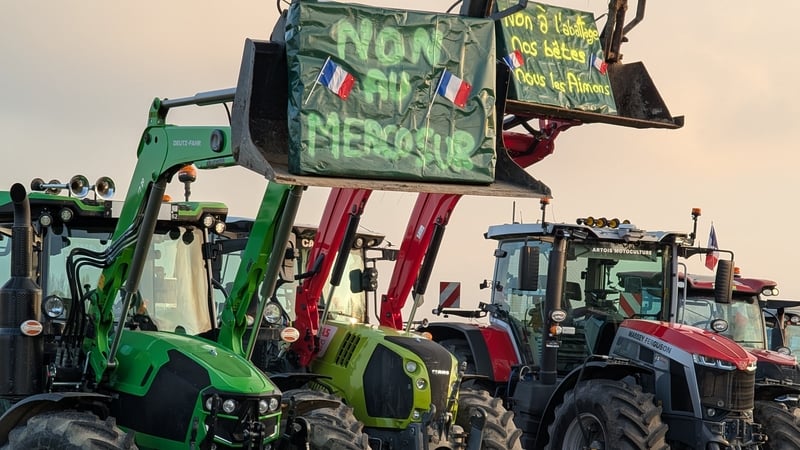
Italy and France want a final European Union vote on the Mercosur trade agreement to be delayed, a move that risks derailing an accord that has taken 25 years to negotiate.
The deal with a group of Latin American nations is the largest brokered by the EU in terms of tariff relief.
Proponents say it offers a route away from reliance on China and relief from the impact of US President Donald Trump's tax increases.
Getting a resolution this month is seen by some as a test of Europe's ability to act as a unified bloc, days after Mr Trump hit out at EU leaders for being "weak" at a time when they are searching for agreement on how to bolster financing for Ukraine.
Germany, Spain and Nordic countries are strong supporters of the agreement.
However, critics worry that it gives away too much to Mercosur members Argentina, Brazil, Paraguay and Uruguay and will result in cheap South American commodities flooding the European market to the detriment of EU farmers.
France has been trying to rally other member states to form a blocking minority against the deal negotiated by the European Commission. It wants more robust safeguards to protect farmers added to the accord.
Yesterday, the French government announced that it was seeking to delay the EU vote to approve the deal in order to obtain "legitimate protections" for farmers.
Asked about the French position, the European Commission said it still expected to sign the accord by the end of the year, adding that "in the view of the commission, signing the deal now is a matter of crucial importance - economically, diplomatically and geopolitically".
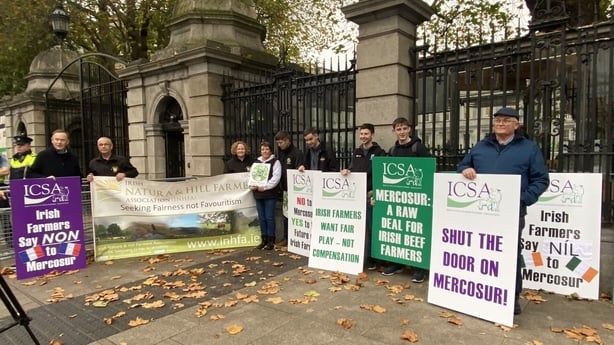
Denmark, which holds the EU's rotating presidency, will have to decide whether to press ahead with a vote this week as planned.
If Denmark defies France and Italy, the agreement could be shot down. A blocking minority requires support from at least four member states representing 35% of the EU's population.
Ireland, Poland, Hungary and Austria oppose Mercosur.
It is understood that France would have a blocking minority if Denmark proceeded.
Minister for Foreign Affairs and Trade Helen McEntee said it was not clear when a vote would take place.
Speaking in Brussels, she said: "We've been very clear on the concerns that we have had in relation to Mercosur, in particular, for our beef farmers.
"We have always said that we will work with like-minded countries on these issues, and we are working through and we are assessing the situation.
"At the moment, we don't have a date for a vote. We're not clear when a vote may or not happen, whether it's before or after Christmas."
France says safeguards are inadequate
A broad majority of EU members need to vote in favour of the deal to allow Commission President Ursula von der Leyen to sign the agreement.
The accord, reached a year ago, would open new markets to European exporters badly hit by US tariffs and Chinese competition and give Brussels new trade allies.
"If we don't sign Mercosur in the next days it will be dead," one EU diplomat cautioned.
"If we can’t agree on Mercosur we don’t need to talk about European sovereignty anymore. We will make ourselves geopolitically irrelevant," they added.
The commission, which is in charge of negotiating EU trade deals, offered safeguards this autumn that would allow preferential Mercosur access for some agricultural products to be suspended under certain market conditions.
The trigger for these to be activated would be if import volumes rose by more than 10% or prices fell by the same amount in one or more member states.
However, France has deemed the safeguards "incomplete".
"Any postponement is a very good signal," said Polish agriculture minister Stefan Krajewski.
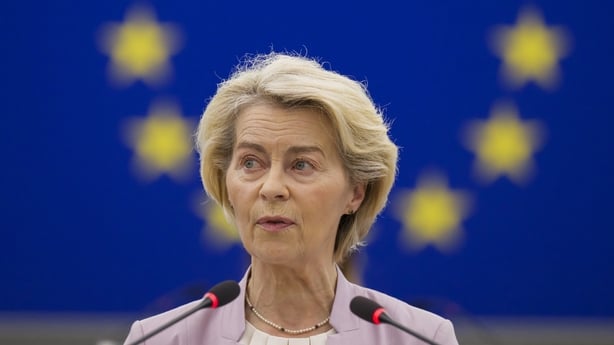
Mrs von der Leyen is due in Brazil on Saturday to sign the agreement to create the world's biggest free-trade area.
Wrangling is set to go down to the wire, with up to 10,000 farmers planning to descend on the Belgian capital to vent their anger at the deal during a leaders' summit on Thursday and Friday.
Mercosur would allow the EU to export more vehicles, machinery, wines and spirits to Latin America, while facilitating the entry of South American beef, sugar, rice, honey and soybeans into Europe.
Complicating matters, the European Parliament is to vote tomorrow the safeguards aimed at reassuring farmers and France.
EU states have already approved these measures, but may decide to strengthen them further.
In another gesture aimed at Paris, the commission last week announced tighter checks on farm imports to ensure they meet EU standards, and pledged to update rules on pesticide residues to prevent banned substances from entering via imports.
Mrs Von der Leyen intends to join the leaders of Brazil, Argentina, Paraguay and Uruguay in the Brazilian city of Foz do Iguaçu for the signing.
Even if she seals the deal in time to fly there, the battle will not be over.
The European Parliament must still give its final approval to the accord, likely early next year. Insiders expect a close vote, with national interests weighing heavily.
Additional reporting Tony Connelly, AFP
