
OpenAI, the company behind ChatGPT, has launched a new partnership framework for Ireland designed to boost AI skills.
The initiative will involve collaborations with the Department of Enterprise and the startup hub Dogpatch Labs.
OpenAI and the Department of Enterprise will launch an "SME Booster" programme in 2026, with hands-on AI skills training, workshops and mentoring for small and medium enterprises around the country.
To boost AI startups, OpenAI and Dogpatch Labs have agreed a new partnership to enable early-stage founders and entrepreneurs to integrate AI into their products and workflows.
To help young builders innovate in AI, OpenAI and Patch, a non-profit programme for people aged 16 - 21, will enter a new three-year partnership.
The collaboration will allow Patch to grow its Summer programme, offer fellowships, finance grants and mentoring, so that more young people can learn to code, prototype and develop early-stage AI products.
We need your consent to load this rte-player contentWe use rte-player to manage extra content that can set cookies on your device and collect data about your activity. Please review their details and accept them to load the content.Manage Preferences
"Ireland has deep talent, from young builders to experienced entrepreneurs," said Jason Kwon, Chief Strategy Officer, OpenAI.
"With over 1 million people here using ChatGPT, we want to help people use AI to grow their businesses, compete globally and build the next generation of innovative products," Mr Kwon said.
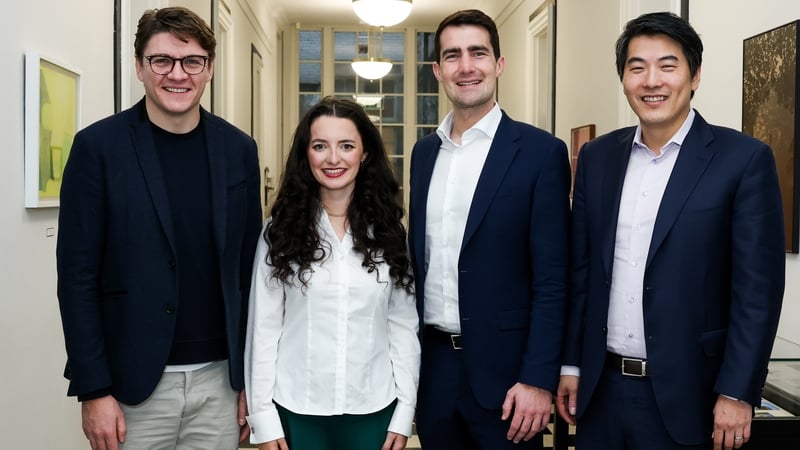
Minister for Public Expenditure, Infrastructure, Public Service Reform and Digitalisation Jack Chambers joined Mr Kwon for today's launch.
"OpenAI’s partnerships will support economic growth by helping SMEs make the most of AI and other emerging technologies, while innovation from start-ups and builders developing new AI-driven products and services will help Ireland compete and succeed on the global stage," Mr Chambers said.
Patrick Walsh, CEO of Dogpatch Labs, welcomed the new partnerships.
"Ireland has a unique opportunity to become a European hub for AI entrepreneurship, by connecting the next generation of builders with the tools, mentorship and networks they need to create world-class AI startups," Mr Walsh said.
OpenAI strategy boss says steps have been taken to address ChatGPT mental health concerns
Meanwhile, Mr Kwon, has told RTÉ News that his company has taken steps to make ChatGPT safer when people ask questions about mental health and depression.
There have been high-profile cases in recent months of people who took their own lives after turning to the chatbot for mental health advice.
"I want to emphasise that each of these cases is a tragedy, and our hearts go out the families," Mr Kwon said.
"We take our responsibility to make our products as good as possible in this space very seriously."
As part of the steps being taken, OpenAI has introduced new parental controls and has begun working with hundreds of mental health experts.
"They are working with us to advise us on the proper method of how the chatbot should suggest things or cut off conversations or refer sources, because we don't necessarily want to be in the position to make these types of decisions," Mr Kwon said.
"This is not our area of expertise, it's their expertise," he added.
Mr Kwon was in Dublin to launch a new partnership agreement with Ireland aimed at boosting AI skills for entrepreneurs and small businesses.
The initiative will involve collaborations with the Department of Enterprise and the startup hub Dogpatch Labs.
But what about concerns that AI will replace humans in the workplace?
"The technology will help people become more productive so that they can free up time to concentrate on tasks that really are for the best of human intelligence, capability and creativity," Mr Kwon said.
"What we have seen in partnerships that we've had with other governments, one being the state of Pennsylvania in the United States, is their workers saving an hour per day."
"That's not leading to job dislocation, it's actually leading them to do more with their time. That's less time spent on menial tasks or tasks that people don't like doing, and more on the tasks that are higher value."
"So the proof has been in the pudding a little bit and the experience they've had so far is that it is improving the overall quality of life associated with work rather than taking away work," he added.
There are questions about the huge levels of spending on artificial intelligence amid concerns of an AI bubble.
"As people think about this technology, what they're really seeing is today's benefits, but those benefits today coming from this technology are the product of capital investment that occurred years ago," Mr Kwon said.
"And what we're investing in today is actually going to produce models in the future."
"So I think that there is this kind of misconception that what we have today is what we're going to get with the investment that we're making today, but it's actually going to be much better than that."
So what does the future hold for artificial intelligence?
"It's going to be increasingly used to advance scientific breakthroughs," Mr Kwon said.
"We're talking about speeding up the pathways of the time to get to cures for diseases."
"We're talking about speeding up the pathways in time to get to new materials that can help with things like climate change."
"We're talking about systems that could help with energy management as well as new ways to kind of organise work," he added.