

Representatives of former Debenhams employees have met the Tánaiste and Minister for Enterprise, Trade and Employment, Leo Varadkar, to discuss the liquidation of the chain, which resulted in the loss of around 1,000 jobs.
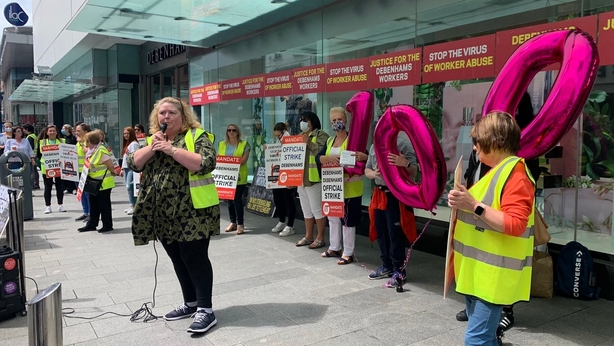
The Mandate trade union is campaigning for the workers to be given an enhanced redundancy package of four weeks' pay per year of service, rather than the two weeks provided for under statutory redundancy.
Following the meeting, the department confirmed that the two sides had discussed the statutory entitlements of employees, and that the Tánaiste had emphasised that the state will uphold the statutory employment rights of workers.
It also said that the two sides had discussed how the dispute might be resolved "in a way that was fair to the retail workers who have given years of service to the company and to the public."
However, the department statement makes no reference to any possibility of enhanced redundancy payments.
"The Tánaiste also confirmed the Government's commitments in the Programme for Government to reviewing whether the current legal provisions on collective redundancies and the liquidation of companies adequately protect the rights of workers," the statement continued.
This evening, Solidarity-People Before Profit will move a motion in the Dáil calling on the Government to forego its priority as a preferential creditor in the Debenhams liquidation, and to instruct the liquidator KPMG to use funds realised instead to pay the enhanced redundancy payments.
It urges the Taoiseach and the Minister for Finance "... to notify the liquidators in Debenhams that the state will forego its priority as a creditor in the process and instruct the liquidator to use funds realised instead to pay the enhanced redundancy payments agreed with the Debenhams workers and the company, and to immediately negotiate with representatives of the Bank of Ireland as to how they can support this process to ensure the workers receive a just settlement."
The motion acknowledges that in the case of Debenhams, the state is the first creditor that the liquidators seek to settle with on amounts due for various taxes and rates owed.
Solidarity-People Before Profit wants workers to be given higher priority as creditors in any liquidation process, and for the government to legislate to strengthen their rights when facing redundancies and layoffs.
The party also want recommendations in the post-Clerys Duffy-Cahill report implemented in law to ensure that where agreements for enhanced redundancies have been negotiated with workers, these should be honoured as preferential creditors in any subsequent liquidation process.
The liquidators of Debenhams Irish operation, KPMG's Kieran Wallace and Andrew O'Leary, have previously ruled out ring-fencing the proceeds of the liquidation to boost the redundancy entitlements of the former Debenhams staff.
They insist that they do not have the legal power to re-allocate the proceeds of the liquidation away from preferential creditors like the Revenue Commissioners to offer enhanced redundancy terms.
Sources close to the liquidation told RTÉ last week that there are no circumstances in which the assets "even if fully realised" would satisfy the debts owed to the state by Debenhams, which exceed €20m.
"Unless the state voluntarily instructs the liquidators to allocate supplementary cash to the workers, there is nothing that can be done," the source continued.
The source also warned that said this would amount to a fundamental change in insolvency legislation, and set a precedent that could prove costly to the state.
Workers are currently blockading stores to prevent the removal of stock, which they insist should be used to fund better redundancy terms for workers. The liquidators have acknowledged that the blockade is slowing down the liquidation process.