


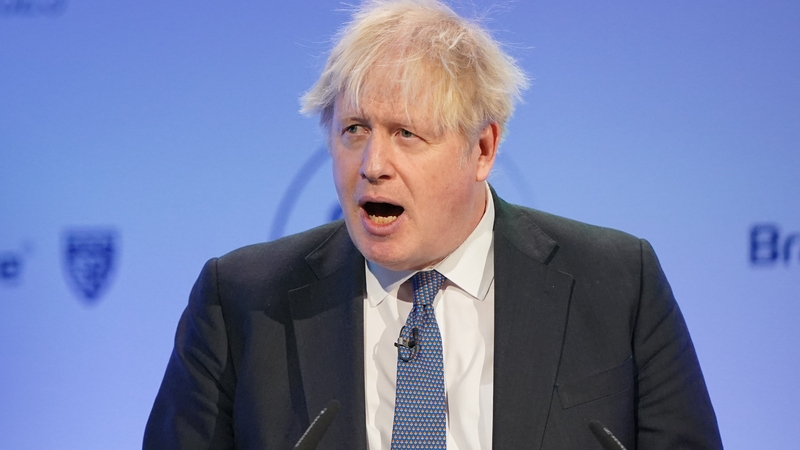
Former British prime minister Boris Johnson has suggested he may not vote for Rishi Sunak's new Brexit deal for Northern Ireland, criticising it as "not about the UK taking back control".
Mr Johnson said he would find it "very difficult" to support the Windsor Framework, despite claiming some credit for the new pact being brokered.
In his first major speech in the UK since being ousted from office, he urged his successor not to slash corporation tax to "outbid the Irish", and to "do things differently" to not betray the ideals of Brexit.
Mr Sunak managed to secure a new deal from the European Union to replace Mr Johnson's much-criticised Northern Ireland Protocol that had seen the Democratic Unionist Party walking out of power-sharing in Stormont.
Mr Johnson conceded people "want to move on" and sign the deal, adding that "they don't want any more ructions and I get that, I've got to be realistic about it".
"When I look at the deal we have now I, of course, have mixed feelings.
"I'm conscious of where the political momentum is and people's deep desire just to get on," he added.
However, he raised numerous concerns about the Windsor Framework at a global soft power summit before telling the audience: "I'm conscious I'm not going to be thanked for saying this, but I think it is my job to do so, we must be clear about what is really going on here.
"This is not about the UK taking back control, and although there are easements this is really a version of the solution that was being offered last year to Liz Truss when she was foreign secretary.
"This is the EU graciously unbending to allow us to do what we want to do in our own country, not by our laws, but by theirs."
Under the deal "British genome edited tomatoes could not go into the making of a cheese and tomato sandwich in Northern Ireland, which is a matter of great regret", Mr Johnson said.
He also challenged Mr Sunak to cut corporation tax to "Irish levels or lower", arguing there is "no point in just emulating the high tax high spend low growth European model".
Mr Johnson said he has "no doubt at all" that his controversial Northern Ireland Protocol Bill threatening to override international law "is what brought the EU to negotiate seriously".
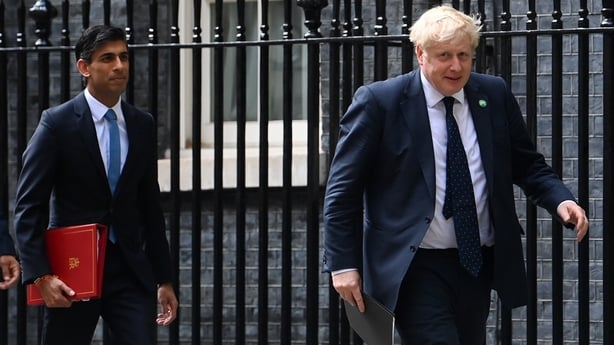
Mr Sunak scrapped the bill after brokering the new deal, but Mr Johnson urged him to have the "guts" to bring it back if the agreement does not succeed.
Mr Johnson added: "I'm going to find it very difficult to vote for something like this myself, because I believed we should've done something very different. No matter how much plaster came off the ceiling in Brussels."
He argued that Northern Ireland would remain under EU law, with Brussels still making regulations, but "with what they hope will be lighter bureaucracy" under Mr Sunak's deal.
He said he is "particularly concerned" about goods going through manufacturing in Northern Ireland from Great Britain undergoing checks in some instances which he argued seems "pretty crazy".
However, Mr Johnson also conceded he made mistakes with his protocol.
"I thought those checks would not be onerous since there isn't that much stuff that falls into that category, most of the goods stay in Northern Ireland," he said.
Muttering, he added: "It's all my fault, I fully accept responsibility."
Earlier in the day, Downing Street said that some people are "misunderstanding" the Windsor Framework signed with the EU's Ursula von der Leyen on Monday.
Mr Sunak is almost certain to win a Commons vote on the deal because he has Labour's support, but he is not finding much in the way of vocal criticism in the Tory party either.
Brexit hardliners on the Conservative European Research Group (ERG) are analysing the deal to see if they will support it, while the DUP is having its own debate.
Mr Sunak has been called to face questions from a cross-party committee of MPs on his new deal.
The European Scrutiny Committee chairman, arch-Eurosceptic Bill Cash, has written to the prime minister asking him to appear on 14 March.
"Given the significance of recent developments and your role in the negotiation and presentation of the Windsor Framework, we think it appropriate that you appear in person to answer the committee's questions," Mr cash wrote.
It was not immediately clear if Mr Sunak would agree.
Prime ministers do not normally give evidence to select committees apart from a twice-yearly appearance before the Liaison Committee made up of the chairs of the other committees.
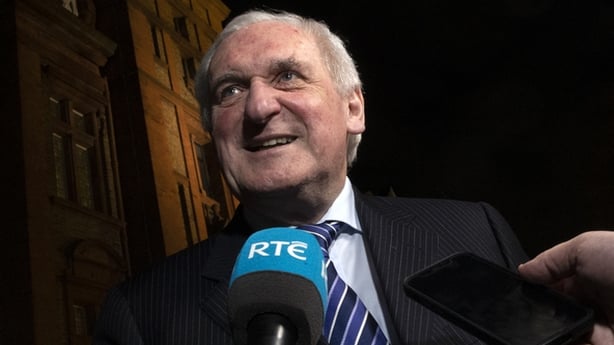
Former Taoiseach Bertie Ahern has said he believes the Windsor Framework was a very good deal that was being well received within Northern Ireland, but that the DUP needed more time to study it.
Speaking in Dublin today, he said Jeffrey Donaldson is "a reasonable, pragmatic person".
"I think he can look back on the last 12 months and say 'I've brought things a long way here'," Mr Ahern said.
"The danger for him and everybody else is that sometimes you can throw away victory when you don't see it. I think that in this case, what's been achieved this week is a very good deal."
Mr Ahern also said it would be very difficult if the DUP did not re-enter power sharing and that he cannot see the European Union coming back in after putting "months of effort" in.
He said Tony Blair gave "an amount of time to the Irish question" and the peace process, which was appreciated at that time.
"Rishi Sunak, he's put a huge effort into this and he has an enormous amount of problems on his plate and he can't sit around giving this the time he's given it in last two months," Mr Ahern said.
"And equally so, neither can the European Union. They have huge problems, not least a costly war.
"As I understand the seven issues, it looks to me as if they're substantially completed. I don't think Jeffrey can honestly say, 'I sat down seven things, I believe all seven should be 100% nailed down'.
"I think if you get five or six, and I think he's got that and maybe more, so that's not a bad deal for him and his party."
When asked if he had any concerns about the Stormont brake, Mr Ahern said it was an "ingenious bit of work".
"The only thing that confused me, and I think everyone that read it, was that the consent principle that it would be two parties from either side of the divide," he said.
"It a bit surprised me that it was 30 members and that seems a bit strange but I don't think anyone is too worried about that. People wanted to see this positively worked through."
Mr Ahern said he did not believe the application of the Stormont brake would cause any issues for the movement of goods on the island of Ireland.
He said the rule is that it is used for "substantive issues" when there is a real risk of a major problem, "not because somebody gets out on the wrong side of the bed".
Additional reporting: Samantha Libreri
