


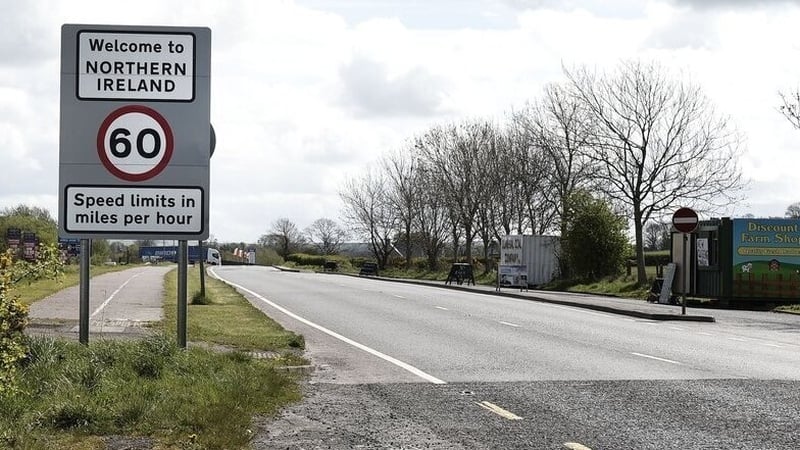
Minister for Foreign Affairs Simon Coveney has asked Britain's Secretary of State for Northern Ireland for "special treatment" to allow border crossings to continue uninterrupted.
But Brandon Lewis has again insisted that a proposed US-style visa waiver requirement for non-Irish EU citizens crossing from Ireland to Northern Ireland does not amount to imposing border controls.
"We don't have borders on the island of Ireland," he said at a joint press conference with Simon Coveney. "That structure won't change at all."
He said that the proposed system will operate "swiftly and efficiently and effectively".
Minister Coveney said that the two men had a good discussion on the issue, and insisted that "our position is understood" by Britain.
But he repeated remarks - which he tweeted yesterday evening - that the Irish Government's position "has been ignored".
Emphasising that the measures are included in a bill which is still before the British parliament, Minister Coveney told reporters that the "conversation will continue" between the two governments.
"Since the peace process was agreed," he said that Ireland has operated with "uninterrupted travel opportunities" across the island, "and we think that's worth protecting".
Mr Coveney accepted that the British government is introducing streamlining "based on international best practice," but said that "not for the first time, we'll be asking for special treatment to protect that relationship" between Northern Ireland and the Republic.
Earlier, Mr Coveney said it was "regrettable" that British MPs had voted to keep the waiver requirement.
Mr Lewis said the new application process for an online visa waiver "is about protecting the Common Travel Area from abuse. Our commitment to the Common Travel Area is absolute".
The CTA agreement between the UK and Ireland means citizens are given the right to travel freely between both countries.
There is ongoing friction between Dublin, London and Brussels over arrangements following Britain's departure from the EU and the thorny issue of the border between Northern Ireland and the Republic.
Under the proposed new rules, non-Irish EU citizens would have to apply for an online Electronic Travel Authorisation (ETA) before entering the UK, including when they cross the border into Northern Ireland.
The legislation is part of a package of wide-ranging and controversial rules to overhaul Britain's post-Brexit immigration laws.
The Irish Government's concern had been "communicated clearly but has been ignored", Mr Coveney said.
Minister for Public Expenditure and Reform Micheal McGrath told the Dáil that the Government "stands four-square behind the Common Travel Area and the open border in all respects".
He said: "We have serious concerns about the [UK] proposal ... to seek to distinguish between EU citizens from another member state versus Irish citizens."
It is neither "practical or fair," he said.
Sinn Féin leader Mary Lou McDonald described the British government move as a "shameful situation".
She said: "It undermines the Good Friday Agreement and the Common Travel Area, and creates significant restrictions on freedom of movement on our island.
"Are we really suggesting that Polish people who live and work in Lifford now need papers to travel to Strabane, or from Emyvale to Aughnacloy?
"It will be devastating for the tourism sector, particularly for counties like Donegal and along the border region. This could cost tens of thousands of jobs in a sector just barely getting back on its feet after Covid-19.
"Minister for Foreign Affairs Simon Coveney has contacted the British government, but we need to do far more.
"The Taoiseach needs to pick up the phone to Boris Johnson today and marshal Irish diplomatic efforts against this decision."
A spokesman for the Northern Irish NGO, the Committee on the Administration of Justice, said that EU citizens living "fluid cross border lives" could "face up to four years in prison for crossing an invisible border" if they failed to apply for a visa waiver.
"It seems that this is all grounded in political rhetoric rather than some evidence-based formulation," he added.
Relations between Ireland, Britain and the EU have been overshadowed in recent months by controversy surrounding the Northern Ireland Protocol.
The arrangement - part of the UK's divorce deal with the EU - avoided the reimposition of a hard border on the island of Ireland by keeping Northern Ireland in Europe's single market and customs union. But it erected an effective trade barrier in the Irish Sea.
During a visit to the UK earlier this month, Taoiseach Micheál Martin said long-running EU-UK negotiations about reforming the pact would proceed.
But he stressed that it offered the best of both worlds for Northern Ireland.
Additional reporting AFP
