
The UK will make a unilateral declaration promising to remain fully aligned to EU food safety and animal health rules for the production of agri-food products destined for Northern Ireland after 1 January, RTÉ News has learned.
The EU will also issue its own declaration recognising that British food meets European safety standards during two separate grace periods, one for three months and another for six months.
The alignment will be temporary, and will last only so long as there are exemptions from certain EU food safety rules for food importers trading meat and dairy products from Great Britain to Northern Ireland.
The declarations will form part of a final sequence of agreements allowing the Northern Ireland Protocol to take effect.
The overall package will be signed off by the Cabinet Office minister Michael Gove and European Commission vice president Maros Sefcovic no later than next week.
The UK's unilateral declaration will be designed to reassure EU member states that any meat, dairy and plant products entering Northern Ireland from Great Britain - and by extension entering the single market - will be safe for consumers and will be a safeguard against any animal or plant health diseases.
A senior EU official told RTÉ News that a British promise to remain aligned to EU sanitary and phytosanitary (SPS) rules for the production of meat and dairy products, as well as for certain plant products, had been agreed by both sides.
It is understood the declaration is specifically linked to the production of meat and products of animal origin in Great Britain that are destined for Northern Ireland.
The alignment will be directly tied to two derogations from EU food safety law, which will give Northern Ireland traders time to adapt to the new regime.
One three-month derogation will mean that traders who send food products of animal origin and plant products, such as seed potatoes, from Britain to Northern Ireland are not automatically required to have export health certificates accompanying the goods.
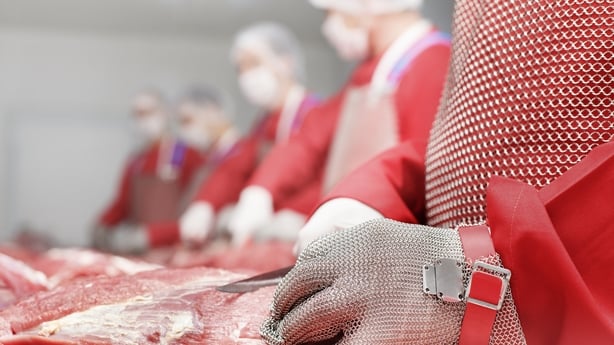
The second derogation, which will last for six months, relates to processed meats, such as sausages, mince, pies and chilled prepared meals.
Under this derogation, such products, normally prohibited by the EU if coming from a third country, will be permitted to enter Northern Ireland, but will still require export health certificates.
Essentially, the UK unilateral declaration agreeing to regulatory alignment will cover the two exemption periods.
After the three-month derogation expires, any products of animal origin entering Northern Ireland will require export health certificates.
It is understood that after six months processed meats from Great Britain will no longer be permitted.
Officials acknowledge that this is a highly sensitive issue.
However, they say that other third countries who are barred from exporting such products to the EU could challenge an open-ended exemption for processed foods from Great Britain.
EU officials say that the overall agreement means that member states will be reassured about any consumer health risk within the single market due to animal-based products entering from Great Britain, which will be - as part of the UK - a third country.
The unilateral declaration will be combined with the effect of the trusted trader scheme and a new role for large UK supermarket chains, which will be obliged to use their own hi-tech stock management and traceability systems to act as de facto export health certificates during the grace period.
Officials also point out that EU veterinary inspectors will be on the ground in Northern Ireland supervising SPS controls at ports.
Under the unilateral declaration, any British abattoirs and meat processing plants involved in trading products into Northern Ireland will have to fully comply with EU food safety and animal health rules.
There will also be a new labelling regime, which will indicate that during the three and six-month derogation periods such products are permitted for consumption in Northern Ireland only.
"The promise will be that, for the time they have these exemptions, because they're coming to the single market, they must be fully aligned with EU legislation, especially in the sensitive issue of SPS," a senior EU official told RTÉ News.
"There is strict conditionality concerning labelling, full alignment, how they should be packaged and so on."
The official added: "In the [EU UK] Joint Committee [tasked with implementing the protocol] there will be a series of unilateral declarations where the UK will commit itself to certain behaviour, and the same on our part, as to how we react to that behaviour."
The overall package, news of which was first revealed by RTÉ News yesterday, follows long and sensitive negotiations at the Joint Committee level, as well as talks at the more technical Specialised Committee.
Throughout the negotiations the UK pressed to ensure that the impact of the protocol on daily life in Northern Ireland was minimised as far as possible.
For the EU, any facilitation had to be compatible with the integrity of the single market and the obligations of the protocol.
According to the EU official: "We cannot decide on this lightly. There is a list of conditions attached.
"First, a clear commitment that there will be full alignment to EU health standards, when they are producing [meat products], for as long as the processed meats are imported into Northern Ireland.
"Then they have to have very clear labelling that these products are only consumed in Northern Ireland."
It is understood the UK has invoked WTO rules governing food safety as a way to frame the unilateral declarations, which could provoke anger among eurosceptics.
Under WTO provisions, if a trading partner decides to change its SPS rules it should not be done immediately but should only happen after a consultation period with another trading partner, lasting up to nine months.
British officials have suggested this unilateral declaration to remain aligned with EU rules would be akin to a WTO consultation period.
The EU will also issue a unilateral declaration on the impact of EU state aid rules, which will apply in Northern Ireland as a result of the protocol.
This follows a dispute over the so-called "reach back" effect, in which any British company with branches in Northern Ireland that enjoys a subsidy from the UK government could be captured by EU state aid rules.
Although British Prime Minister Boris Johnson agreed to this as part of the Withdrawal Agreement in 2019, the UK Internal Market Bill would have given British ministers to power to de-limit any EU state aid effect happening in the rest of the UK.
As part of the overall settlement, the EU will issue a unilateral declaration stating that it will not apply the protocol's state aid provisions in any "abusive" way through the reach back effect.
"There have been worries among some business operators about the so-called reach back effect," said a senior EU official.
"We will issue a unilateral declaration that state aid rules apply and that we will apply them in a way where the worries the UK have will not be substantiated.
"If there is no genuine case we are not going to use it extensively or abusively or hypothetically."
On Monday, the UK announced it would delete the clauses within the Internal Market Bill that would have breached the Northern Ireland Protocol.