


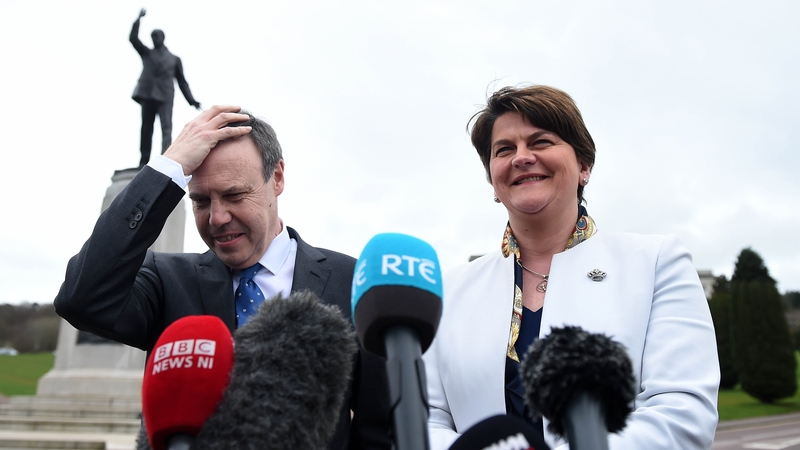
The DUP and Sinn Féin are holding talks at Stormont to explore the possibility of restoring power-sharing.
DUP leader Arlene Foster has denied that there was a revolt in her party after Sinn Féin surged at the polls.
Last week's election radically altered the face of the Stormont Assembly, ending for the first time the overall unionist majority. Sinn Féin secured 27 seats, just one fewer than the DUP.
Ms Foster said she was going into the negotiations to restore power-sharing and wanting to do a deal.
Sinn Féin has demanded she step aside as first minister while a botched green energy scheme she oversaw is investigated.
Asked about feelings within her party, she said: "There is no revolt."
Sinn Féin president Gerry Adams earlier said his party does not want Ms Foster to step down as leader of the Democratic Unionist Party, saying it was a matter for the DUP to decide.
But referring to the potential €500m overspend of a botched renewable energy scheme, Mr Adams said the so-called cash-for-ash scandal needs to cleared up before Ms Foster could be acceptable as first minister.
He said Sinn Féin was open to all ways of resolving difficulties, including modular investigations, and he believed the issues could be cleared up within three weeks.
Mr Adams said: "The question has got to do with the cloud that's hanging over, and imagine half a billion - potentially - of taxpayers' money going to waste without any real explanation.
"And we're asking Arlene to step to one side to facilitate that."
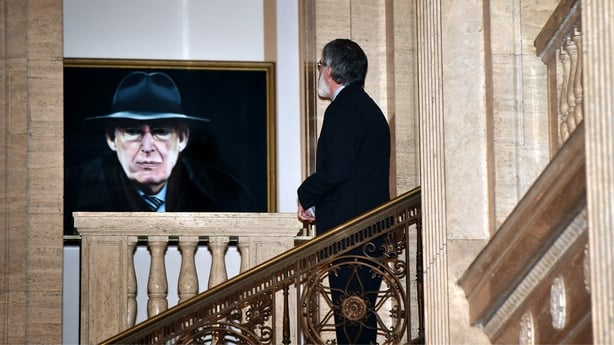
Full Assembly Election coverage | Breakdown of results | A to Z Assembly Election
Mr Adams said it cannot be business as usual at Stormont and the British government, in particular, needed to play a special role and "come up to the mark".
He called on the British government to give Northern Ireland special status in the Brexit negotiations.
We need your consent to load this rte-player contentWe use rte-player to manage extra content that can set cookies on your device and collect data about your activity. Please review their details and accept them to load the content.Manage Preferences
Northern Ireland's parties have three weeks to form an executive or risk the re-imposition of direct rule from Westminster.
The DUP has insisted Sinn Féin cannot dictate who it nominates to lead the party in any restored Stormont Executive.
Mr Adams earlier said Northern Ireland Secretary of State James Brokenshire risked repeating mistakes of the past.
It is understood Mr Brokenshire will meet all five main party leaders "on a bilateral basis", ahead of talks including Minister for Foreign Affairs Charlie Flanagan on Wednesday.
In separate co-ordinated statements yesterday, Mr Brokenshire and Mr Flanagan warned there was a "limited window" to resolve differences and get a functioning parliament back up and running.
Mr Brokenshire said responsibility lies on the shoulders of the DUP and Sinn Féin.
He added that "confidential" talks would start immediately to resolve other outstanding issues over the full implementation of peace agreements and how the legacy of the Troubles is addressed.
Mr Flanagan said it was of the utmost importance for the people of Northern Ireland that the political institutions, established under the Good Friday Agreement, promptly resume, "not least so that they can effectively engage with the issues raised by Brexit".
However, yesterday Sinn Féin's John O'Dowd, education minister in a previous executive, said Sinn Féin would not support Ms Foster's nomination.
The DUP's Simon Hamilton, economy minister until the Assembly's collapse, said Mrs Foster has a mandate to lead her party.
Former deputy first minister Martin McGuinness collapsed the last Assembly by resigning over Mrs Foster's refusal to step aside pending an inquiry into the renewable heat incentive scheme.
