


There is every chance that, over the next decade or so, billions of euro will be spent on an upgrade of public transport systems in Cork.
In its scale, it is an unprecedented investment.
It offers an opportunity to re-imagine the public transport networks of the city in a way that hasn't been possible before.
Through this investment, an integrated, user-friendly and environmentally-friendly public transport system is not only achievable, it is what is being planned to coax people away from their cars and create an alternative transport system that will be sustainable into the future.
Furthermore, investments to date support the view that the projects currently in planning are deliverable: we have seen enough from the spend so far to believe that these projects will actually be delivered.
They will certainly be needed.
The population of Cork, based on the 2022 Census, is around 224,000 people, an increase of more than 6% on the census returns for 2016.
Under Project Ireland 2040, Cork will be Ireland's fastest-growing city region, with a population growth of between 50% and 60% envisaged, to one third of a million people by 2040.
The National Development Plan positions Cork as the primary economic counterbalance to Dublin. That is the reason why so much investment is being directed this way.
But there are challenges too. And how those challenges are dealt with will dictate the quality of the public transport system we end up with by, say, 2050, roughly a quarter of a century from now.
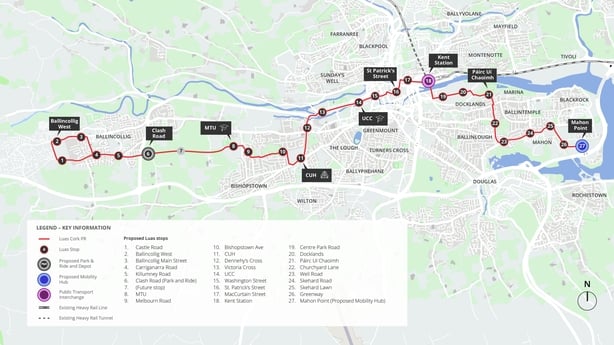
Just over a month ago, Transport Infrastructure Ireland (TII) was in Cork to reveal its preferred route for a light rail service, to run from Ballincollig in the west of Cork city, to Mahon Point in the east.
Along the 18.6km route and through 27 stops, it will connect Munster Technological University, Cork University Hospital, University College Cork, the city centre, Kent rail station on the north side of the city, Cork Docklands, Páirc Uí Chaoimh and the suburbs of Blackrock and Mahon.
Detailed costings haven't been completed as yet, but TII estimates that its Cork Luas project will cost between €2 billion and €3 billion. It insists that the Cork Luas could be operational within a decade, subject to the approval of funding and an application for a railway order in 2028.
Given the progress - or lack thereof - on the MetroLink in Dublin, one could be forgiven for thinking that talk of a Luas for Cork is a pipe dream and highly unlikely in this lifetime, but there is a significant push behind the project from all the relevant local and national agencies involved.
That is sufficient to support the belief that they are serious in their intent.
This week, just over a month after TII revealed its plans for its preferred route for the Cork Luas, Iarnród Éireann came to town to open public consultation on phase two of its Cork Area Commuter Rail project.
We know from phase one of this project that Iarnród Éireann is serious about its intent here: the State rail company has already put its money where its mouth is and spent €300 million on the rail infrastructure in Cork, principally in a revamped Kent Station.
Phase two promises eight new commuter rail stations: at Blarney, Monard, Tivoli, Ballynoe, Carrigtwohill West and Water Rock, along with the accelerated development of stations at Blackpool and Dunkettle close to the city, which are to be fast-tracked.
These developments are part of a plan to create a commuter rail service with a 10 minute frequency, while also significantly increasing capacity.
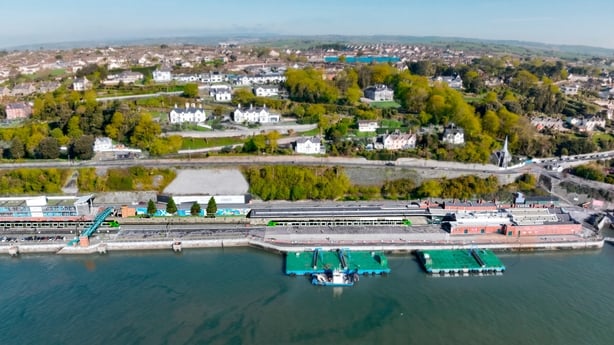
Cork's commuter rail services between the city, Mallow, Midleton and Cobh already cater for one million passenger journeys per year. When the current planned upgrade is completed, Iarnród Éireann says it will be capable of catering for three million passenger journeys every year in comfort.
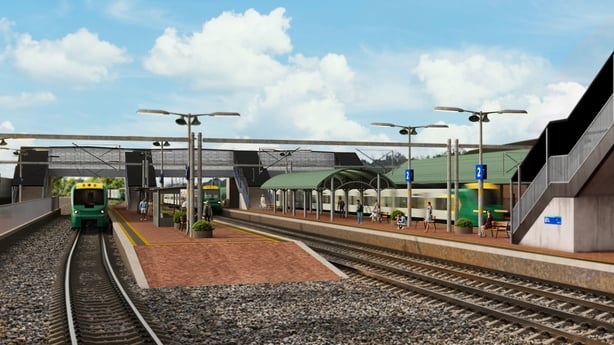
There are also plans for upgrades to the stations at Cobh and Mallow, where longer platforms, new footbridges and lifts will increase capacity for increased frequency on services and improve customer experience.
Along the way, the commuter rail network will be electrified, to cut carbon emissions, and park and ride facilities will be provided at Blarney station on the northwest of the city and at Dunkettle in the east.
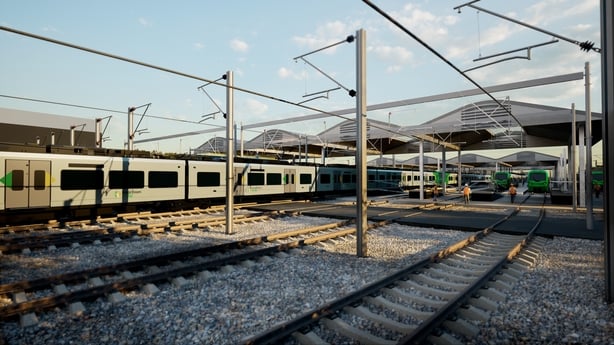
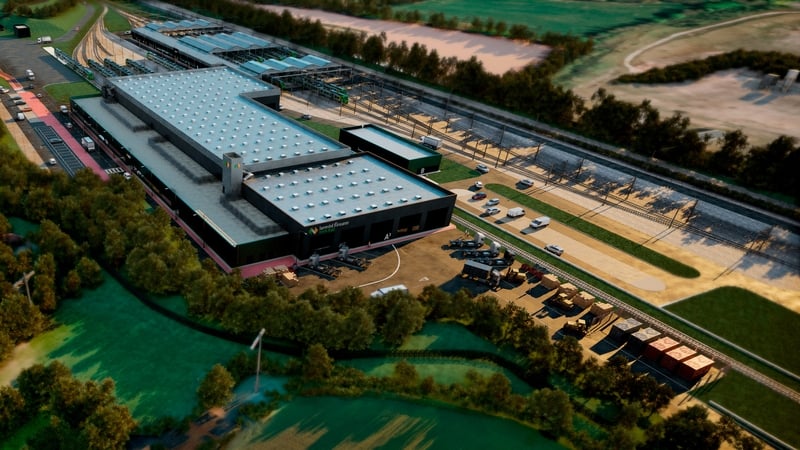
A new depot will also be built to maintain the newly-electrified fleet.
Transport services will be integrated so that passengers will be able to use them and travel on them seamlessly.
Iarnród Éireann puts the total project cost at €1.8 billion. The company points to its delivery of phase one of the project as a measure of its commitment to doing likewise with phase two.
"We are very ambitious that this work should be beginning construction in May 2028," said Iarnród Éireann Chief Executive Mary Considine.
"We should begin to see stations open and see the entire programme completed in the early 2030s."
Responsibility for delivery of these projects falls to AJ Cronin, Iarnród Éireann's aptly-named Delivery Manager for the Cork Area Commuter Rail project.
He's optimistic about the projects and about user up-take once they're completed.
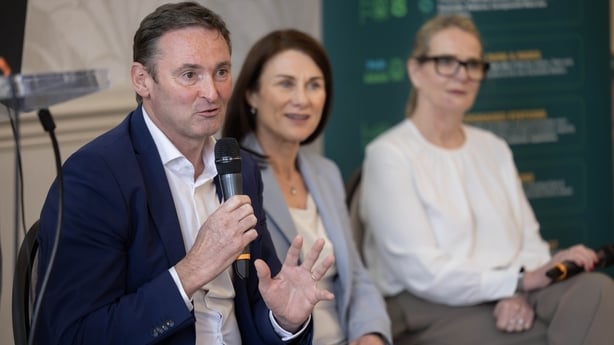
"Since Covid, we've seen up to a 70% increase in passenger numbers in the Cork area on the three commuter routes, so over one million passenger journeys in Cobh, Midleton and Mallow," Mr Cronin said.
"That's expected to grow significantly when we put in phase two, with the additional access to stations on the network, providing more access for communities and for new population areas and new housing areas."
The construction of a new commuter rail station in Blarney is also expected to facilitate the development of a new town close by at Stone View.
The overall aim is to move from the current one million passenger journeys per year, to a three-fold increase of three million passenger journeys per year on the Cork commuter lines.
Changes en route for roads, buses and bicycles
While all this is happening, construction of the €456 million M28 Cork to Ringaskiddy motorway is also under way - another huge infrastructural project.
The M28 is set for delivery by summer, 2028. It will significantly help to future-proof the road network around Cork and improve access to Cork Port.
The investment covers two linked schemes: 11km of motorway from the N40 Bloomfield Interchange to Barnahely in Ringaskiddy, being delivered by BAM, and the 1.5km Ringaskiddy Relief Road, being delivered by Sorensen.
As well as improving the road network and easing congestion at a notoriously dangerous bottleneck, the M28 will deliver faster, more reliable journeys for residents, commuters, and commercial traffic, while strengthening Cork's role in European trade and logistics.
In terms of travel by bus and by bicycle, plans are at an advanced stage for a capital investment of between €2.3 billion and €3.5 billion in the bus and cycling network in Cork, following approval by the Cabinet last October of BusConnects Cork.
BusConnects will deliver 11 sustainable transport corridors in three schemes across the north, southeast and southwest of the city and suburbs. These will consist of 90km of segregated bus lanes and bus priority routes, and 95km of segregated cycle routes.
Planning application for the three schemes are expected to be submitted to An Coimisiún Pleanála this year.
BusConnects Cork will provide new bus stops and shelters, real-time passenger information, simplified fares and next generation ticketing (including payment by mobile phone), on a zero-emissions bus fleet.
The redesigned bus network envisages having over 50% more bus services in place, with two routes operating 24 hours per day.
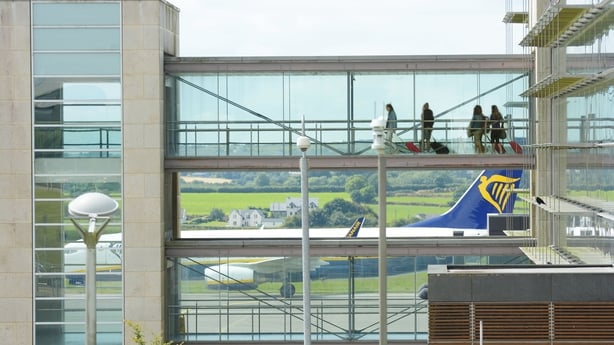
While all this is ongoing, work is also under way on a €200 million investment at Cork Airport to cater for the expansion of passenger numbers there over the next decade.
That investment will see passenger numbers at the airport grow from just over three million per annum currently, to five million.
And for those who enjoy travel at a slightly more relaxed pace, there are long-standing plans to develop a greenway along a 45km route from Coachford, west of Cork City, that will roughly follow the path of the River Lee to Blackrock, Monkstown, Carrigaline and onto Crosshaven.
Delivery of all these projects is a tall order, but they are all proceeding.
The challenges to them - referred to above - relate to cost inflation and the availability of funding.
Largely, though, the progress of these plans is in the hands of the people of Cork and whether they decide to embrace them or to oppose them.
Overall, though, re-imagining a new future for public transport in Cork is now quite conceivable, and realistic.
