
For a century, Fianna Fáil's 1916 commemoration event at Arbour Hill has been one of the party's most solemn occasions.
In the Dublin location's hallowed grounds, the great and the good - and, on occasion, the not so good - within the soldiers of destiny's ranks have stood side by side to listen respectfully to the leader's speech, the tricolour flowing in the wind behind him.
On the surface at least, tomorrow's event is unlikely to differ much from that tried and trusted script.
But no one, least of all the Taoiseach himself, will be in any doubt of the deep disquiet among some party members, who are increasingly looking to the future while colleagues hold onto the past.
Not for the first time, recent days have seen Fianna Fáil engulfed in rumours of its own making that a heave against the party leader, now 15 years in his role, is imminent.
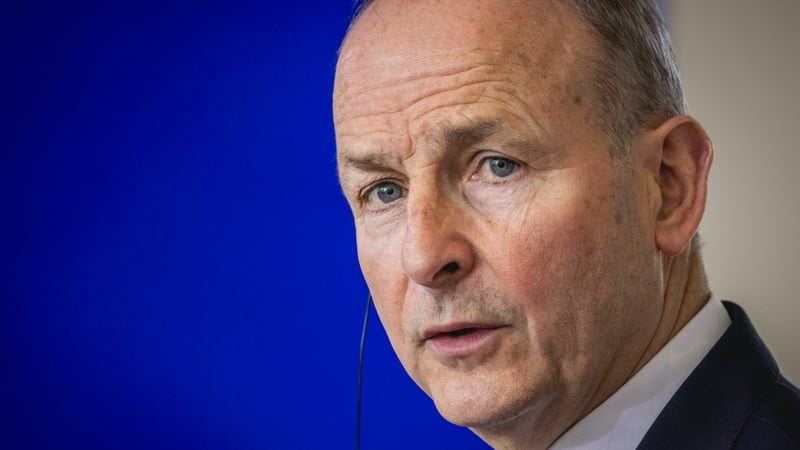
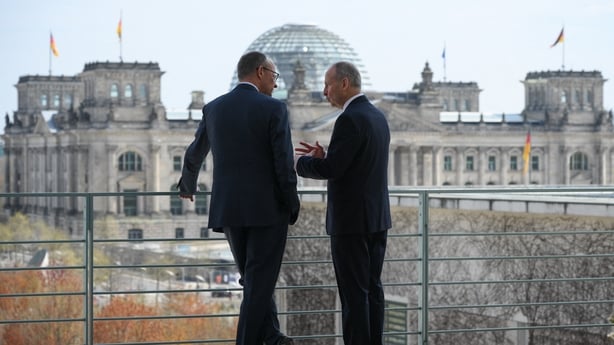
And, potentially not for the last time, those same days have seen Micheál Martin face the rumours down, replying firmly when asked at a bilateral meeting in Berlin with German chancellor Friedrich Merz on Thursday whether he felt under threat: "No, I do not, in any shape or form."
This time the fuel price protests and blockades, and the Government's tone in responding to them, have been the spark to light the fuse of the presumptive revolt.
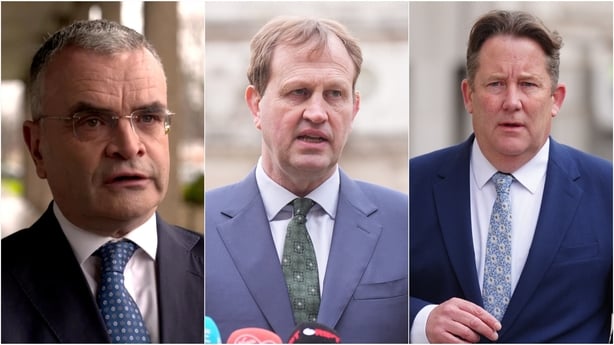
That fuse has for now fizzled out, with the three long-speculated potential future leaders - Minister for Justice Jim O Callaghan, Minister for Social Protection Dara Calleary and Minister for Transport Darragh O'Brien - all, belatedly, publicly backing the Taoiseach on Thursday evening and yesterday morning.
But few believe that means the plotting will be gone for long, or that the reasons behind it have now been resolved.
Fianna Fáil instability
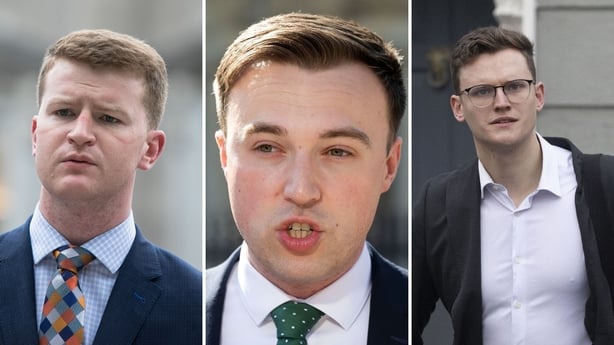
It began on Wednesday afternoon when Fianna Fáil's three youngest TDs - Albert Dolan, Ryan O'Meara and James O'Connor - raised concerns about their party's current circumstances.
In a lengthy statement, the three rural TDs from Galway East, Cork East and Tipperary North - all areas where the fuel protests had garnered support - said they "viewed the events of the past few weeks with a real and deep concern".
Warning of a "disconnect" between the party and the public, they said "the social contract is strained to breaking point" and that the view from some unnamed senior colleagues, that TDs are there to "just explain government difficulties to our communities" is "not a role we want, nor will we accept it any longer".
The statement was quickly followed three hours later by a separate - and, those involved insist, entirely coincidental - letter from TDs Sean Ó Fearghaíl and Paudie O'Sullivan, as well as Senator Anne Rabbitte, to parliamentary party chair Brendan Smith, calling for an "urgent" meeting of TDs and senators to discuss concerns within Fianna Fáil's ranks.
Of course, it cannot be discounted that the need to be seen to distance yourself from at times unpopular Cabinet remarks about the protests and blockades was just as key a reason for the statement and letter as the more worthy and pious reasons given.
But, regardless of the intent, the very public correspondence was immediately latched onto by those seeking leadership change in the party.
By Thursday morning, an atmosphere of whispered strategising occupied many in Fianna Fáil who, after a long week, were still in Leinster House.
Watch: Taoiseach says position not under threat in 'any shape or form'
Some talked up the possibility of a no confidence motion in the Fianna Fáil leader being tabled at an "urgent" parliamentary party meeting or what Micheál Martin's supporters have pointedly described as "the standard weekly parliamentary party meeting on Tuesdays".
Others privately debated whether rebels had the names of 12 party TDs required to table the motion, or not.
Yet more groups discussed the possibility of a candidate emerging, either from the ministerial ranks or a "credible" yet-to-be-found stalking horse from the backbenches to push more senior colleagues into action.
And those loyal to Mr Martin were just as keen to ask what exactly had the Taoiseach done to genuinely warrant another rumoured revolt mere months after the Jim Gavin affair, given the fuel cost crisis's origin is in global not national events - one quipping that Iranian supreme leader Mojtaba Khamenei and US President Donald Trump are unlikely to be swayed too much by who heads up the party.
Of the few Fianna Fáil Oireachtas members to go on record on Thursday were Wicklow-Wexford TD Malcolm Byrne, who said Mr Martin "has been a good Taoiseach but not always a good Fianna Fáil leader", and senator Fiona O'Loughlin who said many of those seeking leadership change have a "pattern" of doing so.
Dublin South West TD John Lahart, considered to have a good read on the ongoing leadership debate, later told reporters "I don't think the party is ready" for a change at the top.
All that was left was for Ministers O'Callaghan, Calleary and O'Brien to each re-affirm their public loyalty to Micheal Martin. All did so by yesterday morning.
Why not now?
For some, that change in tone from rebellion to apparent knee-bending in a matter of hours indicates the alleged heave may have in reality been little more than the latest in a long line of huffs.
But there are five practical and pragmatic reasons for why the latest mooted move against Mr Martin has seemingly ended before it ever really began, and which suggest the stand-down has more to do with current timing than a lack of desire for change.
The first reason is the rather obvious one: there is for now no confirmed alternative candidate.
While speculation continues over the future ambitions of Mr O'Callaghan, Mr Calleary and Mr O'Brien - two of whom were politically bruised by the fuel cost protests - all three made it abundantly clear this week, after a period of silence, that they would not support any heave at this stage.
Some backbench Fianna Fáil rebels have suggested a non-Cabinet candidate could be put forward as a stalking horse to force one or all of the ministers to reveal their true intentions, but others in the ranks have made it clear there would not be any value in asking the party to change leader unless there was a clear idea of who would be the replacement.
The second reason is that while there is significant disgruntlement within Fianna Fáil, there is no guarantee any internal party no confidence motion against Mr Martin would succeed right now.
That point was underlined by an Irish Times straw poll of the Taoiseach's 47 TD colleagues yesterday, of which 22 responded saying they would support the current leader, 25 keeping their silence.
Given Mr Martin would need the backing of 25 party TDs to win a confidence motion, and can already rely on 22 plus his own vote, the current numbers run the real risk of not adding up. And the more detail-orientated among the rebels know it.
Thirdly, the window for any leadership change in the very near future is extremely tight, given the fact Fianna Fáil's centenary celebrations and Ard Fheis are on 16 May; the Galway West and Dublin Central bye-elections most likely on 22 or 23 May and the small matter of Ireland's six-month control of the EU presidency beginning on 1 July.
Trying to change leader before the bye-elections could risk a messy 100-year anniversary when everyone is meant to be on their best behaviour, while doing so after what are predicted to be difficult bye-elections for the party would mean any new leader's first big moment would be the EU presidency itself.
Fourthly, due to party constitution rule changes more than a decade ago, grassroots members will have a vote in any Fianna Fáil leadership contest, a situation that, while not overly complicated would stretch out any campaign and voting process to weeks rather than days.
And, fifthly, while not receiving as much attention as other factors, there is the age-old political adage that it is never a good idea to become leader just as a potential crisis is looming on the horizon.
In recent weeks, the Cabinet has been briefed on various consequences from international energy difficulties, a situation that changes by the day and week.
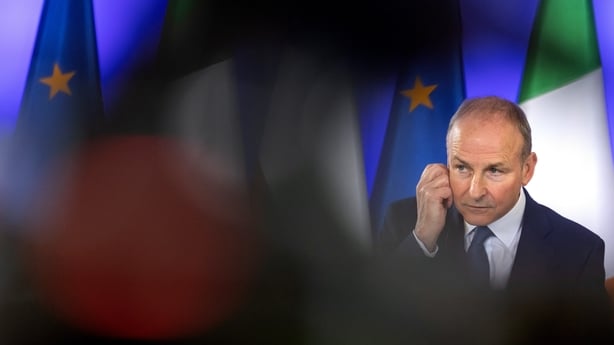
The more pessimistic of those predictions are sobering, particularly when they are coupled with the ongoing question of what impact last weekend's more than €500m extra energy supports could have on this autumn's budget and future industrial relation disputes, ICTU's Owen Reidy telling RTÉ News on Friday night "too many in Government have taken [traditional] industrial relations peace for granted".
Given their roles in Cabinet the three ministers long-rumoured to be potential future Fianna Fáil leaders will know about these predictions all too well, again pointing to a more likely timeline of early next year for a renewed heave when the EU presidency is over and the full scale of the economic situation truly known.
The best it seems rebel TDs can hope for is that Mr Martin hints at a timeline in the coming weeks or as some have suggested at the centenary Ard Fheis.
But given the Taoiseach told the Sunday Independent in February he wants to lead Fianna Fáil into the next general election; that he will in theory remain as Taoiseach until the role rotates to Fine Gael at the end of 2027; and that outlining any timeline risks immediately making him a lame duck leader, it would seem any chance of Mr Martin doing so may be wishful rebel thinking.
Wider coalition discontent
Given such intense focus in recent days on internal Fianna Fáil manoeuvres, you could almost be forgiven for forgetting the Coalition actually faced a far bigger wobble this week in the loss of two Government-supporting independents.
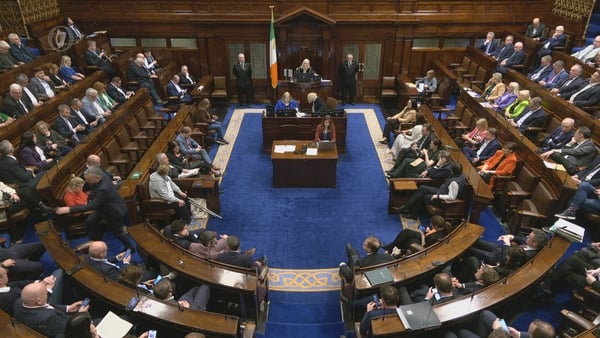
The now former minister of state Michael Healy-Rae and his brother Danny went back to their political roots on Tuesday after refusing to vote with the Government in a confidence motion which was eventually won by 92 votes to 78.
Ever the locally-focused politician, Michael announced his decision in the Dáil by saying: "The people of Kerry are telling me, they are unhappy with this Government. They don't want to see me or any Healy-Rae supporting it."
Watch: Michael Healy-Rae tells Dáil he will resign as minister of state
And, ever the shrewd showman, he was soon outside the gates of Leinster House, fist clenched high above his cap as he received the cheers of nearby protesters who hours earlier had urged him and other independents to step down.
The development does not yet fully threaten the coalition as the combined power of Fianna Fáil, Fine Gael and independents can still rely on 92 TDs, a relatively comfortable total of five more than what is needed to retain a Dáil majority.
But it is an unavoidable reality that the gap has tightened by the decision of the Healy-Raes - who despite the sometimes deliberately cartoonish image are widely regarded by strategists for their instinctive political antennae - to depart.
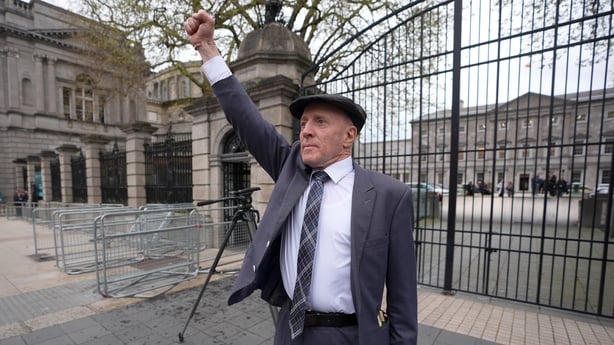
And the fact that same decision appears to have led to a bump in local constituency support will not have been lost on other Independents and backbenchers currently tasked with trying to defend the reasons for Government policies, and who will have been given food for thought by the Kerry TDs' latest political pivot.
Asked on Wednesday if she was surprised by the move, Fianna Fáil TD for Kerry and Minister for Children Norma Foley said: "Michael has to do, and indeed any TD has to do, what they have to do.
"But government has to lead, and government in times of international turmoil has to provide steady leadership."
The Last Post
That 'do what's in your interest or do what's in Government's interest' dilemma will no doubt be on the minds of many in Fianna Fáil as they arrive for tomorrow's Arbour Hill commemorations.
It is and will remain a solemn event. A chance to honour those who have come before them, to send a message to the country of today, and to hopefully inspire the next generation.
As Fianna Fáil's leader, Cabinet ministers and senior colleagues from the past and present stand to attention and watch the tricolour lowered to half mast at the commemoration, there will be much on the minds of those involved.
And, as the lone bugler plays the Last Post as is tradition, it is inevitable one or two will be wondering what the coming months will bring, and who the music is really playing for.