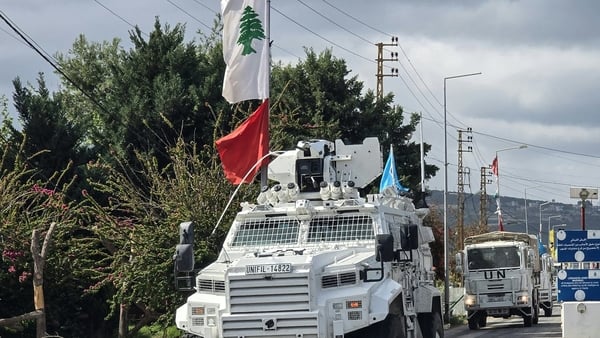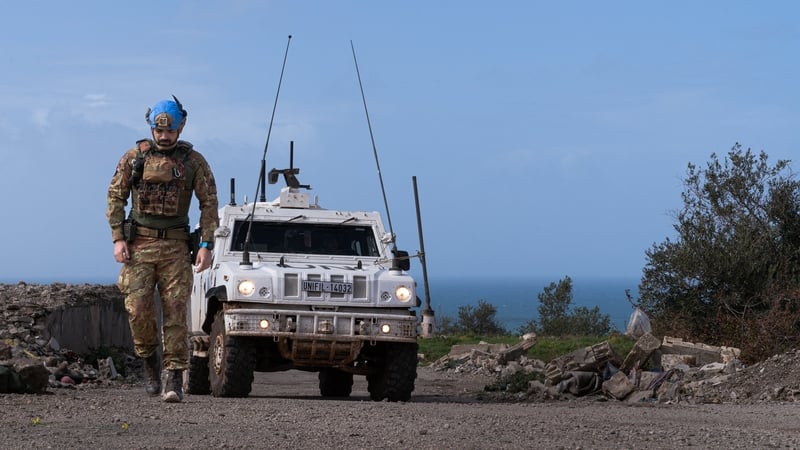

"This has been a difficult week for peacekeepers working near the central part of UNIFIL's operations," a UN spokesperson said, after another explosion inside a UN position injured three peacekeepers on Friday.
It followed the killing of three Indonesian soldiers and the wounding of three more, in two separate attacks earlier in the week.
Taoiseach Micheál Martin called it a "shocking escalation of violence".
The Blue Helmets have vowed to stay in position, but the situation grows increasingly volatile by the day.
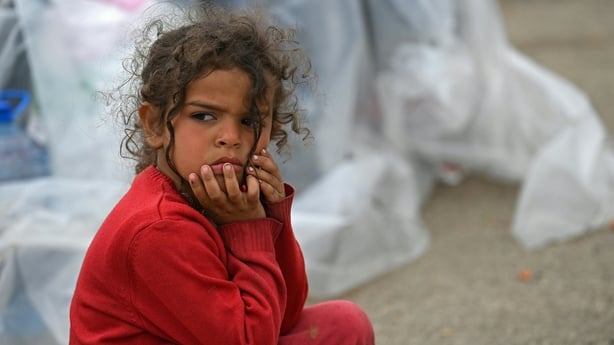
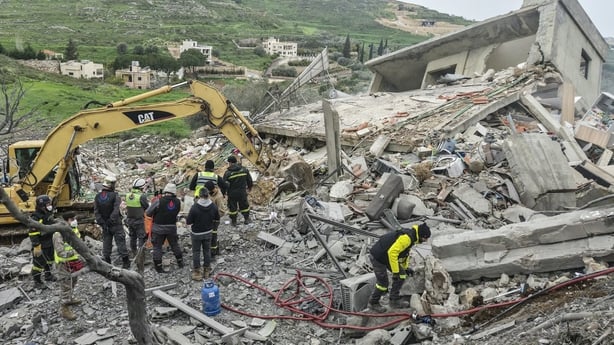
One million people have been displaced as Israel presses deeper into Lebanon.
Israel launched this latest offensive after Hezbollah fired rockets across the border, following US and Israeli strikes on Iran.
There are just a few months to go before UNIFIL's near five-decade deployment, in which Irish troops have continuously served, winds down and many fear a bleak future awaits south Lebanon.
Michael Browne, former head of UN Security who served three tours with UNIFIL during the 1980s and 1990s said that peacekeeping, particularly in Lebanon, was "baked into the DNA of the Defence Forces".
"Those of us who have served on deployments in south Lebanon are very proud of Ireland’s contribution to peace and stability in the area and we are ever mindful of the ultimate sacrifice made by 47 comrades-in-arms while doing so," he told RTÉ News.
He said seeing the region and its people engulfed in another conflict not of their making was "heartbreaking in the extreme".
"There could not be a worse time for the non-renewal of UNIFIL’s mandate and the cessation of vital support which the force provides to the local populations," he said.
Last August, the UN Security Council voted to end UNIFIL’s mandate on December 31st 2026.
UN sources told RTÉ News that beyond that date, a contingent of foreign troops could remain in the country in support of the Lebanese armed forces.
UN Secretary General António Guterres has been tasked with making recommendations to the council by June this year, for the post-UNIFIL scenario.
"Maybe the EU as a regional institution could come in behind the Lebanese Armed Forces and provide support," said Vice Admiral Mark Mellett, former Chief of Staff of Ireland’s Defence Forces.
"I would be very reticent to have an alternative to UNIFIL, because the legitimacy of the United Nations is gold standard," he said.
"Anything less than that, I think, is suboptimal".
But the chances of a multinational force winning the backing of the deadlocked UN Security Council remain slim.
Agreement between major powers on the UN’s most senior decision-making body is notoriously scarce.
Eyes and ears
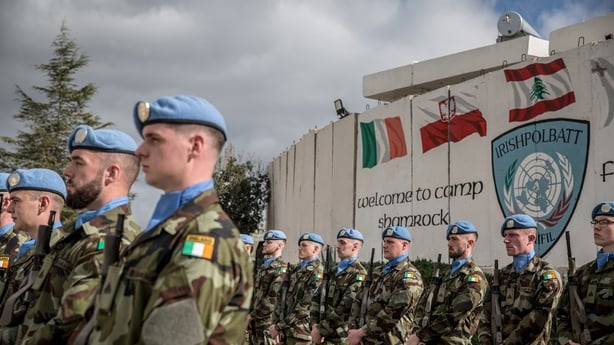
UN officials often describe the United Nations Interim Force in Lebanon [UNIFIL] as the "eyes and ears" of the international community.
That’s because observing, monitoring the "cessation of activities," and reporting their findings to the UN Security Council - are the key pillars of the mission.
They also act as a deconfliction liaison between Israel, Lebanon and Hezbollah.
The Blue Helmet force was first deployed there in 1978 following Israel’s invasion of Lebanon, in response to a cross-border raid into Israel by a Palestinian group.
Its mandate was to observe the Israeli withdrawal from Lebanese territory and support Lebanon in re-establishing control over the south of the country.
Over time, as hostilities continued to erupt, the mission’s mandate - renewed by the Security Council on an annual basis - expanded.
In 2000, a Blue Line marked by blue barrels was drawn some 120km from the Mediterranean Sea to the Golan Heights, to separate the parties to the conflict.
But violations by Israeli forces and Hezbollah militants persisted.
In 2006, Israel invaded again, in response to a Hezbollah ambush of Israeli soldiers and demands for the release of Lebanese prisoners.
UNIFIL's mandate grew to include a humanitarian element, to assist the residents of southern Lebanon, and, crucially, to "ensure that its area of operations is not utilised for hostile activities of any kind".
This became a sticking point.
Israel and its chief backer at the Security Council, the United States, pointed to ongoing Hezbollah activity in the area as evidence that UNIFIL had "failed" in its mission. Israeli officials even accused Blue Helmets of acting as "human shields" for the Iran-backed Shia militants.
UN officials vehemently reject the accusations.
"There is a deep-rooted misconception in some circles that UNIFIL was tasked with, or even had the authority to, disarm Hezbollah," said UNIFIL spokesperson Kandice Ardiel.
"This has never been the case," she told RTÉ News from UNIFIL headquarters in Naqoura, southwest Lebanon.
Implementing the terms of the Security Council resolution under which UNIFIL is deployed is the responsibility of the parties - Israel and Lebanon - with UNIFIL playing a supporting and assistance role, she said.
Under the resolution, Lebanon is required to establish a zone "free of unauthorised weapons" between the Blue Line and the Litani River.
When UNIFIL forces observed and reported a number of activities and sites, including private property that it sought to investigate and asked Lebanese authorities to facilitate access, "that facilitation was not forthcoming," she said.
"UNIFIL has always been there to help, but we can only do what the Lebanese authorities ask us," Ms Ardiel said.
Mark Mellett said he had a "sense of foreboding," about Lebanon’s future as UNIFIL prepares to leave, Israel continues its advance, while the Lebanese Armed Forces lack the capability to counter Hezbollah without substantial international support.
"The bedrock of any state sovereignty is its defence forces," he told RTÉ News.
"They provide the kind of framework for the institutions that provide for the state, for where institutions function, people are free and the vulnerable are protected," he said.
Caught in the crossfire
Distrust of UNIFIL among some locals has grown in recent years, often seeded by Hezbollah disinformation, according to UN officials.
The slain Hezbollah leader Hassan Nasrallah once described UNIFIL as an "armed foreign force operating on Lebanese soil" and a "spy for Israel."
In 2025, a UN spokesperson told RTÉ News that "persistent rumours" had played a role in the killing of Irish peacekeeper Seán Rooney.
Private Rooney was killed after the UN-marked armoured vehicle he was travelling in came under fire near the town of Al-Aqbiya in the south of Lebanon, on 14 December 2022.
Another Irish soldier, Trooper Shane Kearney, 22, was badly wounded in the incident.
Meanwhile, troop-contributing nations have accused Israeli forces of directly targeting peacekeeping troops and UNIFIL bases.
The UN’s preliminary findings, indicate the first explosion inside a UNIFIL outpost was consistent with Israeli tank fire, according to UN sources.
The second was a roadside bomb, consistent with Hezbollah activity in the area.
In a hastily convened Security Council meeting on Tuesday morning, the attacks were widely condemned.
Diplomats accused Hezbollah of indiscriminate rocket fire and of keeping the Lebanese people hostage.
Israeli forces also came in for heavy criticism. The French envoy accused Israeli soldiers of "aggression" and "intimidation" of the French contingent there.
After UNIFIL
Exchanges were characteristically diplomatic.
But hanging over proceedings was the question of what happens next.
On the same day, Israel’s defence minister Israel Katz outlined plans to clear southern Lebanon of its inhabitants, citing Israel's destruction of Gaza as a model.
"All homes in Lebanese villages near the border will be destroyed — in accordance with the Rafah and Beit Hanoun model in Gaza," he said, "to remove, once and for all, the threats near the border."
"At the conclusion of the operation, the IDF will establish a security zone inside Lebanon… and will maintain security control over the entire area up to the Litani River," he added.
He said that Israel would prevent the return of 600,000 residents of southern Lebanon to areas south of the Litani River "until the safety and security of northern Israeli residents is ensured".
UN humanitarian chief Tom Fletcher asked the Security Council on Tuesday how the body would react to these pronouncements.
"Given the trajectory that some Israeli ministers have described and given what we have seen in plain sight in Gaza, how will you protect civilians?" he said.
"Secondly, given the intensity of the coercive displacement that we are seeing, how should we prepare collectively as the international community for a new addition to the list of occupied territories?" he added.
On Thursday, the New York Times reported that Israeli officials had made private calls to local Christian and Druze communities in south Lebanon assuring them that they could stay.
But they said any Shiite Muslims who had sought shelter in other areas, amid Israel's destruction of Shiite-majority villages, should be forced out, according to the newspaper.
It’s an indication that the map as well as the ethnic mix of south Lebanon is being redrawn.
And with that, the Blue Line is likely to vanish.
Reflecting on the force’s imminent departure, spokesperson Kandice Ardiel said: "From 2006 to 2023, UNIFIL contributed to the longest period of stability in south Lebanon in recent memory, which meant a generation of children could grow almost to adulthood without knowing war".
"That is hard to quantify, but I think it’s truly meaningful".