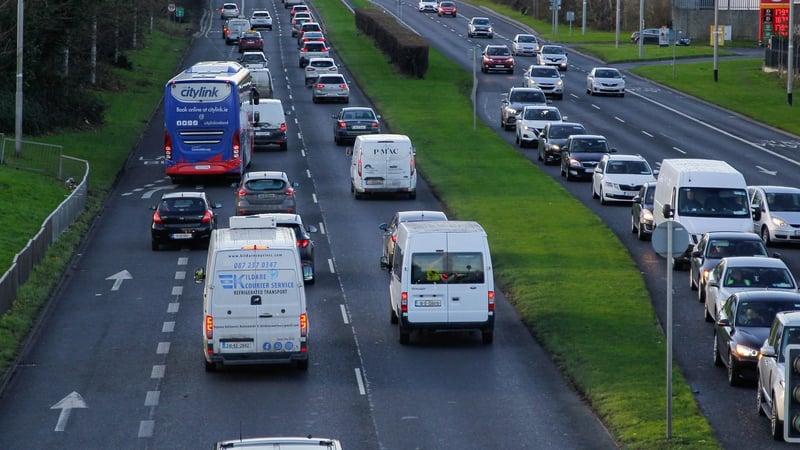

Did you ever wonder why it seems to take longer and longer to commute by car?
There are various reasons.
But the growing number of cars on the road is a major factor.
Over a 20-year period from 2005 to 2025, the number of cars rose from 1.6 million to 2.5m, according to figures from the Department of Transport and the Central Statistics Office.
That is an increase of 56%.
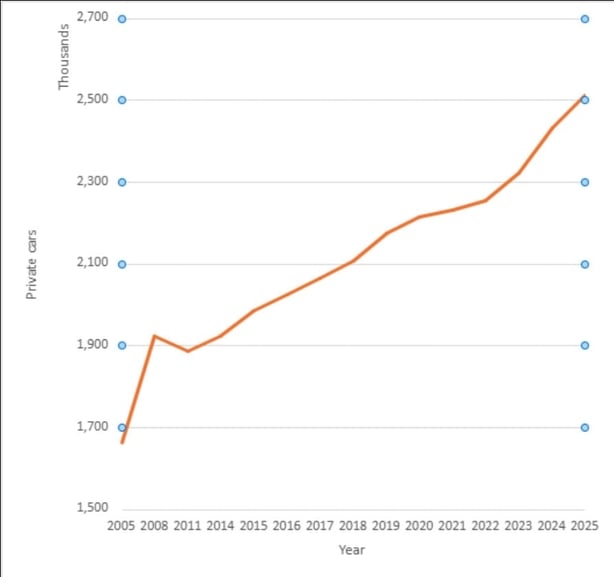
One interesting feature from the graph above is that the only period when car numbers fell was during the financial crisis which began in 2008.
But the rising numbers on the road over the past two decades comes as the population has grown too.
In 2005 there were 4.1m residents in the Republic of Ireland. By last year it was 5.4m - an increase of 31%.
However, the rise in the number of private cars has been proportionately faster than population growth.
But Ireland's car ownership rate is the fourth lowest in the EU.
Stronger economic growth over the past 20 years also means people have more money to buy cars.
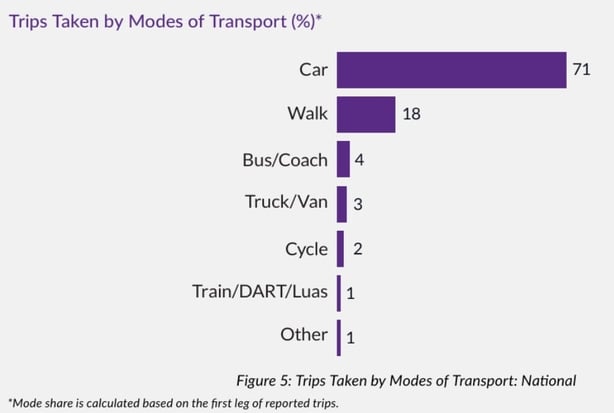
The National Household Travel Survey for 2024 published by the National Transport Authority shows the overwhelming majority of journeys were made by car at 71%. The remainder were: 18% on foot, 4% by bus or coach, 3% in truck or van, 2% by bike and 1% via train, DART or Luas.
The housing crisis has also forced many to travel longer distances as they seek more affordable accommodation.
That frequently means public transport, cycling or walking are not options.
The trend of employers asking staff to return to the office and cut back on remote working is a factor too.
UCD Professor of Transport Economics Aisling Reynolds-Feighan says "Covid hid the problem" of the huge increase in the population and workforce.
But she adds: "Employers are now looking for people to spend more time in the office because there are all sorts of advantages to having people on site working together.
"It has really brought home this increase in the population and in the labour force."
'Fairly extraordinary period of growth', says academic
Dr Pete Lunn, Research Professor with the Economic and Social Research Institute, says most countries struggle to keep infrastructure abreast of economic growth.
He adds: "We had a fairly extraordinary period of growth, so it happened to us. We are struggling to keep pace, so we are seeing massive congestion."
He says Ireland's climate target means the Government has to invest in giving people alternatives to cars.
The State has spent heavily on transport with significant emphasis on buses, trains, cycle paths and foot paths while reducing public transport fares.
Dr Lunn says that lower public transport fares have "worked well" and are a key part of influencing behaviour.
"If you want to make something attractive to people you make it easy, you make it cheap and you make it fair," he says.
Over the past ten years the Budget for the Department of Transport has risen from €1.8bn in 2016 to €4.7bn in 2026.
This year the two biggest spending categories will be public transport and sustainable mobility (including walking and cycling) which will receive €2.39bn. Roads and road safety is allocated €1.73bn.
Professor Reynolds-Feighan says: "They are investing heavily in public transport, but it is really not enough to affect a shift away from private cars."
She goes on: "People will use public transport if it is reliable and if it is close in time and money costs to what you get with a private car. Unfortunately, it is not.
"We have a huge increase in people trying to get to work and public transport does not work for a large share of those people. It does not link where they live and where they work."
She says it will require a "huge increase" in public transport provision to reduce the share of journeys by car.
In the capital she suggests building more light rail and pressing ahead with MetroLink which she predicts will probably take 20 years.
She says shorter term measures should also proceed, such as connecting Dublin’s three main rail stations so that heavy and light rail are joined up.
'Significant increase in public transport usage', says minister
Minister for Transport Darragh O’Brien says there has been "a really significant increase in public transport usage".
"We actually had record numbers in 2025. About 365m public passenger journeys in one year. It's over a million a day," he says.
Minister O’Brien admits there are "issues" with congestion on Irish roads due to an increase in the number of private cars.
"But we've got to continue to provide the alternatives for people [so] that they can get out of the car and they can use the train, the Luas and the bus, and that's what's happening."
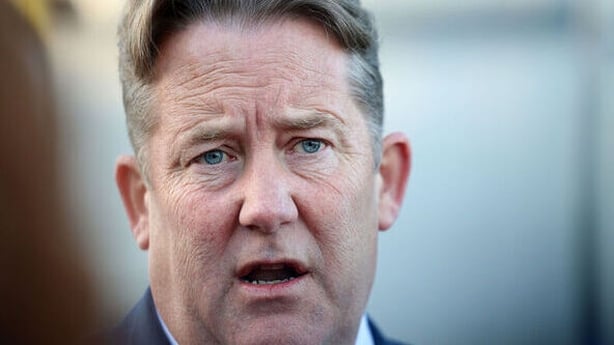
The minister has convened a working group on congestion, which he chairs, to work on short term measures in advance of major transport projects being completed.
He says it is going to examine measures to "alleviate some of the congestion issues that we see, particularly in the Greater Dublin Area, but not exclusively".
Another issue is opposition to changes to public transport.
Dr Lunn says new projects are frequently met by resistance from people who see the downsides before the advantages become clear.
At present there are pockets of opposition to changes to the bus network as National Transport Authority rolls out Bus Connects.
Dr Lunn says: "If you cast your mind back to when the Luas construction was ongoing, there was a lot of controversy about whether it would be a white elephant and whether it would really work. And then of course once you have got one everybody wants one."