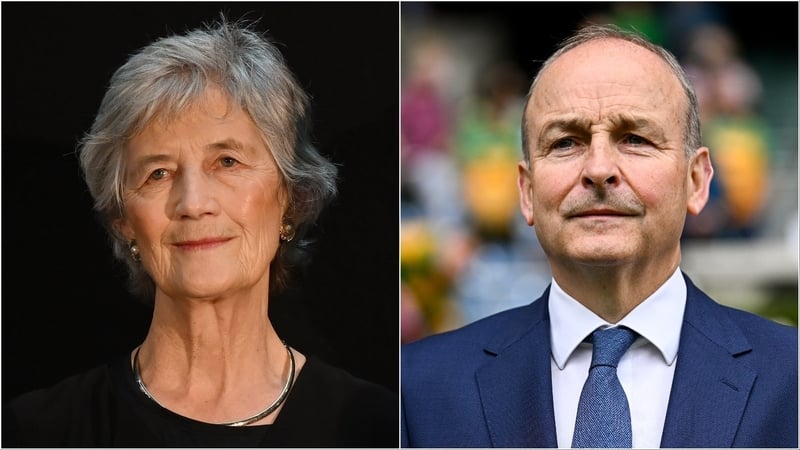
On Sunday last, as the US and Israel's conflict with Iran entered its second week, President Catherine Connolly issued what can be interpreted as a direct intervention on the crisis in the Middle East.
Against a backdrop of Government leaders refraining from outright condemning the US-Israeli strikes on Iran as a breach of international law, President Connolly declared that Ireland had an obligation to "speak plainly" about any such violations.
Without namechecking the US and Israel directly, President Connolly said the situation in the Gulf was a "deliberate assault on international laws that have underpinned global peace for 80 years".
Her message was unmistakable.
"Violations of the UN Charter cannot be ignored. We must name them as such, without euphemism and without equivocation," she said.
The statement, which came on International Women's Day, is being viewed as many as a pointed intervention in the early months of her seven-year Presidency.
Is this a sign of things to come?
President Connolly's words may have served as a vivid vindication for many of those who propelled her to a landslide election victory over Heather Humphreys in October.
However, given her unequivocal stance on Gaza, the Triple Lock and Ireland’s neutrality, this intervention could be seen as largely expected.
An inauguration speech with a political edge
Throughout the campaign, President Connolly made clear that she would be an Uachtarán who would never shy away from speaking her mind, akin to her predecessor Michael D Higgins.
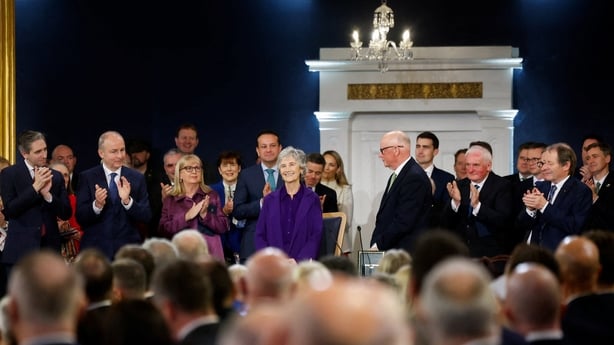
Indeed, her inauguration day in Dublin Castle’s historic St Patrick’s Hall last November was a day not only marked by ceremony, but by a forthright inaugural address that effectively threw down the gauntlet at the Government’s feet.
Her speech to the assembled party leaders, diplomats, her family and her friends carried a political edge and a signal to Government that she would push the envelope of her powers.
She lauded Ireland’s longstanding tradition of military neutrality, and paid tribute to the highly respected Irish peacekeepers who have worked on UN peace support operations for almost 70 years.
And she emphasised how the "horrors of war" and the "normalisation of genocide" have never been and never will be acceptable to the Irish people.
She namechecked three of her predecessors, Michael D Higgins, Mary McAleese and Mary Robinson, and told how they pushed the boundaries of their position to became influential and societal voices against a backdrop of a shifting political landscape both home and abroad.
Perhaps most significantly, she spoke of the "powerful mandate" that she had been entrusted with by her supporters and how she wanted to "articulate their vision for a New Republic".
It was crystal clear from that first address that while President Connolly knew she cannot make policy, she certainly wanted to influence those who do.
Consequences of 'might is right' now clear
Last January, the first demonstration of that came at a welcome reception for more than 50 ambassadors and diplomats to Ireland at Áras an Uachtaráin.
Here, we got a real sense of how President Connolly intends to deliver on her mandate.
While she was unable to deliver a speech to the assembly due to family reasons, it was circulated to those gathered in the room and to the media.
She asked had the world abandoned the agreed language of peace and moved to a new language where war is normalised and peace is undermined.
And she highlighted the "appalling humanitarian situation" in Gaza and criticised Israel’s "highly restrictive controls continue to obstruct an effective humanitarian response".
This speech came at a time when tensions between the US, Denmark and Europe were bubbling over the sovereignty of Greenland.
While not specifically referencing Greenland and the US, she said: "The consequences of 'might is right' are now crystal clear before our eyes.
"Countries can be invaded at will, or threatened with invasion, and the UN organisations doing invaluable work in extremely dangerous locations can be demolished on a whim."
Looming White House visit at forefront of Taoiseach's mind
Fast-forward to the past two weeks, when the US and Israel's strikes on Iran and Iran's subsequent attacks on US bases across the Gulf region marked a deadly new phase of the Middle East crisis.
Taoiseach Micheál Martin has, thus far, abstained from directly labelling the US and Israel's actions as a breach of international law.
In his first remarks, he said he was "deeply concerned" by the developments and said Ireland has "always believed that conflict should be resolved through diplomacy and negotiation, in line with the principles of the UN Charter and international law. That must apply in this situation as much as in any other".
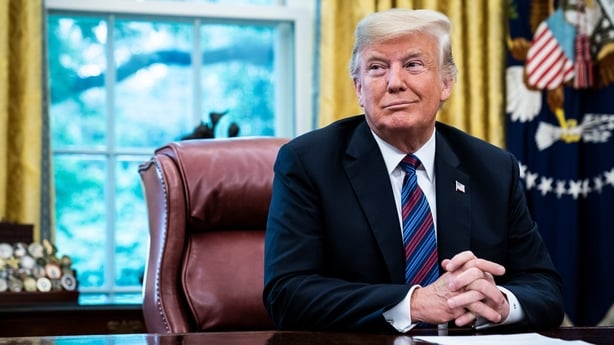
Undoubtedly at the forefront of his mind is his looming St Patrick's Day visit to the White House for a meeting with Donald Trump that will play out in front of the eyes of the world.
Replying to critics from the Opposition in the Dáil, the Taoiseach has repeatedly said he has to be mindful of Ireland's national interests during the visit.
It was never going to a simple encounter anyway but outright condemnation of the US and Israel's actions ahead of this engagement would certainly add to the tensions around the Oval Office visit.
Enter President Connolly.
In that International Women's Day statement, her message was clear - "deliberate assaults on international law" must be called out.
And she said Ireland's "unbroken record" of international peacekeeping since 1958 and the "hard-won, peaceful resolution" to the Troubles in Northern Ireland "oblige us to speak plainly".
Read more: Middle East conflict is 'assault on international law' - President
On Monday, came the Government's response. It was delivered by a Government spokesperson at a briefing for political correspondents.
The response to the President was carefully crafted, but clear in its message.
"Successive governments have always stood firm in support of international law, it's especially important for a small country like Ireland.
"The Government fully respects the constitutional role and office of President Connolly, but it is important to recall that responsibility for international affairs rests with Government."
Later that day, Tánaiste Simon Harris said Ms Connolly was "right to remind people of the horrors of war" while defending the Government's stance on the Middle East crisis.
"I think the Government has been very clear and consistent that the current actions in the Gulf do not have a UN mandate ... I have huge respect for the President, I have huge respect for her mandate, her constitutional role and her office, and therefore her right to speak on issues of concern to her, and indeed issues of concern to the Irish people," he said.
Connolly, Government, heading for a direct collision course?
As the Middle East crisis grinds on, debates are ongoing here over Ireland's security, defence, neutrality and the Triple Lock.
All are matters President Connolly was vocal on as a politician prior to her election as President.
And if last week's statement is anything to go on, she may well have more to say on them in future, honouring her mandate whatever concerns the Government might have.
The question that emerges after this episode is: Will President Connolly's "powerful" mandate and uncompromising views on national and international affairs place her on a direct collision course with Government policy?