
"This is a temporary pause. It's a year-long pause. We are going to be in exactly the same position in a year’s time. Everyone here knows that. SNAs know that, teachers know that, parents know that."
Those are the words of special needs assistant Samantha O'Flanagan at a protest outside the Dáil on Wednesday night.
After Monday night's dramatic reversal of plans to cut SNA provision in a number of schools, Opposition leaders made the same assessment.
They spoke of "kicking the can down the road". Privately, senior education figures agreed.
It is difficult to disagree with that.
As the dust settles on an eventful two weeks in politics and education what are we left with?
We have an extra €19m, much or all of which will be spent to keep 500 SNAs in the schools they work in.
Those SNA posts had been deemed surplus and were due to be reallocated to other schools where the need is regarded as greater.
This was always intended as a reallocation of posts, not a cut in overall SNA numbers.
Through the clouds of dust kicked up over the past fortnight, the Government was at pains to point out, again and again, that the actual number of SNAs will increase next year, by a record 1,717.
At the Public Accounts Committee on Thursday the secretary general of the Department of Education reiterated this.
Bernie McNally complained of "misinformation". She apologised for "miscommunication" on the part of the department.
"We very much are sorry for the distress that was caused to parents and to school communities over this, and we are going to do better in the future," Ms McNally said.
She was echoing the stance of Minister for Education Hildegarde Naughton, and others, but it is difficult to see this debacle for the Government as purely a result of miscommunication.
A huge public backlash led to intense political pressure, and the Government was obliged to take action, and quickly. On that everyone can agree.
The scale of the problem can be measured by its price - €19m in additional funding from the Department of Public Expenditure.
Two key ingredients combined to concoct this explosive situation.
As NCSE staff reviewed schools that they had not visited in years, in some they found SNA provision vastly out of kilter with what it should be, under the criteria, and the NCSE moved to correct this.
It was traumatic for schools to be suddenly and bluntly informed that they would be losing, in some cases, four of five out of nine mainstream class SNAs.
Yes, perhaps the news could have been communicated better. The pill could have been sweetened. But the severity of the cuts for those schools would have remained.
The second ingredient was the strong and organised parent-led grassroots movement that has developed in recent years.
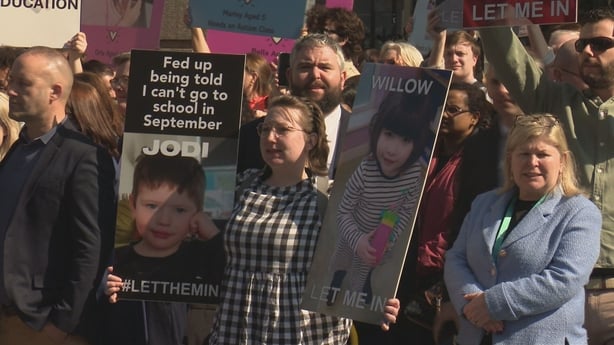
We saw the power of this movement last year, especially, as groups of parents from across the country engaged in a series of protests, sometimes locally, sometimes at the Department of Education in Dublin, or sleeping out overnight at Leinster House, to draw attention to the lack of specialised school places for their children.
Carrying placards with the pictures and names of their kids, the parents of children with additional needs have found their voice and are a new and formidable force.
"The group has grown organically from parents who are desperate to fight for their children's rights and who feel they are not being listened to or being taken seriously," one organiser, Rebecca Meehan from Waterford, told me at a protest last April.
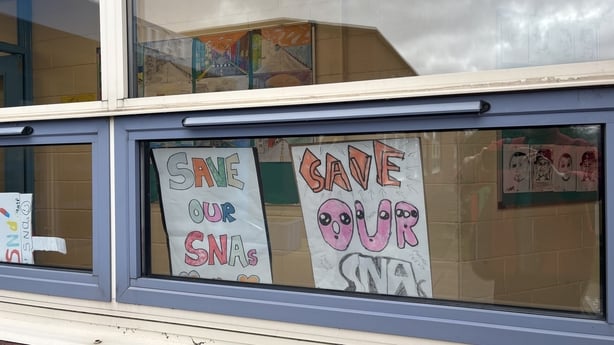
Parents like her, and schools and SNAs, rose up again this month at news of cuts to SNA provision. The deluge of letters to local TDs, the meetings, and the promise of protests, meant something had to give, and fast.
SNA projections short of actual demand
So there is a stay. The €19m means 500 SNAs will stay where they are. They will not be reallocated.
On top of this, schools will get an additional 1,717 SNAs next year.
With plans to open at least 400 new special classes in mainstream schools next year at least 800 of these new SNA posts will go towards staffing them.
A further 130 or more will go towards additional places to be created in special schools.
This leaves around 800 of the new SNA posts to be allocated to support children in mainstream classrooms in primary and post-primary schools.
But these calculations are based on projections made by the department before last year’s 1 October initial deadline for applications for special education places. This week we got confirmation that those projections are way short of actual demand.
On Wednesday, in the Dáil, Taoiseach Micheál Martin warned that the number of applications for specialised school places next year was "over and above anything contemplated".
On Thursday, the Public Accounts Committee heard more.
Questioned by Labour TD Eoghan Kenny, Bernie McNally confirmed "substantially increased need coming down the track".
"I can't share the number," she said, but it was "significant".
'Big question is where is the money to fund the teacher in each extra special class coming from?!' - INTO source
A system already running to stand still to meet special educational need is going to have to run even faster.
The department has committed to creating 3,000 additional specialist places for children in the coming academic year, and it has received funding on that basis, but that is not going to be enough.
"There is intensive planning happening since October to work to respond to the need" Ms McNally said. "We are working on that and we will publish the numbers and that plan."
Also at the Public Accounts Committee hearing on Thursday, an official from the Department of Public Expenditure was questioned persistently as to the source of the extra €19m suddenly allocated to the Department of Education last Monday.
Georgina Hughes-Edgars would not be drawn. "We are considering how to operationalise that," she said.
On Monday night, a Department of Education spokesperson confirmed to RTÉ News that the €19m was additional funding, over and above its budgetary allocation.
But listening to the Department of Public Expenditure official on Thursday the issue seemed somehow greyer.
"We are engaging with the Department of Education internally about that," Ms Hughes-Edgars said. "We are negotiating internally in relation to where monies are coming from."
It's not just SNAs. Primary teachers' union the INTO has said that it will insist on augmented special education teacher numbers and will hold the Government to its commitment to reduce class size to 19.
There is no doubting that the system is under huge pressure. There is also no doubting that it is not easy to get additional funding from the Department of Public Expenditure.
The additional, and as yet publicly unquantified demand for specialised education places in our schools next year, means the Department of Education is likely to need more additional funding. Will it get it? Will other areas suffer as a result, with funding reduced?
"Big question is where is the money to fund the teacher in each extra special class coming from?!" one INTO source texted me on Friday.

There are many more questions.
Apart from funding, where will the NCSE find the staff needed to serve these children?
This week and last, schools pointed out that SNAs and teachers are struggling to manage behaviours in vulnerable children who have no access to the therapies they so badly need; therapies such as speech and language or occupational therapy.
In the Dáil this week, Minister Hildegarde Naughton gave an update on moves to reintroduce therapists into special schools (they were removed a number of years ago).
To do this, the NCSE needs to recruit.
"I am pleased to inform the house that the initial recruitment campaign for 90 therapists is now closed with interviews currently under way. There was a very good response with almost 200 candidates applying for posts," she said.
To be viewing a response rate of just two applicants on average for every post as "very good" is an indication of the severe skills shortage in this crucial area.
A few final points:
Policy in the allocation of SNAs has not changed. Bernie McNally explained the process at length at Thursday's committee hearing and she defended it.
She explained how reviews are conducted by NCSE staff, and SNA posts found to be no longer needed, because the children whose needs they attended to have moved on for example, are reallocated.
Schools and parents will be hoping that a new circular might widen the criteria for the employment of mainstream SNAs but that process of reviewing and reassigning of provision will continue.
This does mean that those 500 or so SNA posts 'saved' for now may well be redeployed elsewhere in a year's time.
Ireland is not unique in the special education challenge it faces. "Internationally the prevalence rates are increasing" Bernie McNally told the Public Accounts Committee.
At a recent EU meeting in Cyprus, Minister Naughton asked her counterparts what was their departments’ number one challenge and all of them said "special education".
Last but not least, parents are not going away.
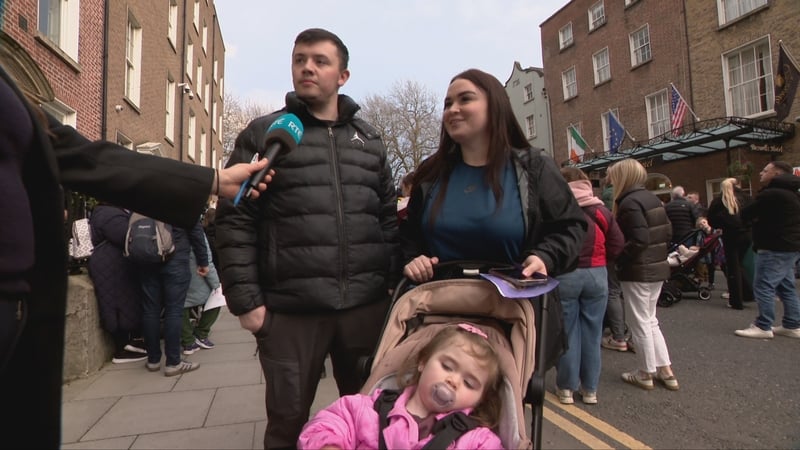
Among the 200 or so protesters who attended Wednesday’s demonstration outside the Dáil were Caine Graham and Hayley Myles, a young couple whose daughter Rumy has just been diagnosed with autism.
They looked the picture of the perfect family. To caresses and tickles from her parents, Rumy, in her buggy, responded with giggles and joy.
But her parent's fear and anxiety about the road ahead was palpable. Rumy is only three but they are already on that hard road.
"We cannot find a creche place for her because of her autism," Hayley explained. "She can't even speak at the moment and it’s impossible to get help."
This is what brought this young couple onto the street with their child on a February evening.
Like countless other parents, Rumy's will do everything they can to fight for their precious little girl.
The past fortnight has shown that the power of parents, such as Caine and Hayley, should not be underestimated.