
Amid the biggest US military build-up in the Middle East since the US invaded Iraq in 2003, it's becoming increasingly difficult to avoid the conclusion that Washington is planning war with Iran.
Some in Washington are cheerleading the move, framing it as an unprecedented opportunity to finally topple America’s arch enemy.
Others, though, are terrified another Western-backed intervention will plunge the country into a bloody and protracted civil war, as in many of Iran’s neighbours.
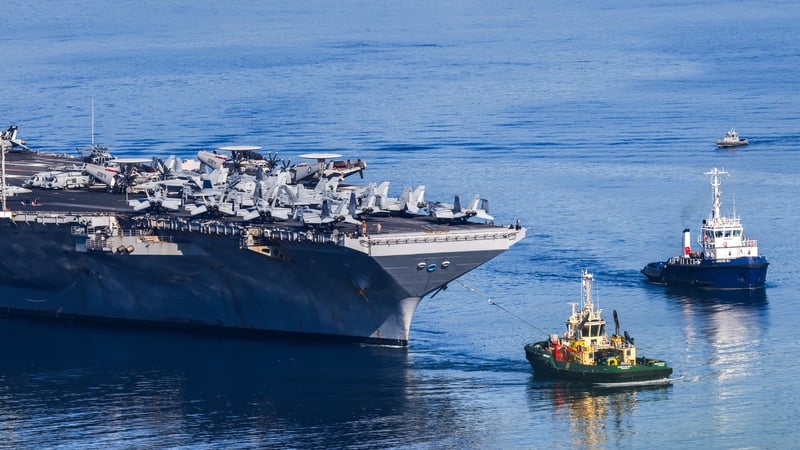
This week, the world’s biggest warship - the USS Gerald R Ford aircraft carrier - arrived at the US naval base on the Mediterranean Island of Crete.
It had previously been operating in the Caribbean Sea where, notably, it played a key role in the capture of Venezuelan leader Nicolás Maduro last month.
The ship joined the USS Lincoln already in the region, along with hundreds of fighter jets and enabling equipment, including air-to-air refueling tankers and warning and control systems.
"Apart from the number of ships and aircraft that they've got there, they've got a lot of the backup forces that you need to conduct quite a prolonged military campaign," said Michael Clarke, visiting professor at King's College London.
Alongside the military flex, US President Donald Trump ratcheted up the rhetoric.
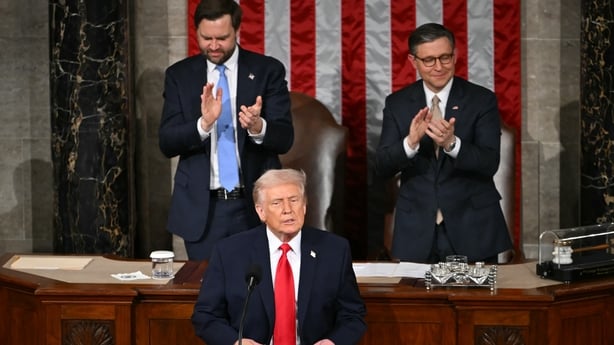
"I will never allow the world’s number one sponsor of terror to have a nuclear weapon," he told Congress in his State of the Union address to Congress on Tuesday night.
And in language reminiscent of the case built by the Bush administration ahead of the illegal US invasion of Iraq two decades ago, Mr Trump accused Iran of developing missiles "that can threaten our bases overseas and they are working to build missiles that will soon reach the United States of America".
That assertion appeared to contradict US intelligence assessments of Iran’s missile capability.
A few hours before, the Secretary of State Marco Rubio and CIA Director John Ratcliffe had been to see senior congressional leaders, reportedly to brief them on a potential attack.
"This is serious," said the Democratic Senate majority leader Chuck Schumer, as he emerged from the closed-door meeting.
"The administration has to make its case to the American people," he added.
A potential diplomatic off-ramp took the form of a third round of talks between US and Iranian negotiators in Geneva on Thursday, which the Iranian side described afterwards as "good progress".
The US, represented by Mr Trump’s go-to foreign conflict negotiating team made up of his son-in-law Jared Kushner and real estate developer Steve Witkoff, said little.
That suggested the Americans were keeping all options on the table.
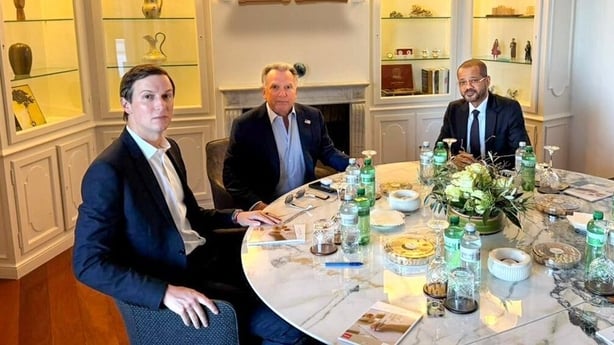
And a main sticking point had not gone away.
Iran insists it is developing nuclear capabilities for civilian purposes. But the US has repeatedly said no amount of uranium enrichment would be acceptable.
And so the talks, which included discussion on US sanctions and Iran’s missile program, went nowhere.
Another meeting is planned for Monday, this time with the UN Nuclear Watchdog - the IAEA.
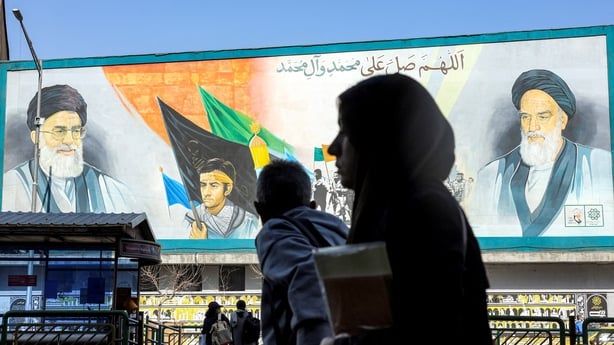
Throughout negotiations, the Iranian regime remained defiant.
Iran favoured diplomacy, the speaker of Iran’s parliament Mohammad Bagher Ghalibaf said in response to Mr Trump’s State of the Union speech, but he added that the country was prepared for "a remorseful response that would make any aggressor regret their malicious behaviour".
It echoed similar remarks by Iran’s supreme leader Ayatollah Ali Khamenei.
Writing on X – and thereby demonstrating the leadership’s unfettered access to western social media platforms, while maintaining a communications blackout on the Iranian people – he said the US President kept saying they had "the strongest military in the world".
"The strongest military force in the world may at times be struck so hard that it cannot get up again," he wrote.
Anticipating retaliation perhaps, the United States Embassy in Beirut, Lebanon, ordered the evacuation of all non-essential staff.
And yesterday, the US Ambassador to Israel Mike Huckabee emailed staff urging those who wanted to leave to "do so TODAY", according to reporting from the New York Times.
"There is no need to panic," he added, "but for those desiring to leave, it's important to make plans to depart sooner rather than later".
For Professor Michael Clarke, the situation suggested that the Pentagon was furnishing President Trump with a range of options – from one-off precision strikes to all-out war for regime change - but that he was yet to make up his mind.
The problem with that, he told RTÉ News, is that it created expectations.
"He's painted himself into a corner by having such a big military buildup," he said, "because people will be expecting some significant political gain from this, or the initiation of a war against Iran".
A further problem, he added, was logistical.
"You can't keep everything keyed up, all the engines ready without replacing them," he said.
"You can't keep people keyed up either, without them needing some rest and rehabilitation," he said, adding, "you can do it for a while, but you’ve either got to use it or stand it down after two to three weeks".
He estimated we were over a week into that time frame. Already, reports of blocked toilets causing problems for crew on board the USS Ford are circulating.
Meanwhile, Iran’s neighbours have made it clear they are firmly opposed to US military intervention.
Despite strong antipathy to the Iranian regime, they fear not just retaliatory strikes either by Iran or its proxies (including Houthis, Hezbollah and Iraq-based groups), but also the very real prospect of regional chaos - not to mention an overwhelming refugee crisis, in the event of collapse of a nation of some 93 million people.
Europe too would be on the doorstep of another wave of asylum seekers fleeing conflict in the Middle East, potentially far bigger than the Syrian crisis that began in 2011.
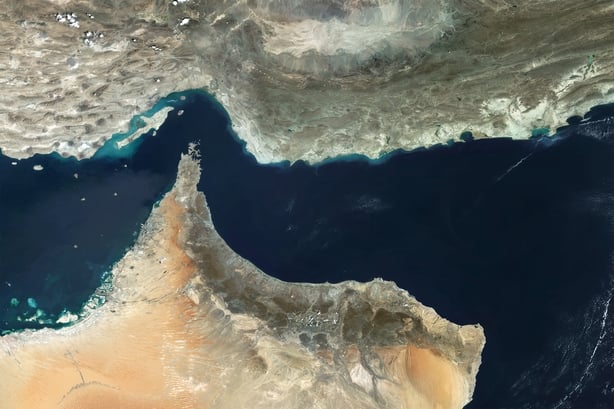
There’s also the economic risk of war choking off the Strait of Hormuz, through which roughly one fifth of the world’s crude oil and a quarter of the world’s liquified natural gas are shipped.
That could send energy prices and inflation soaring around the world.
US allies Saudi Arabia, Qatar, Oman, Türkiye and Egypt urged Washington to pull back from the brink.
The Israeli government, by contrast, is supportive of action, despite being in the firing line should Iran strike back. The US military presence, of course, is in no small part designed to protect Israel in the event of hostilities.
"We are keeping an eye open and prepared for any scenario," Israel’s prime minister Benjamin Netanyahu said on Monday.
"I made it clear to the Ayatollah regime that if they make perhaps the most serious mistake in their history and attack Israel, we will respond with a force they cannot imagine," he said.
Not for the first time in the context of war with Iran, the US president recently invoked the two-hour US special forces raid to seize the Venezuelan leader Nicolás Maduro in January.
In a Truth Social post on the US military build-up in the Middle East he wrote: "Like with Venezuela, it is, ready, willing, and able to rapidly fulfill its mission, with speed and violence, if necessary".
But analysts warned Iran is no Venezuela.
It’s three times as large in terms of population and far more politically and militarily complex.
And it’s not alone.
Russia, China and North Korea provide Tehran with military components, technology and hardware.
Those in Washington who oppose strikes fear the US could end up bogged down in another unwinnable conflict, by a president who came to power vowing to end America’s "forever wars".
On Thursday, former US soldiers who fought in some of those wars added their voice to the growing opposition.
"We urge you to reject calls for regime change wars and instead prioritise sustained, serious diplomacy," the 90 veterans wrote in an open letter.
"Pursuing peace through strength requires wisdom, not perpetual conflict," they wrote.
Of course, Washington has long weighed the risks of toppling the Iranian regime through military force.
And it wouldn’t be the first time.
In 1953, President Dwight Eisenhower authorised a covert CIA mission to overthrow the democratically elected prime minister Mohammed Mossadegh and install the western-leaning Shah instead.
Since the Iranian Revolution in 1979, Mr Trump’s predecessors have calculated the risks of full-blown intervention were too great, opting instead economic sanctions to squeeze the country.
But this president is nothing if not different.
Indeed, this week, he appeared to reject the concerns raised by General Dan Caine, chairman of the Joint Chiefs of Staff over the risks of a military campaign.
The general believed a war could be "easily won," Mr Trump wrote in a social media post.
As someone keen on securing his legacy as a peacemaker, he may consider it worth the gamble.
In January he called on Iranians to "keep protesting," writing on social media that "help" was on its way.
The protests began following the rapid devaluation of the Iranian currency. First shopkeepers and then others took to the streets to protest the regime’s economic mismanagement.
A brutal government crackdown killed thousands, according to rights groups.
"The moral imperative to protect civilians is understandable, as is the strategic allure of punishing the regime in Tehran," wrote Ellie Geranmayeh, deputy head of the Middle East and North Africa program at the European Council of Foreign Relations.
But after the painful experiences in Afghanistan, Iraq, Libya and Syria, other countries need to be realistic, she said, about "the limits of Western influence and the dangers of prolonged war with Iran".
"The risks attached to further military intervention are severe, with little assurance this sustainably helps Iranians on the ground".