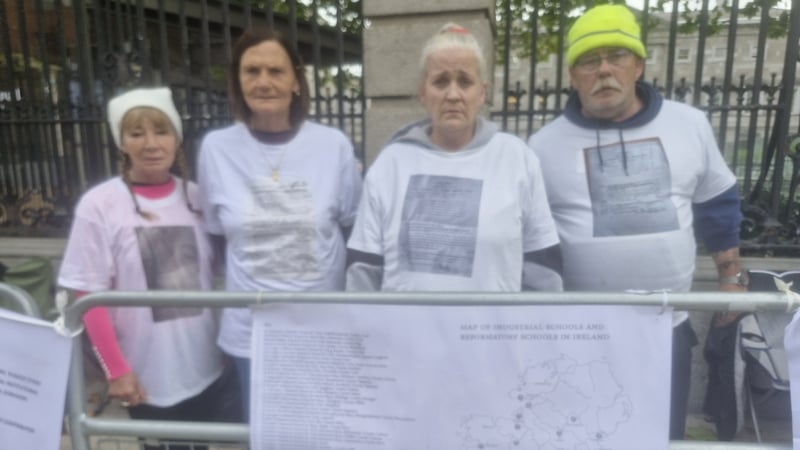

It's just months since Maurice Patton O'Connell, Miriam Moriarty Owens, Mary Donovan and Mary Dunlevy Greene completed their 51-day protest outside Leinster House.
When they returned this afternoon, they didn't enter through the gate they sat outside for weeks last year, instead they were escorted through the other side of the building via the Taoiseach's office.
Micheál Martin had met the group before with then minister for education Helen McEntee, but a further meeting was organised before he got to his feet in the Dáil chamber.
It was the fourth State apology by a Taoiseach to people who had experienced institutional abuse and the second apology to those who had attended industrial schools.
The four survivors were given special seating in the Dáil's public gallery, a space usually designated for visiting dignitaries.
Mr Martin took people back to 1999 when then taoiseach Bertie Ahern issued an apology to survivors of residential institutions, following the Ryan report.
Watch: Taoiseach and Tánaiste formally apologise to survivors of institutional abuse
He reiterated that apology to all survivors at the start of his speech and concluded it with an apology directed at his four guests in the gallery.
There was a further apology for a cohort of people who have often been referred to in past speeches, but never sufficiently addressed.
Those who were boarded out from industrial and reformatory schools experienced harrowing physical, emotional and sexual abuse. Many were left abandoned.
"I am very sorry for what was done to you. I apologise on behalf of the State for the abuse and neglect that you suffered. What happened to you was wrong, shocking and should never have happened," the Taoiseach said.
The Government has promised "to continue" to support boarded out survivors "as much as possible".
So, what does the current support entail?
There is a free and confidential service provided by Barnardos, funded by the State, which delivers "practical and therapeutic supports".
Mr Martin also noted that there's the Special Advocate for Survivors who "amplifies the voice of survivors", including those who were boarded out as children.
That's the extent of it.
Patricia Carey, who's the Special Advocate, emerged from the Dáil in shock.
"I'm frankly quite shocked that the Taoiseach mentioned those who were boarded out so many times, but yet again, after decades, no mention of a proper redress scheme," she said.
The Barnardos scheme and her office are already in existence, she explained.
€1.2 billion has been spent by the State on redress, but there's a broad view that the exclusion of boarded out survivors from any scheme is unfair.
While she welcomed the apology and acknowledged its importance for survivors, Ms Carey is troubled for those who - after four State apologies - still feel excluded.