Among the deluge of emails received by Minister for Education Hildegarde Naughton this week and last on the issue of Special Needs Assistants (SNAs) was one from the principal of one DEIS primary school, which included an invitation.
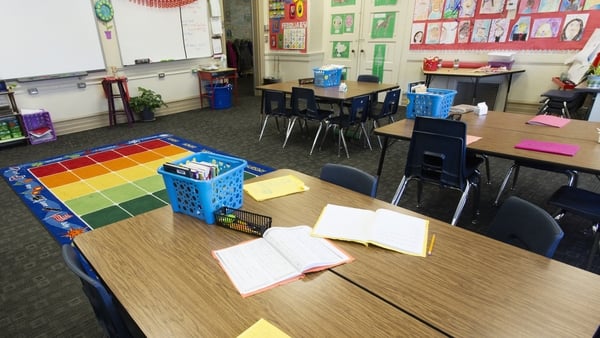
"I would warmly invite you to visit our school and spend time in one of our Junior Infant classrooms," Ann Marie Blake told the minister.
Her school was not among the 194 that received letters last week, informing them, bluntly, with no explanation, of cuts to their SNA provision from next year.
For some schools, the cuts were severe indeed; in some cases amounting to the loss of up to six SNAs, all at once. No wonder there was consternation among school staff and parents.
Ann Marie's school was not among those schools, simply because it has not yet undergone an SNA review, but she knows that under the current criteria her school would "absolutely" stand to lose SNAs if it were.
"I wrote to [the minister] because I wanted her to realise how things have changed since 2014," she said.
2014 is the date of the circular which sets out the narrow criteria under which an SNA is granted to a school. It limits SNAs mostly to children with very specific physical care needs, such as toileting needs.
In reality, in recent years, the role of SNAs has been much wider, and schools say this is justified.
They are hyper-vigilant, they are angry, they are having tantrums
"The needs of children have changed so much since then. The causes are societal; increased child poverty, homelessness, and where does that play out? It plays out in the classroom," this principal said.
Ann Marie describes Junior Infant children whose families are couch surfing "coming in absolutely exhausted".
"Because of their home situation they are hyper-vigilant, they are angry, they are having tantrums, everything feels so uncertain in their lives that they have a sense of panic.
"Another huge thing is language. Many children are far behind where they should be." She blames isolation during the pandemic as well as too much screen time for this.
And then there is the lack of therapeutic supports. "We have children whose parents have been told they will be at least two-and-a-half years on a waiting list for an assessment, and then there is at least another 18 months for intervention."
This week schools across the country all made the same point; that SNAs regarded as surplus by the department had become vital in their classrooms; that without their support many children would not be able to access the education their teacher provides.
"Their whole day is taken up with trying to prevent dysregulation, with stepping in when they see a child is about to have a meltdown, with preventing a child from running out of a classroom, or meeting a child who won't come in the front door in the morning to coax them in," Ann Marie said.
In response to the outcry, on Tuesday the Government 'paused’ the cuts.
On RTÉ’s Morning Ireland yesterday, Minister for Special Education Michael Moynihan said there was a need "for a far better system". He said the department would now "engage intensively with schools individually". He promised no "cliff edge".
That cliff edge facing schools was part of the problem. How could a school that had managed with nine SNAs suddenly cope with just five?
An informal 'freeze'
For the past number of years, the National Council for Special Education (NCSE) has not proactively carried out reviews of SNA provision in schools and so there have been no cuts to SNAs in mainstream classes.
"In recent years, due to the level of demand in our education system, the reviews have concentrated on reviews submitted by schools," the Department of Education told RTÉ News. (Schools will only submit a request when they need more provision, not less).
The department may blame the level of demand in the system for the lack of cuts to SNAs deemed surplus in recent years, but senior education sources say the fault for this lies with an informal agreement that was reached with SNA trade union Fórsa; that there would be no cuts to mainstream class SNAs until a redeployment scheme for those workers was in place.
The introduction of such a scheme - which would give security to SNAs who lose their posts through cuts - was announced by then Minister for Education Helen McEntee last April, but it is still not in place.
Fórsa has confirmed this informal ‘freeze’. "There was a freeze placed on allocations in mainstream classes," the union’s head of education Andy Pike said, "and we were quite happy with that".
Some schools are screaming out for SNAs while other schools have frankly more than they need
Asked about this freeze, the Department of Education said that "a commitment" was given last year in relation to 67 surplus SNA posts that they would remain in their school until a redeployment scheme was operational.
"We never envisaged that they would go ahead now [and announce cuts] without that redeployment agreement being in place, and it is still not in place. It is still not confirmed," Andy Pike added.
Such an agreement would have made news of cuts more palatable for SNAs whose posts were suppressed. At least they would have had some level of certainty regarding future employment. But it would have done nothing to address the concerns of schools and parents.
Because the issue of SNA provision is so sensitive, senior figures in education who spoke to me were reluctant to go on the record.
"Some schools are screaming out for SNAs while other schools have frankly more than they need," said one.
This person says that as a result of inaction by the department in recent years "there has been this build-up of misallocation, and this was the first year that the NCSE tried to tackle it". And during this time "the definition of the role has not changed, but informally the rules had been stretched a bit".
'Exponential rise in number of children with special needs'
In the background to all this, and impossible to ignore, is the significant rise in the number of children being assessed with additional needs.
According to the Department of Education, an estimated 25% of the total student population, or 240,000 children and young people with special educational needs, are supported in mainstream classes.
An additional 30,500 with more complex needs are enrolled in special classes and special schools. This is an increase of 67% since 2020.
"There is an exponential rise in the number of children with special needs, and we can’t explain this," said another senior education source. "We have literally thousands of children presenting with special needs that did not present before."
More than 2,000 additional special classes have opened in mainstream schools since 2019/20. Three hundred opened this year alone.
Next year at least that number again of new special classes will open, all to meet burgeoning demand. The vast bulk of these classes are for children with autism.
These new special classes need dedicated SNAs.
"There is a widespread fear that [the recently announced cuts to SNAs in mainstream schools] is about moving SNAs out of mainstream and into special classes", said one senior source, "because the emerging demand is considerably more than was anticipated or planned for".
Department of Finance revised estimates bear this out.
For 2024/25 the department had projected that schools would need 21,871 SNAs. But that turned out to be almost 800 short of the 22,637 that were actually employed that year.
The Department of Education has received budgetary approval for an additional 1,717 SNAs for the coming school year. But will this be enough? If the Department of Education does not have enough SNAs to meet demand next year, it will have to go back to the Department of Finance to look for additional funding. That may or may not be forthcoming.
There is a lot of concern in schools and in education circles that the new plethora of special classes are being resourced at the expense of children - also with great need for support - who are in mainstream classes. This concern is not limited to the issue of SNAs.
So, what now?
At the end of a week of controversy and Government climbdown there is huge uncertainty.
"The problem with the pause is that we are going to have to go at this again," said one of my sources. "There has just been this massive increase [in need] and it is putting the entire system under strain."
Minister Moynihan came under pressure on Morning Ireland yesterday to explain what would happen now and when schools would be informed.
On the ‘pause’ and of the new ‘review’ of the previous reviews that led to the SNA cuts, he said: "We will engage meticulously with all school communities and families that have contacted us.
"There's no point coming out and saying to you it will be done in a number of days, a number of weeks - it will be done properly."
On Tuesday Emily Branigan, Special Needs co-ordinator at Assumption Junior National School, spoke on RTÉ News about how her school had been told they would lose four out of their nine mainstream SNAs. That decision is among those now ‘paused’.
Yesterday evening on the phone, she said: "I’m still wondering what is going to happen now."
As the week drew to a close no one seemed to have an answer to that.